By DCist contributor Elena Goukassian
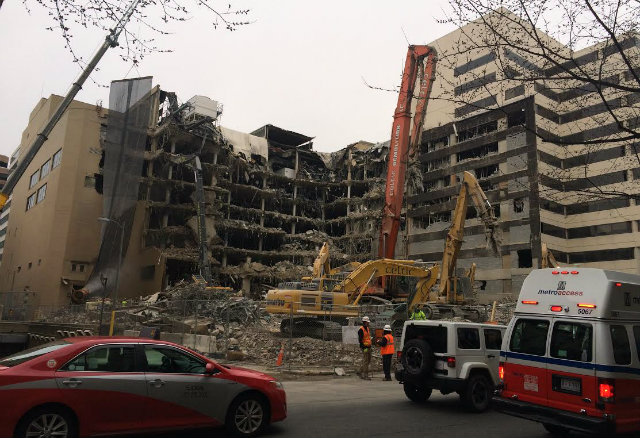
The Washington Post at 15th and L streets NW is no more (we’ve apparently already turned our attention to the newspaper’s mouse problem at its new building).
But now that the historic structures are in the throes of demolition, we thought we’d take this opportunity to look back on their history. Not reminiscences of the newspaper and its employees (The Post has done enough of that already), but rather, stories that centered around the buildings themselves.
October 16, 1972
Only a few months after Bob Woodward and Carl Bernstein published their first article on Watergate, The Washington Post’s sixth headquarters at 1150 15th St. NW opened with a dedication ceremony featuring Secretary of State William P. Rogers, Mayor Walter Washington, and the Woodrow Wilson High School Band playing John Philip Sousa’s “Washington Post March.” The new building connected to the Post’s existing former headquarters, which was located at 1515 L St. NW since 1951, and the massive complex that included editorial offices and printers was given its own zip code, 20071. The $25 million building was not well-liked—even by the Post’s own architecture critic, Wolf Von Eckardt, who wrote “Inspired architecture The Washington Post building is not.” Designed by Sol King of Albert Kahn Associates, this was actually Plan B, after I.M. Pei’s design (the architect behind the National Gallery’s East Building) was deemed too expensive.
October 1, 1975
A fire alarm went of at 4:45 am, and when firefighters arrived, they saw that one of the Post’s printing presses was on fire. When the smoke cleared, it was revealed that disgruntled pressmen had vandalized all nine of the paper’s presses that night, going so far as to attack the pressroom foreman when he tried to put out the fire. But the newspaper’s pressmen weren’t crazed arsonists. Their union contracts had expired at midnight and Post management had already threatened to reduce their numbers and pay less overtime. The resulting union strike drew hundreds of workers to the picket lines and caused much animosity between the paper’s office staff and its blue-collar workers. The Newspaper Guild called for reporters and editors to cross picket lines and keep the paper going (many of them also working the presses at night), while production and crafts unions joined the pressmen on strike. The strike lasted almost two years. In the end, the pressmen were completely defeated, and so many people had crossed picket lines and come in as scabs that few of the original picketers ever returned to work.
April 23, 1987
According to the next day’s Post, the D.C. police bomb squad found a quarter pound of TNT and “assorted ammunition” in a former employee’s locker on the fourth floor of the Post building, discovered by security guards cleaning out old lockers. Oddly enough, “Police did not disclose the name of the employee, who they said left the company in January 1982.” The incident wasn’t mentioned again.
February 14, 1997
A few months after President Bill Clinton signed the Defense of Marriage Act into law, the National Organization for Women celebrated Valentine’s Day with a demonstration in front of the Post building, protesting the paper’s refusal to print wedding announcements for same-sex couples. The demonstration drew about 50 protestors. (NOW held a simultaneous demonstration in front of the New York Times building.) Spokespeople for the Post defended their policy, stating that the paper only runs wedding announcements for relationships that are “legally recognized.” By the mid-2000s, the Post would change its policy, several years before same-sex marriage was officially legalized in D.C. in 2009.
January 10, 1999
After years of production downtown, the Post’s presses moved to the suburbs—College Park and Springfield, to be exact—where the Post would print in color for the first time. As Marc Fisher pointed out in a eulogic article that day, downtown would become much quieter all of a sudden: “No more shall oversized trucks lumber along downtown avenues, depositing 2,000 tons of blank newsprint a week. No more will long lines of people snake along the sidewalk of 15th Street NW at midnight, waiting for a few hours of work inserting sections of the paper. And one of the city’s last communities of people who gather to share the mysteries of the night will dissipate.”
October 1, 2013-today
This was the day the Graham family transferred ownership of The Washington Post to Amazon founder Jeff Bezos, who bought the paper for $250 million. The buyout, however, did not include the Post building, which was sold to Carr Properties a couple months later for $159 million. Carr eventually picked Fannie Mae as an “anchor tenant” for a new development on the site. The D.C. Preservation League decided not to fight for landmark status, saying that the architectural significance of the building pales in comparison to what happened inside of it, effectively giving the go-ahead for demolition. In mid-December 2015, the seventh Washington Post headquarters officially opened at 1301 K Street NW. There was no high school band playing Sousa, but at the dedication a few weeks later, Secretary of State John Kerry and Mayor Muriel Bowser welcomed home reporter Jason Rezaian after 18 months in captivity in Tehran.
Demolition work is permitted to take place 24 hours a day through mid-April, but the entire project won’t be completed until the summer of 2018.