 Rachel Sadon
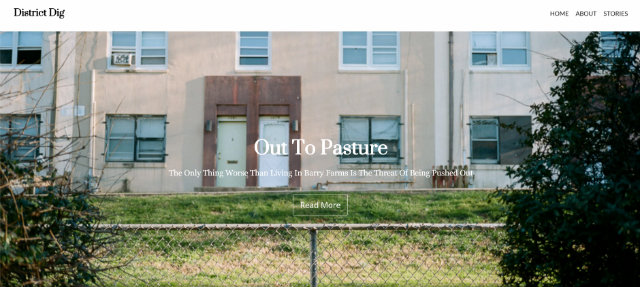 The District Dig is a new local journalism site from Jeffrey Anderson and Andy DelGiudice.
Jeffrey Anderson and Andy DelGiudice recently launched a news site, The District Dig, but they don’t claim to have all the answers. They aren’t touting a magic social media cross-publishing immersive experience big data social platform to save local long-form journalism. They are, respectively, a freelance investigative reporter and a photojournalist who are in it for the story—the whole story, including the photos.
With a spirit of going all-in, they’ve started publishing their work and seeing where it goes. We talked to the pair about their partnership, the state of local journalism, and the sort of work they are planning to put out there on The District Dig. Our conversation has been edited for length and clarity.
DCist: So who are you guys, and how did you come to work together?
Jeffrey Anderson: I grew up in Northern Virginia and started my journalism career while exiled in Los Angeles for a decade. By the time I came home in 2007, I’d accomplished a lot as an investigative journalist out of LA. I worked at the Washington Times and the Baltimore City Paper, and I became known as an investigative local reporter, though I’ve done other stuff. I left the Times in 2013, and while freelancing for the Washington City Paper, I met Andy at a D.C. Council hearing. It actually says a lot about him that he was even there in the first place. He was scrambling around taking photographs of people who were sharing horror stories of workers comp issues. We quickly struck up a relationship and began working on stories that we’re now just getting to publish.
Andy DelGiudice: I’ve been in D.C. for about seven years, photographing for about a decade. Close to two years ago, I went full-time with professional photography. When I met Jeff originally, we talked about collaborating on pitches and exercising my editorial storytelling muscle to get a little bit of a break from the professional stuff. We worked so well together and it kept snowballing to the point where we had enough momentum to go for it, build our own thing from scratch and have full control over what we’re doing right from the beginning. It’s been a pretty incredible year figuring out how everything is going to go.
DCist: You’ve published a few stories already, including a long feature about Barry Farm. Where are you at in terms of developing the site?
JA: We have a well of reporting and stories in development. We’re working on new stuff all the time. One of the things driving this is demand. People never stop finding me with their stories in D.C. We’re going to be rolling stuff out as quickly as we can do it to the standards and quality that we aspire. We’re trying to break stories and tell stories that working press doesn’t always have time to do when they’re feeding the beast. How I’m going to feed the beast myself is a different story.
DCist: So you aren’t planning to make a living from this?
JA: We’re doing it in a noncommercial manner for now. It’s all hands on deck, going hard on stories. We have a duffel bag full of stories that we’re just dying to get going on. I freelance elsewhere, and it’s really unclear how that’s going to mesh. I’ll be representing myself as a contributing writer of WCP and founder of District Dig at other times. I’m treating it like my own news agency.
AD: It’s kind of up in the air right now. I love the decluttered look of the site. And if there’s a way to sell advertising space that’s agreeable and worthwhile for folks who want to provide sponsorship content, that would be great. There’s also the possibility of a subscription service down the road. But right now we’ve been concentrating on getting the bulk of it up and going. If there’s as much interest as we think, we’ll look to monetize it down the road.
DCist: How often will you publish new stories?
JA: We’d like to put stuff out on a weekly or biweekly basis. I can work fast when the situation calls for it. But since we’re doing this with a collaborative vision, and it has to look great, we’re not putting any timelines on it right now. It might take a little while to hit our stride. I’m just a reporter, and I’m realizing how much time it takes and I have a lot of respect for people who run things.
DCist: Ha, we hear that.
JA: I would like, eventually, for people to check out a new dig every week. It could be a profile of a person, could be someone’s story, could be investigative work. We have some friends and contributors who will be helping out, too.
DCist: And they won’t be getting paid either?
JA: None of us are getting paid, we’re totally pro bono journalists in the public interest. We’re here to serve.
DCist: How does your vision for the fit into the rest of the local media landscape?
JA: We have some good local talent covering news in this town. But I hear from reporters all time that they are unable to execute certain stories because of the job constraints. Media in general has sort of divested from this type of storytelling. When big papers do it, they can do astonishing work, like Dan Zak’s cowboy poet story. That’s something he worked on on and off for three years. I routinely wrote 7,000 word features—but you just don’t see it that often anymore.
The Post divesting from local coverage just gives us an opening. When I was at the Washington Times, we had a team of four, the Examiner had two or three people, maybe more. The Post had some of their best on the Metro desk, and the City Paper and everybody else was competing. But it’s not like news stopped happening.
What has happened is that people’s appetites have adjusted because they’re being given less of it. And my inbox starts filling up because people can’t get their story out. I think the city has learned to live with less in terms of journalism. It has turned into a fraction of what it used to be, with neighborhood bloggers and local websites filling the void. But we’re not hyperlocal, not a neighborhood, not a blog. We’re looking at the city as our canvas.
One thing I firmly believe: Many of the things that become front burner political, government and policy issues do so because no one was paying attention, to either the government or the lives of the people it affects.
DCist: In the “about” section, you guys write “The Dig aspires to be an agent for change.” What are you hoping to inspire?
JA: Those are Andy’s words, and I think they’re well chosen. I think that he would like to see the civic debate change in terms of quality and debate, and maybe get out of the political day-to-day, chase the lead story that everyone’s chasing, and expand the dialogue. For me, I’ve always regarded journalism as a pursuit based on positive change. Public benefit could be a change in discussion topic on the radio, a council hearing, a prosecution, an audit.
AD: I’m right in line with what Jeff is saying about presenting a topic or an angle that introduces a conversation. That hearing we spoke of earlier came about because of a story that Jeff wrote. Sixteen years of worker’s comp opinions were handed down by an unlicensed judge, and it was a shocking story that lead to another story that lead to a council hearing that lead to a bunch of money being restored to a broken part of the bureaucracy.
JA: There’s just not just the bandwidth for reporters to cover all the government agencies that affect people’s lives. Many of my colleagues don’t have as much freedom to really dig. They have job demands that I don’t—because I don’t have a job.
AD: That agenda for change comes directly out of that story, where I saw that, by the end of it, decisions were made and funds were relocated. When I saw that and the impacts you can have, I was hooked.
JA: Who knows how many lives were affected by this guy. The court is still trying to figure out if they should roll back 16 years of worker’s comp decisions. When you get a photographer who’s willing to go out, and people let you into their living room, all of this starts to become very meaningful.
I’m positive that my fellow reporters out there would love to be doing more of it. And they do as much as they can, but I think there’s a big void to fill. I know there is, because people come to me all the time. I had a very productive for four years at the Washington Times, almost an embarrassing number of clips—all original. I almost didn’t have a choice when Andy came along.
DCist: So what topics are you planning to tackle?
JA: When you look at the news of the day, the topics coming out of the Wilson Building, it’s obvious that this mayor has recognized and at least tried to focus energy on the things that lead to the disgusting disparity in the city, like education, affordable housing. We’re both drawn to the less fortunate and everyone should be; we need to hold city leaders accountable. For all D.C.’s superlatives in growth and leading the nation, I think it’s impossible to accept ignoring the other end of the spectrum that is happening right in front of us. But we’re also interested in inspiring stories of people who are thriving in spite of that. We’re going to have something out soon that people will find uplifting. I’m usually associated with the bad news but this is an opportunity to let stories breathe a little. I want to share moments instead of statistics.
In a follow up email, Anderson adds: “Oh, one last thing: If I could emphasize anything, it’s that Andy is the best thing to come along for me in a long while. He’s breathed life into a veteran reporter and writer who found himself on the street, trying to keep the spirit alive.”