 Rachel Sadon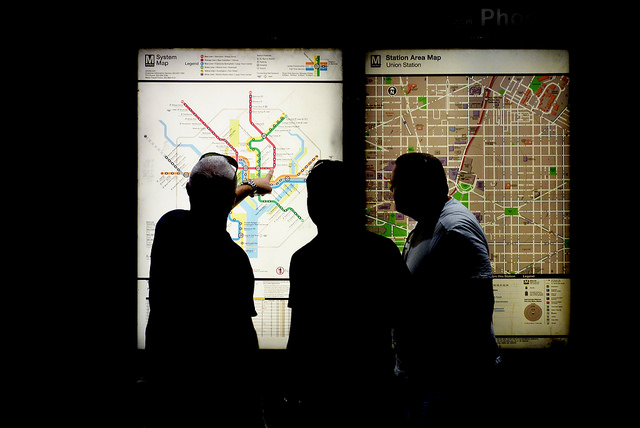
 (Photo by Jordan Barab)
“We’re sorry … What is important is that we’ve let you down.”
It’s the kind of thing that Metro riders often find themselves wishing they’d hear from WMATA. But after a group created the WMATA Riders’ Union to push for more accountability, among many other things, their membership is hearing that apology from the union itself.
A little bit more than six months after announcing the organization—similar to rider advocacy groups in Portland, Los Angeles, Seattle, and elsewhere—the union’s leaders apologized for the group’s inactivity and said that they are seeking to add members to their team and come up with a more coherent vision.
In an open letter, the two remaining leaders told their membership of more than 1,700 that “running an organization like this, it turns out, is not easy. Especially not when you’re understaffed and overworked—we’ve all had our day jobs and other commitments. But the solution to that is not for us to give up and disband.”
Of the original five-person team, Ashley Robbins, a research analyst at Mobility Lab, and Graham Jenkins, a risk management consultant, remain at the helm.
The most high-profile departure was that of Chris Barnes, better known as the prolific tweeter @FixWMATA and one of the founding members of the group. “I renounce all affiliation with them and am ashamed of what it’s become,” he tweeted in November.
According to Jenkins: “Chris left the group of his own volition in October over disagreements with Ashley’s leadership style.”
Barnes confirmed that account, explaining that he left the group about a week before their first public meeting. Robbins “couldn’t account for funds” and was unwilling to use some of the money they’d raised for sign language interpretation, Barnes said, but he still wished them success after quitting. “Even though I wasn’t going to be in leadership, I still felt there needed to be a riders’ union.”
As the nascent group muddled along, Metro was finally making some long-needed changes. “In the early days, until they had announced a new general manager, we were in kind of wait and see if it was a GM that we could work with,” Jenkins says.
By December, it seemed, they could; the riders’ union held a packed forum with the then-newly announced general manager, Paul Wiedefeld.
And then … nothing, at least publicly. Behind the scenes, Robbins has been talking to WMATA and Jenkins has been doing some writing. But two people working on WMATARU effectively as a second job just isn’t enough, Jenkins says. “We haven’t been able to devote the full and necessary attention to working on this.”
So they’ve put out a call for fresh blood—five to seven people to be exact—and are also thinking about changing how the group is run, though what form that takes will depend on who steps up to the plate.
“We’re entirely receptive to new people and new ideas,” Jenkins says. “We’ve got ideas and we have solutions, but it’s how best to convey that and channel the membership into something that can affect change.”
Ironically enough, Metro seems to be paying more attention than ever. Wiedefeld rolled out a plan this week to turn around the beleaguered system, announced the completion of Metro’s work on Transit Signal Priority for buses, started testing a new app to better predict bus times, and finally enacted a grace period for riders to leave a station once they’ve entered it (sample reactions to that news today included: “ABOUT TIME” and “Hallelujah”).
Still, the Riders’ Union believes it isn’t enough. “[Wiedefeld’s] recently announced plan is a step in the right direction, but a lot of it is goodwill gestures and tokens. They are good, but don’t really improve service all that much,” Jenkins says, pointing out that something like having a more explicit timetable for track work doesn’t change how they make the fixes, for example.
Barnes, for his part, agrees that a riders’ union is still needed, though he doesn’t believe it will be successful under the current leadership. “I think [Wiedefeld] doing a fantastic job. This is the guy we’ve been waiting for,” he tells DCist. “But there’s a lot that a riders’ union can accomplish on a day-to-day basis that [Riders’ Advisory Council] members can’t … We need a group that is completely separate from WMATA.”