Rachel Kurzius
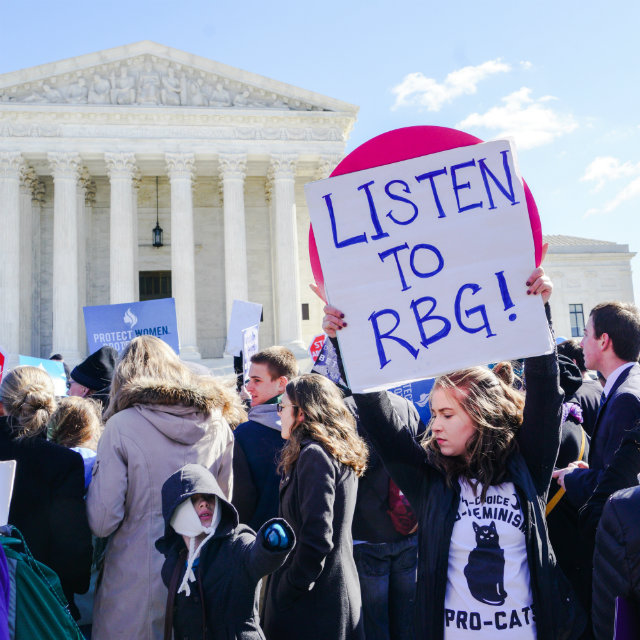 Demonstrations outside the Supreme Court on the day the justices heard Whole Woman’s Health v. Hellerstedt. (Photo by Victoria Pickering)
“I’ve been doing reproductive health work most of my life,” says Dr. Jamila Perritt. “I don’t remember not doing it.”
Perritt, who grew up in D.C. and attended medical school here, returned after a fellowship following her residency to practice as an ob-gyn. On National Abortion Provider Appreciation Day —observed today, the anniversary of the murder of Dr. David Gunn—she reflected on her experiences
“For me, abortion was part of reproductive health education, on the continuum of birth, miscarriages, contraception, adoption. It was never something that was an outlier in my mind,” she says. “It’s one of the most common medical procedures in the country.”
Perritt has been an abortion provider in the area for six years. Even though D.C. has bucked the national trend of tightening restrictions on abortion access, she sees the impact of the legislation in her offices.
“We saw an increase in patients when the TRAP laws came down in Virginia, beginning with the ultrasound law,” she says. The term “TRAP laws” refers to legislation that saddles abortion providers with onerous requirements beyond what is necessary to ensure patient safety. “It brought patients into D.C. from Northern Virgina—Fairfax and Falls Church, but sometimes they’re coming in all the way from Richmond or Tappahannock. To drive hours to get the care you’re entitled to in the Constitution is awful. It creates a huge burden for patients.”
And some patients are coming from much further than Richmond. “We’ve seen a good number of patients come up from Texas, as well,” Perrit says. “Every patient I’ve seen from Texas has said the exact same thing: ‘I’m so lucky that I could come.'” In Texas, a controversial abortion bill currently under review at the Supreme Court would shutter all but 10 clinics, and has already made abortions more expensive and complicated to obtain.
Perritt has little regard for these laws. “What we see as medical professionals, as these laws are put into place, is that it’s barely hidden contempt masquerading as concern. These laws don’t help women, they hurt women. And those who are most vulnerable are hit the hardest. That’s what really angers me.”
It’s not just legislation bringing women from outside the region to D.C. for medical care. “A week after the shooting at the Planned Parenthood in Colorado Springs, we saw a patient in our office with a Colorado Springs address. She said she had an appointment that day [of the shooting] but overslept. She had the means to fly all the way to see us the following week,” says Perrit. “The thing that most people don’t realize is that those of means will always find a way to get it.”
In D.C., women face a unique challenge to access, as Congresswoman Eleanor Holmes Norton pointed out during a national abortion speakout. Congress prevents the city from using local funds to subsidize the procedure for low-income women.
“For the people in D.C. to pay their taxes and be liberal-minded, to make decisions wholeheartedly and enthusiastically, only to be overruled by people who don’t live here is really disgusting,” says Perritt. “And it’s not just women who have Medicaid—it’s also people who get coverage from the federal government.”
The national abortion speakout is part of a larger concerted effort for women to talk about their abortion experiences and end the stigma that still surrounds it. Perritt says this strategy has “had a huge impact. It stops people from saying, ‘Oh, I would never have an abortion but other people should have that right,’ which is still stigmatizing. To have people who look like you, or who you know and love say they’ve had abortions or provide abortions—that changes things.”
But for patients and providers alike, the stigma continues. Perritt says that she deals with protesters on a constant basis. “There are people outside every day. It has a huge impact on our patients. It really is a hard thing to walk into your doctor’s office, whether you’re coming in for an abortion or not, to have people screaming at you. It has a huge impact on the staff as well.”
Anti-abortion protesters in the District haven’t limited their demonstrations to providers’ offices—in the fall, Two Rivers Charter School filed a lawsuit against protesters for harassing students, whose school is next door to the construction of a Planned Parenthood clinic.
“I think the terrorism that the anti-choice movement has fully embraced is effective in a lot of ways, because you have to make a decision to go into this work with all of the knowledge of their threats in mind,” says Perrritt. “We had a break-in at our house a couple of years back, and the first thing I thought was, ‘Did they do this because of who I am and what I do?’ But those of us that do this work cannot allow fear to be our dominant emotion.”
“It’s really meaningful to me to be here at home providing this work for the people in my city. I’m invested in a really special way,” says Perritt. “The women in this city deserve the right to control their own lives, and part of that is deciding whether they want to have children.”