Rachel Kurzius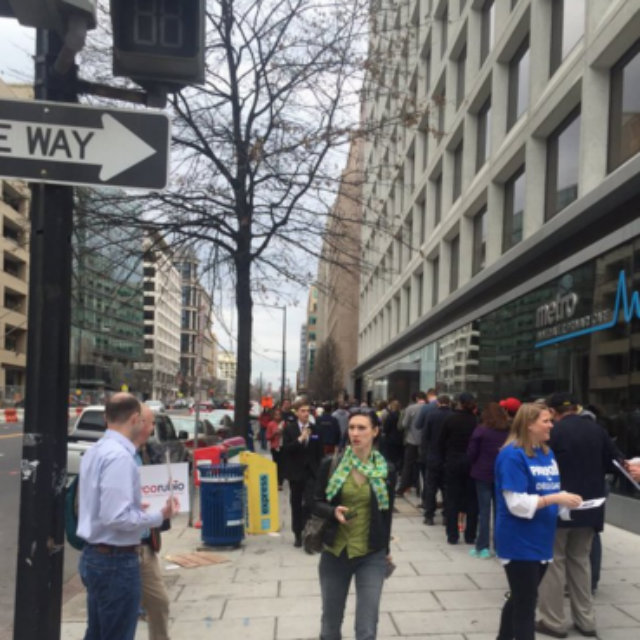
DC Republicans really like voting #DCGOP #19Delegates pic.twitter.com/Lr6CVfClu9
— DC GOP (@DCGOP) March 12, 2016
In a city that bemoans taxation without representation, D.C.’s Republican primary on Saturday saw 1,059 GOP voters netting 10 delegates for winner Florida Senator Marco Rubio. Compare that to the 159,802 Alabamans who voted for Rubio and earned him one delegate.
In a rare moment where the city’s voters had more of an impact than those in other states, a total of 2,839 GOPers participated in the primary. Runner-up Ohio Governor John Kasich, who got nine delegates, had 35.5 percent of the vote, to Rubio’s 37.3 percent. Donald Trump received 13.7 percent and Texas Senator Ted Cruz 12.4 percent, though neither of them cleared the 15 percent bar for delegates.
With lines rivaling those of the Momofuku Milk Bar, some participants had complaints about the way the primary was conducted.
“It should never be as burdensome to exercise your democratic right to vote as it was this Saturday,” says J.P. Szymkowicz, a Republican who voted for Kasich. “I knew it was going to be bad, but I didn’t know it was going to be this bad.” In sum, it took him three hours to vote. Szymkowicz thinks many more would have come out to vote had the lines not scared them away.
D.C. Republicans opted to schedule an earlier, standalone event because the D.C. Board of Elections-run primary on June 14 is less than 45 days before the Republican Convention, which begins on July 18. Rules dictate that having a primary too close to the convention (as in, less than 45 days) could result in losing some or all of one’s delegates.
“What’s the point if you don’t have delegates?” says Patrick Mara, executive director of D.C. GOP. He says the primary cost the D.C. GOP between $60,000 and $80,000 in total.
Running it on your own comes with its own set of logistical challenges. Mara says that at first, he reached out to Howard University and UDC to host the primary, though “it became clear we had to do this at a hotel.” After reaching out to about 20 hotels, Mara says he’s “very grateful to the Loews Madison” for hosting. “It was very hard to find a hotel that would host.”
But at least one voter, Szymkowicz, took issue with the location as well. “Having an election in a five-star hotel just looks bad,” he says. “It makes us look like the party of the rich and powerful.”
Other than location, the D.C. GOP had to acquire enough voting machines to accommodate two votes—the one for presidential candidate, and a second one to determine which delegates will represent D.C. at the national convention.
Mara attributes the primary’s long lines to that second vote, where voters had to choose 32 delegate candidates out of 160 options. While there were 15 machines, he says it it took voters “a lot of time looking through 160 names. It’s a bit overwhelming. People were in there for a while.”
He says in the future, he will advocate for an earlier primary. “You have greater influence earlier in the process.” He says that by the time D.C. Democrats vote on June 14, “Secretary Clinton will already have the nomination. It’s the difference between voting as civic duty versus being excited about engaging in the process.”
That’s a larger footprint for individuals voters than they would have had with a bigger turnout. Mara had previously estimated that about 30 percent of registered D.C. Republicans would come out to vote. Still, “I was excited about turnout,” says Mara. “Eleven percent is excellent in a primary.”
According to Szymkowicz, one person who turned out shouldn’t have had a voice at all. He brought his neighbor—who is French—to observe the primary, and says that volunteers gave him the opportunity to vote. “But for the fact that he was honest, he could have voted in the primary,” he says.
Mara says that the Frenchman would have only had the opportunity to vote for the D.C. delegate representatives, not the presidential contest, though acknowledges that he “shouldn’t have been allowed up there.”
Still, he is pleased with Saturday’s outcome. “It’s likely the best we could have done,” says Mara. “There are armchair quarterbacks who may say we should have had another polling place. But I say to them: get me 30 more volunteers and another facility.”