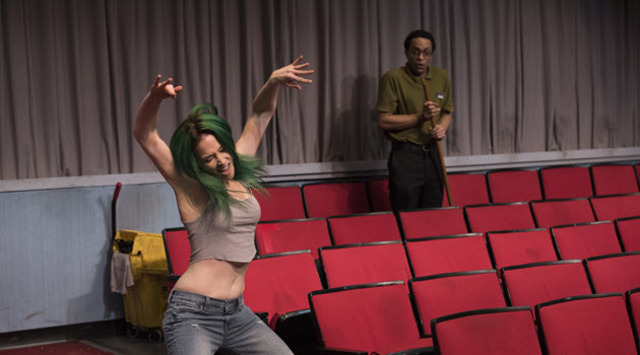
 Ushers Rose (Laura C. Harris) and Avery (Thaddeus McCants) take different approaches to their jobs. Photo: Margot Schulman
By DCist Contributor Anya van Wagtendonk
When Annie Baker’s The Flick made its debut at Playwrights Horizons in New York three years ago, audience members walked out by the dozens. So loud was the outcry that artistic director Tim Sanford was forced to issue a statement, defending his company’s decision to mount the play in its pure, uncut form. Its great offense? As written, The Flick clocks in at more than three hours — and you can feel every one of those 190 minutes pass by.
That’s the play’s genius, though. The Flick displays, in real time, the mundane tasks and talk that pass between three movie theater employees. The piece is packed with long stretches of silence and uncomfortable pauses between conversations, with only the sound of broom bristles hitting popcorn-strewn aisles to break the quiet. It’s strange that such tedium feels so thrilling, but the reaction of those high-fallutin’ New York audiences demonstrates why Baker’s slow burn approach is actually downright ballsy. Rather than brushing past the working class people who clean up after our evenings of entertainment, we now have to consider their humanity for three hours. (Even those who would storm out at intermission would get two-thirds of the effect.)
Blessedly, Signature Theatre didn’t truncate the show’s runtime for its current production, running through April 17. But director Joe Calarco doesn’t dwell in silence, either. His is a louder Flick, which fills in the awkward silences, plays up characters’ anxieties and anger for laughs and nods, and tamps down the absurd into something more accessible. That doesn’t mean this production isn’t worth your while; indeed, the end result is a delightful dark comedy, and the hours pass quickly. It just won’t be discomforting theatergoers anytime soon: After intermission at the sold-out performance I attended, the audience was still full.
The Flick focuses on a few weeks when three people briefly overlap as employees in a dinky movie theater in Worcester, Mass. There isn’t much by way of traditional plot. The struggling theater may get sold to a chain and go digital, which upsets Avery (Thaddeus McCants), the new kid—a depressed, nervous film obsessive taking time off from college. Sam (Evan Casey, with an accent inspired more by JFK than Central Mass) pines for Rose (Laura C. Harris), who is not interested in Sam or much else, at least not for very long. She enjoys chewing on things (soda straws; Twizzlers), and has green hair. On paper, in other words, these lives seem small, and often sad, and sometimes very, very sad.
The characters’ richness comes from the naturalistic language that Baker puts in their mouths: the ums, the likes, the tangents they spin off on and the stories they tell. They are often, and usually accidentally, very funny. The things they say are not necessarily meaningful, though; this is not a play about something. Avery’s passion for celluloid film over digital does not make this a Treatise on Aesthetics. Race, class, and ability figure in, but in complicated, glancing ways. Avery makes reference to himself as a black man once, then drops it when he feels awkward; Rose brings up her student loans and, sort of, in her way, alludes to the crumbling middle class. Then she moves along. Broad social themes factor into these characters’ lives, as they do in all of ours real lives, but they ebb and flow in importance, and the play does not concern itself with any grand commentary.
Instead, the business of the play is shared interaction between people. These interactions become more intimate as the play progresses. We, the audience, are situated behind the movie screen, as it were, facing the rows and glowing EXIT sign of the theater, and are thus granted full access to this intimacy. From this vantage, then, we see the unbearable flip side of that coin: the thousand banal and awful ways humans are unkind to one another. It is so easy to disappoint, to betray.
No wonder, then, the discomfort. But by playing up what should be left quiet, this production won’t let you sit in that discomfort for too long.
Sam and Avery maintain an ongoing argument: has there been a great American movie made in the last ten years? Yes, says Sam, listing a half a dozen. No, counters Avery, those are all very good, but all ultimately lack something that could have made them great.
So it is with Signature Theatre’s production of The Flick. It lacks faith in the disquieting power of stillness, and so avoids being the kind of great performance that sparks mass crankiness. Instead, the audience stayed and gave a standing ovation. It was, after all, very good.
The Flick runs at Signature Theatre through April 24*. Tickets are available online
*Updated to reflect today’s announcement of an extended run