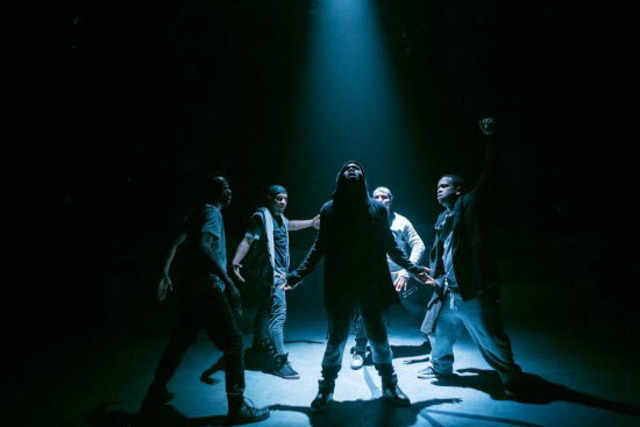
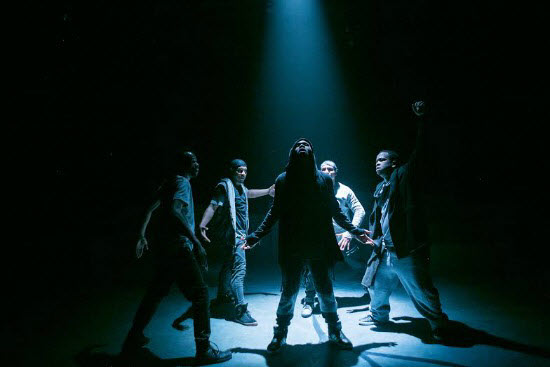
 The cast of Word Becomes Flesh. Photo: C. Stanley Photography
By DCist contributor Allie Goldstein
Word Becomes Flesh and for colored girls who have considered suicide/when the rainbow is enuf are each provocative in their own right, but Theater Alliance’s pairing of the two plays, which were written nearly three decades apart, starts a new conversation. Both plays reach across time, space, and race to offer a raw portrayal of what it means to be black in America today.
In form, the two plays are very similar, and they’re performed on alternating nights during the week and in repertoire on the weekends. Word Becomes Flesh has an all-male cast, with five actors—Louis E. Davis, Chris Lane, Clayton Pelham Jr., Gary L. Perkins III, and Justin Weaks—all playing the part of the expecting father of “a brown boy” in a script that consists of Marc Bamuthi Joseph’s letters to his unborn son. for colored girls has an all-female cast, with seven actresses—Christa Bennett, Kashayna Johnson, Noami LaVette, Alina Collins Maldonado, Lolita Marie, Sharisse Taylor, and Natalie Tucker—relating the stories of black women in a series of poems by Ntozake Shange.
As choreopoems (a term first coined by Shange’s for colored girls), both plays combine spoken word with movement in a way that deems the two inseparable. Tony Thomas’s choreography in Word Becomes Flesh uses the actors’ bodies as poetry, with each scene designed as if it were a stanza. In one freeze frame, the men pose as if ready to start a race; in another, they lie face down on stage as if shot in the back. Nick “tha Ida” Hernandez’s sound design and original music rely heavily on feet-stomping, chest-pounding bodies, with finger snaps from the audience blending seamlessly.
The marriage of movement and spoken word is also fully consummated in for colored girls, though this choreopoem strikes a slightly more, well, feminine tone. The women orbit fluidly around each other, each dressed in a different color of the rainbow. Choreographer Sandra Holloway’s dance training comes through, especially in a mambo scene, though there is power, too, in the relative stillness of six women when they train their focus on the seventh actress. In a play that shifts sometimes suddenly between joy and grief, David Lamont Wilson’s sound design carries the emotion along with riffs of jazz and Latin music, making occasional use of LaVette’s strong pipes.
In some ways, though, the mirroring of form disguises the fact that Word Becomes Flesh and for colored girls are not so much in conversation with each other as they are highlighting the different struggles of black men and black women. At the heart of Psalmayene24’s skillful direction of Word Becomes Flesh lies the question of whether to embrace or run from fatherhood. One eerie refrain throughout the play is the sound of gunshots. “Are you going to be hunted too?” the father asks of his unborn son. As the “sum of cells” becomes an “it” and then a “he”, the father struggles with the weight of raising a black boy within a system that often works against black men. No wonder so many of Thomas’s choreographed frames capture the actors frozen in mid-run: “Ask a room full of black men about their fathers / And you’ll see the choice to stay or leave.” It’s a choice that bears heavily in the final scene, when the five men—who have been moving so breathlessly across the stage during the play’s 60-minute runtime that they are by now drenched in sweat—finally come to stillness as their “brown boy” is delivered into their arms.
This conversation, however, is not picked up in for colored girls, directed by Deidra Starnes, and shown second on days with dual performances. The only father portrayed in for colored girls is a man propelled to monstrosity by mental illness; motherhood is treated as a fact rather than a question. The women in Shange’s poems bring us to some very dark places in their lives: the experience of being raped by a friend, of fending off an abusive boyfriend, of contracting HIV from an unfaithful lover. Men are often portrayed as the off-stage aggressors in these stories. There are some lighter moments for sure (Tucker’s rendition of “somebody almost walked off wid alla my stuff” is laugh-out-loud funny), but overall for colored girls is a collection of survival stories, Shange’s poetic anti-suicide note. The women’s bright costumes, designed by Marci Rogers, serve as reminders of their resilience amid circumstances that are dire indeed.
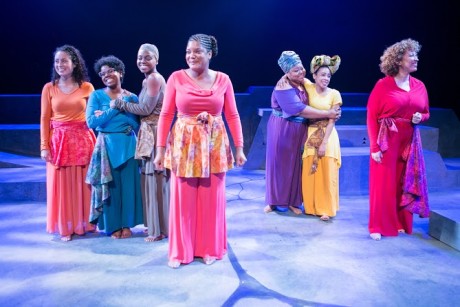 The cast of for colored girls… Photo: C. Stanley Photography
In both plays, the opposite gender figures prominently into the stories, but often as a disembodied catalyst—the womb that holds the child, the semen that bore the virus—instead of as a full character. More than being in conversation, the two plays seem to be talking past each other, with men and women co-habitating the same streets but not the same realities. Though Word Becomes Flesh addresses the objectification of women, in life and in hip-hop music (“This is a culture of one night stands/ Promoted by one hit wonders”), it doesn’t say much about the issues that presumably drive the women of for colored girls to consider suicide: rape and domestic violence.
Though Joseph drew inspiration from Shange’s 1974 script when writing his in 2003, Word Becomes Flesh is not meant to be the male response to for colored girls. And, though Shange’s script was updated in 2010 to include the new stories about PTSD and HIV, in Anacostia, it is Psalmayene24’s interpretation (the first authorized update of the play without Joseph’s direct involvement) that speaks more directly to the present time and place. In one scene, four men lie head-to-toe, wriggling as if packed into a slave ship. One by one, they sit up, recalling the places where Laquan McDonald, Michael Brown, Akai Gurley, and Freddie Gray (among others) were killed by police, all within the last two years: “Chicago. Ferguson. Bed-Stuy. Baltimore.” The very last sounds of the play are a mash-up of voices chanting “Black Lives Matter” and “Hands Up, Don’t Shoot,” during which the actors exit and then re-enter the stage with their hands up, as if they’ve both won and lost the race referenced throughout the performance.
Though for colored girls is also a strong commentary on race (“I couldn’t stand being colored and sorry at the same time / It’s so redundant in the modern world”), Starnes does not overtly tie the play to 2016 D.C., instead staying true to Shange’s script. Parts of the performance thus feel more like a glimpse of coming-of-age in a different age—a black girl trying to keep white girls out of her hopscotch game, a teenager losing her virginity in the back of a Buick—than a statement on growing up black and female today.
But part of the point of both plays is that race, gender, and the relationship between them are in fact a product of history and of the generations-long stories we tell ourselves. Thus, showing the stories of black women alongside those of black men—even if those stories contrast more than they connect—makes two plays that are meant to start conversations that linger a bit longer. And now that they’re paired, it’s hard to imagine seeing one without the other.
Word Becomes Flesh and for colored girls who have considered suicide / when the rainbow is enuf are showing alternately Thursday through Saturday at the Anacostia Playhouse through March 26. To see back-to-back performances of both, go on Sunday, March 20 or Saturday, March 26. Tickets are available online