The District’s art and music scenes converged at Transformer last night as the multimedia sound-art exhibition No Sharps, No Flats opened to an enthusiastic reception.
For the next six weeks, the storefront space on P Street hosts an array of eclectic, new sounds by local music luminaries like Mary Timony, Anthony Pirog, Jules Hale (Den-Mate), Laughing Man’s Brandon Moses, Paperhaus’s Alex Tebeleff, and Mark Cisneros. Their collective recordings form the sonic component of an engaging installation that experiments with ideas centering around dichotomies of harmony and entropy.
Curated by Alex Braden in collaboration with multi-disciplinary artists Emily Francisco and Adam Richard Nelson Hughes, the group show features 27 original compositions presented via audio cassettes in a sculptural housing comprised of components from vintage boomboxes.
For this project, Braden commissioned pieces from a diverse group of D.C. musicians who worked within a number of restrictions: each composition was to be rendered in the key of C Major, a rudimentary signature which has no sharps and no flats; pieces had to have a tempo of 120 beats per minute; finally, musicians could only use a single instrument. These strictures cut down on variables and established a common framework for virtual collaboration, and helped to harmonize the disparate pieces that would be presented together.
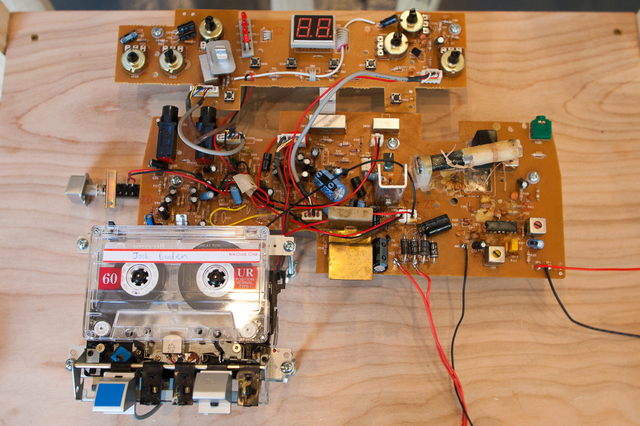
Braden dubbed the resulting compositions (ranging from 30 seconds to 15 minutes in length) onto cassettes, and salvaged parts from thrift-store boomboxes. Francisco and Hughes then constructed the simple but striking sculptural installation in which the electronics are housed. The once-common audio devices are stripped bare, with normally-hidden motors, wires, and circuit boards open to view, highlighting the materiality of old-school analog modes of audio reproduction.
With the constraints of Transformer’s tight space in mind, a multi-tiered wooden frame was designed to facilitate audience participation and enable visitors to help determine how the sounds would unfold. Gallery attendees were invited to stop, start, or flip over cassettes as they pleased, which (along with built-in vagaries such as the varying durations of each composition and their diverse aesthetics) creates a situation in which loose harmony increasingly breaks down into discordant entropy.
According to Braden, this element of disorder and uncertainty is central to the exhibition. “I like the idea of not knowing the finished project,” he said. “Everybody is collaborating in this way that on paper makes a lot of sense and should be harmonious. But when you introduce this medium, it just totally goes downhill from there, which I think is really fun, and having played in a lot of bands, that makes a lot of sense. Collaboration is hard.”
Played at a moderate volume, mixed with the ambient sounds of a bustling gallery opening, the compositions hardly coalesced into anything resembling a coherent whole. It was often difficult to focus on individual pieces, even when stooping down to get close to one of the ramshackle boombox speakers. Certain sounds occasionally stood out, such as Timony’s elegantly distorted electric guitar, Dan Gleason’s hypnotic singing of the numbers 1 through 120 in serial order, and the rhythms Johnny Fantastic created with what Braden described as an unidentified “crazy instrument from Mexico.” But these soon receded into a dissonant din that sounded more like a collage of structured sound, rather than like music in any conventional sense.
When DCist spoke with him towards the end of the reception, Pirog had yet to hear the spatially-open virtual-synth piece he contributed to the show, noting that the cassette player with his composition was silent when he passed by it during a crowded walk-through. (Each playing of an individual piece is—barring intervention—followed by an equal period of silence.) “I would like to come back when it’s a little quieter,” he remarked.
Braden seemed to agree that opening night was perhaps not the ideal context in which to experience the installation. Acknowledging the potential advantages of visiting by oneself or as part of a smaller group, he noted: “If you’re tired of the cacophony, you can turn off some and just listen to a few, or just listen to one at a time. The styles are very different, all the timbres are different. They don’t all work together. Some work better than others, and they will change over time. I would personally probably go in and listen to each one individually and then play them [together] as I see fit after that.”
This may be an exhibition whose full meaning and impact can perhaps only be appreciated over time. As people visit and revisit the show during the course of its six-week run, the installation’s underlying entropy will increasingly manifest itself with different choices and different permutations. On a physical level, the tapes will deteriorate, as will the motors driving the cassette decks themselves, leading to discernibly changed, degraded sounds. Every encounter will be inherently unique and inevitably unpredictable.
No Sharps, No Flats will remain in situ at Transformer, 1404 P St NW, until April 30. Gallery hours are Wednesday through Saturday, noon to 6 p.m. Braden, Francisco, and Hughes will give a performance at the gallery on April 9, during which they will arrange their own cassette-rendered orchestrations using the infrastructure of the ongoing installation.