By DCist contributor Kim Vu
Restaurant names are a funny thing. Sometimes they require an elaborate backstory (see: Tail Up Goat). Sometimes they don’t (see: The Pig). And sometimes they’re oddly contradictory (see: Toki Underground, which is neither subterranean nor secret).
But sometimes they’re also right on the nose, which is something that strikes me as we walk into Convivial at 8:30 p.m. on a Tuesday night, with a lively buzz that emanates from all corners of the bar and its dining room appendages. It’s also probably the best word to describe the man who slides up to our table a few minutes later with the purpose of annotating the menu. Suggesting a few dishes each from the “nibbles,” “cold,” and “hot” sections, he’s quick to wave off the suggestion that they can be described by the two words that have become newly verboten for any aspirational restaurant: “small plates.” This is delivered with a knowing smirk. Instead, Convivial’s plates are “medium-size,” and about two dishes per diner should suffice.
It’s at this point that we might have normally nodded and went about our business, but the charming man at our table is Chef Cedric Maupillier, and so his suggestions carry rather more weight. On his recommendation, we ordered the leeks dijonnaise, a reconstruction of a classic French bistro flavor profile that has already been featured in the Post and Washingtonian.
You have to hand it to Convivial: their plating is immaculate. If the two-word menu line “leeks dijonnaise” evoked a pool of limpid onions in mustard, the actual dish is its polar opposite: a bright cake of purples, oranges, and greens, like a Monet painting come to life. Yet, however beautiful it may be, I don’t quite get the plaudits. Sure, there’s a lot of fun textures that crunch and squish, but the flavors I get are salt and tart mustard and capers with the occasional leek cleanser. It’s good, but not quite superlative.
There are other dishes that might be lumped into similar descriptions: fun takes on known favorites that execute but don’t necessarily exhilarate. A duck egg beignet filled with feta plays like a grown up mozzarella stick, replete with a piperade dipping sauce in place of marinara. Pickled rockfish with green papaya, avocado, passion fruit, and radish evokes Southeast Asia, but it leans a little heavier on brine than might have been called for.
But if the first few bites didn’t amaze, from there, the meal only launched skyward. A set of “latkes”—more like flat tater tots but with the same unmistakable taste of its namesake—come topped with a celery root coleslaw and a thin slice of cured lamb (a last hour substitution we are coyly told by chef, as the initial plan was to have ham instead of lamb, but the discordance with the word “latke” was too strong). If you’ve eaten at Chef Maupillier’s first restaurant, Mintwood Place, then this assemblage might be familiar; there, Maupillier pairs duck breast, sauerkraut, and grapes atop a hashbrown in a very similar way. And just like that dish, these are delightful—crispy and creamy all at once. This is some of what marks Chef Maupillier at his best: putting traditional pieces together with the same knowing smirk that he evinced earlier in the meal.
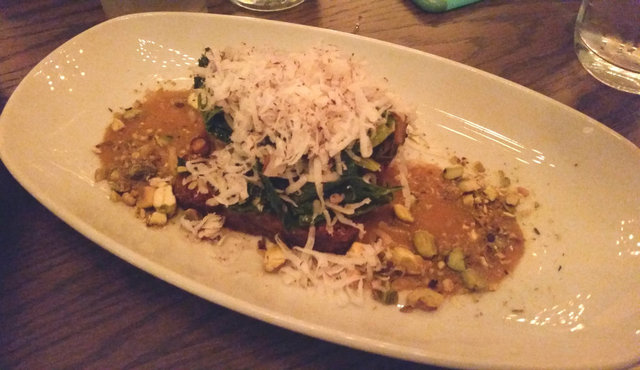
The vegetarians at the table coo at the squash vadouvan, which like the rockfish before it dazzle. To wit, this dish takes something like Thai X-ing’s pumpkin curry, accentuates the coconut and greens, and Frenchifies. It’s the first thing that disappears completely, exactly because it’s so right on.
But still, for me, the winners of the night are two hot dishes: the grilled white perch with octopus in crab bisque, and the fried chicken “coq au vin.” The former brings all the richness one might expect without any of the fishiness one might also expect. The star here is the carefully blackened octopus bits, which adds a smokiness that I love. The coq au vin is even more fun, closer to Korean wings than anything you might find at Le Diplomate. The sticky sauce is delicate, the breading is to die for, and the meat is winningly tender.
What little room we have left is dedicated to wonderful creme brulee—perhaps the lone traditional interpretation all night—and some gooey toffee pudding. We bemoaned our fullness and then proceeded to completely devour both.
While there are still a few kinks to be worked out (the restaurant opened in November), this joyful food lives up to its billing.