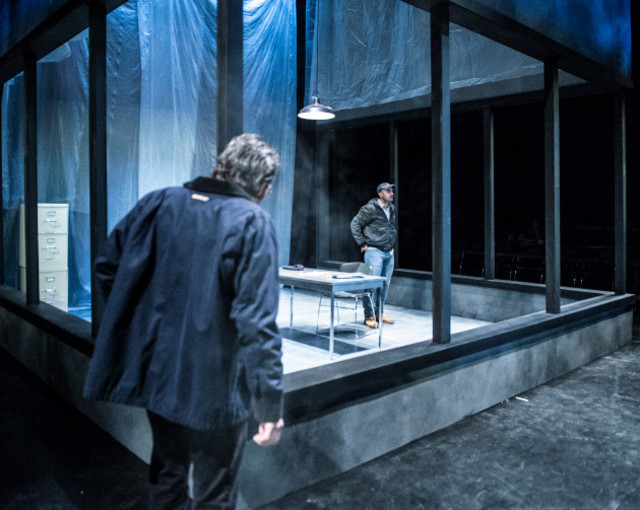
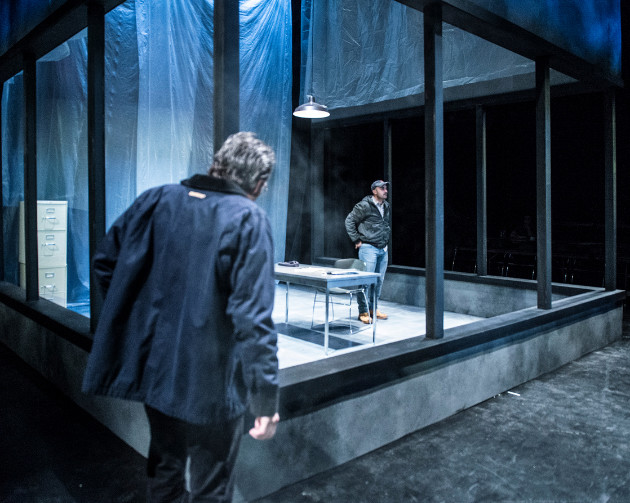
 Katurian (Maboud Ebrahimzadeh) is interrogated by bad cop Ariel (Bradley Foster Smith) in Forum’s The Pillowman. Photo: Teresa Castracane Photography.
By DCist Contributor Seth Rose
Forum Theatre had their work cut out for them with their production of The Pillowman. Like much of Martin McDonagh’s work, the script defies convention and presents bizarre and unique challenges to any director wanting to capture the playwright’s absurd, piercing voice. Director Yury Urnov, along with the actors and designers at Forum Theater, all rise admirably to this challenge, putting forth a production that amplifies everything distinct about the show without resorting to slavish devotion to the script.
The Pillowman tells the story of the self-styled writer of gore-soaked “children’s stories” Katrurian (Maboud Ebrahimzadeh) and his mentally disabled brother Michal (James Konicek) as they are interrogated by a pair of cops, Tupolksi (Jim Jorgensen) and Ariel (Bradley Foster Smith), who have reason to believe they murdered a series of children based on the events of Katurian’s stories. The script is one of intense contrasts, flitting from absurd near-slapstick humor, to gruesome depictions of Katurian’s stories, to heartfelt interactions between the brothers, and back again— many times over the course of the show.
Urnov’s understanding of the complexity of this script is perhaps the greatest strength of this production. From the ground up, everything is built around its ephemeral quality. Set pieces are sometimes walls and sometimes nothing but air, the pair of cops fill in as Katurian and Michal’s mom and dad with no costume changes aisde from a bad wig and a cheap mustache, and the long plastic sheets used to frame the playing space become projection screens to illustrate Katurian’s stories. Urnov takes a difficult script that others might have had to interpret or tone down and manages to force its inherent madness into a twisted sort of sense through his willingness to move with, rather than fight, its thematic ebbs and flows.
The actors are all willing and highly capable of following this difficult path with him. Jorgensen and Smith set the scene with over-the-top-playfulness and imposing physical presences, bringing more than enough comedic chops to make the audience laugh while implying (and sometimes demonstrating) just enough barely-under-the-surface sadism to never make those laughs feel totally comfortable. Maboud Ebrahimzadeh’s Katurian plays off of this feeling well, knowing exactly when to play the straight man to their antics and when to open up and reveal some of Katurian’s many inner darkness (and there is more than enough to fill a show).
The high point of the show’s performance arc though comes from the chemistry between Katurian and James Konicek’s Michal. Konicek makes the disability at the core of his character as central as it needs to be without ever devolving into caricature. We feel for the heartbreak of his condition, and as more and more of the horrific history of the brothers is revealed, we focus less on his mental status and more on the trauma he shares with his brother.
The vision and performances are supported in turn by some impressive work by the set, lighting, and sound designers. Paige Hathaway’s scenic design frames Katurian and Michal’s “cells” as nothing more than four knee-high walls with long rolls of semi-transparent plastic sheets covering the large gaps. The sheets look like they could be used to contain some manner of biohazard, and combined with the addition of a series of tables in the audience, the feeling evokes an 18th century medical theater with all of the eerie and vaguely unsettling notions that entails. It’s not just for looks though: the tables are used to provide the cops with a loudspeaker and height dominance for their interrogations, and the plastic sheets provide useful built-in backdrops for projections and shadow puppetry (conjured ably by lighting designer Jason Arnold) and serve the leitmotif of impermanence as Tupolski, Ariel, and later even Katurian move around and through them with ease.
That overall vision is one of which Urnov should be proud. He has taken a slippery script and managed to not only communicate it compellingly but to add just enough of his own voice to it without drowning out any of McDonagh’s. It is a delicate balancing act, and everyone involved with this production assured that it never once fell.
The PIllowman runs through April 2nd at Forum Theatre at the Silver Spring Black Box Theater. Tickets are available online, or pay what you can at the door.