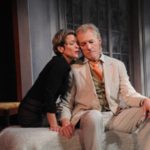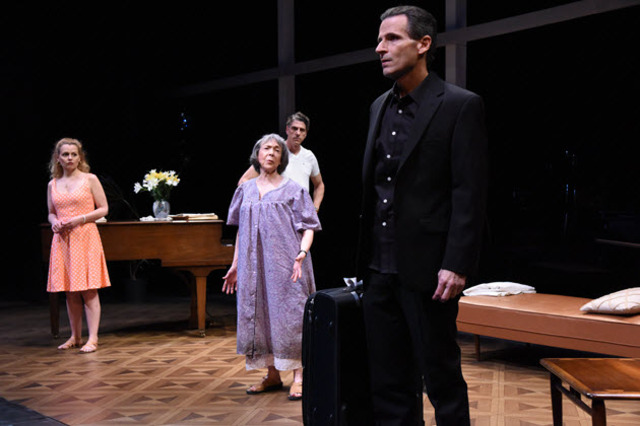
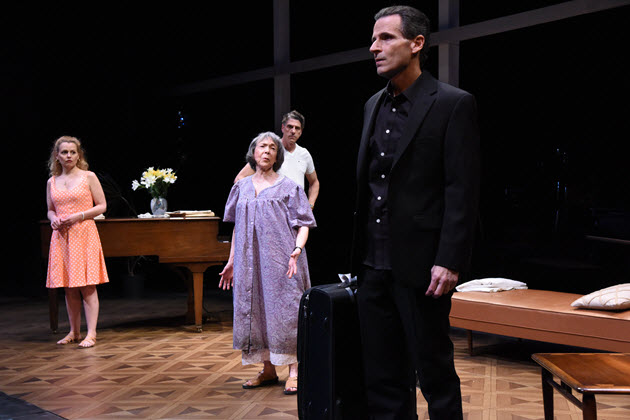
 Tonya Beckman, Barbara Rappaport, James Whalen and Paul Morella in After The War. Photo: Stan Barouh
The last time Ari Roth and Sinai Peter worked together on a show, the production sparked a controversy that rippled through the national theater community. A lot has changed since The Admission hit the stage at the Washington DC Jewish Community Center, ultimately relocating to Studio Theater after seeing its run at Theater J shortened.
Many cite the play, about the 1948 Arab-Israeli War, as the tipping point for Roth’s dismissal from Theater J. Fired for what he called “insubordination,” So Roth set off to found his own group. His freshman troupe, Mosaic Theater Company, found a home at Atlas Performing Arts Center, where Roth is free to produce the work he wants—politics be damned.
Reunited, Roth and Peter are once again collaborating on a drama by Israeli playwright Motti Lerner. The world premiere of After The War is the penultimate offering in this year’s Voices From A Changing Middle East Festival, which followed Roth from 16th Street to H Street.
“There were attempts to censor [Motti Lerner’s] voice in D.C.,” Roth says. “It would have been a long day in the future before Motti Lerner would have had his work appear again…at the JCC, and I felt it very, very important to demonstrate a commitment to this artist who still had something very powerful to say about how his society was changing, how his society was responding to criticism internally and externally, what was happening to his country, and what was happening to dissidents.”
Set in Tel Aviv after the 2006 Lebanon War, the production follows ex-pat Joel (Paul Morella) as he returns home to the family and country that wishes he’d stay away. He is a world-renowned pianist, but arguably a lousy son, brother, and father. Publicly outspoken about Israel’s “war crimes,” he creates a divide between himself and his countrymen that cannot be easily bridged. After spending 18 years away from home, he returns to his parents’ house to find he has become a stranger, and not a welcome one.
Peter, the longtime resident director of the “Voices” Festival, says it is Lerner’s most personal play to-date.
“On one side, it is a very personal play. On the other side, the way he deals with issues of art and family makes it also universal, and not only Israeli,” he says. “What is the significance of art, how can a person stay loyal to his own beliefs and yet keep his love to the family, being loved by the family who opposes his beliefs? These are universal questions, and I believe that the play crosses boundaries on that level.”
Peter says the topic is personal for him, too, as an Israeli artist. “I also ask myself again and again how long will I be able to create my work in Israel, how much the atmosphere in Israel will allow me to deal with political issues sometimes very much far from the conservative,” he says. “So the question of being in exile, or working outside of Israel, and what does it mean, are also my personal questions, and when I look at the way the American actors deal with it, in a way, they are my witnesses and also my therapists, because I examine my own self searching through the way they do it and the way they sold it on stage.”
In the play, Joel is both looking for his son (Guy Kapulnik), a soldier in the Israel Defense Forces, and looking to reestablish his career in the country he grew up in. With a gig lined up at the Israel Philharmonic Orchestra, Joel is uncomfortably upbeat. The tension is palpable as he engages with his mother (Barbara Rappaport) and brother (James Whalen). It’s difficult to be casual and friendly with a family member who’s spent nearly two decades abroad, achieving notoriety for slandering his homeland before an international audience. Joel’s blind merriment reinforces the awkwardness of the situation.
But whether audience members are invested in (or even familiar with) Israeli politics, the show aims to speak to the universal truth that families can’t possibly agree on everything. There are many shades to suffering, and this production plans to call upon the full scale.
With the show coming together amid the climate of heated political primaries, Peter says the fear of instability that runs through the current American political atmosphere seems to align with the content of After The War.
“It’s not a surprise for me that the actors while rehearsing, that in their breaks are very much engaged in what’s happening in the American primaries,” he says. The main point of contention in After The War arrives when Joel pledges to donate to Lebanese children who’ve been wounded by Israeli bombs.
“It’s a big issue whether we have to take care of the children of the so-called enemy or not, and this question of empathy to the other is the main fabric nowadays in America,” Peter says.
After The War from Mosaic Theater Company opens tonight at the Atlas Performing Arts Center and runs through April 17. Tickets are available online.
Update: Hyperlink error corrected