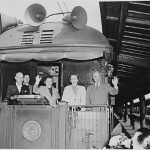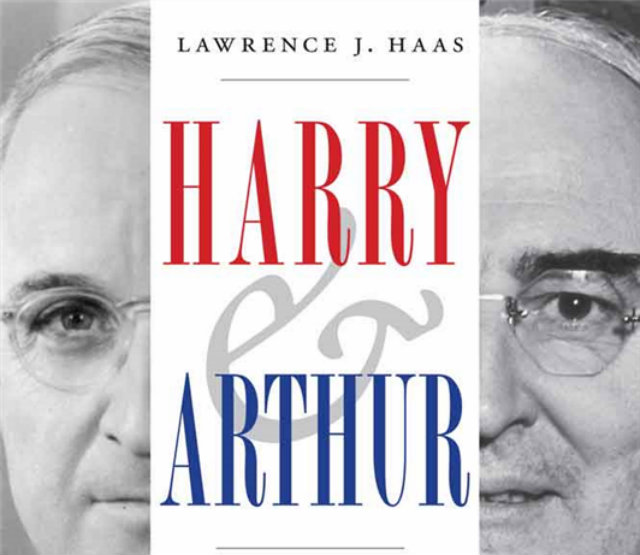
 There’s nothing more heartwarming than good old fashioned bipartisanship (is there any other kind?). In Harry and Arthur: Truman, Vandenberg, and the Partnership That Created the Free World (Potomac Books, $30), author Larry Haas explains how Democratic Vice President-turned-President Harry Truman and Republican Senator Arthur Vandenberg joined forces to address and repair a war-torn country. Haas will be at Politics and Prose this Saturday, April 9 at 1 p.m. to chat about the book.
Truman may or may not have once said, “It is amazing what you can accomplish if you do not care who gets the credit.” But according to Haas, that was essentially Truman’s M.O. when it came to establishing the United States as a world leader. When President Franklin Roosevelt died in 1945, World War II was almost over and the Soviet Union was already working on being a massive thorn in the U.S.’s side.
For the previous 150 years, Haas writes that the nation had largely been guided on foreign affairs by George Washington’s Farewell Address of 1796, which warned citizens to “steer clear of permanent alliances.” This meant avoiding the mess in Western Europe and having “no real interests” outside of U.S. borders. (He doesn’t discuss the country’s interventions in Latin America.)
At this point, the United States was also facing more bitter partisanship in Washington than it ever had. Republicans were sick of Democratic power after FDR had been elected four times, and were determined to win back the White House. They accused Truman and other Democrats as being “soft” on communism, giving way to McCarthyism shortly after. The 1946 midterm and 1948 general elections saw “vicious, searing, personal” attacks that went much further than usual.
But, both Truman and Vandenberg won in their respective reelection campaigns. Although the two were fiercely loyal to their parties, they “never lost sight of the big picture” when it came to foreign affairs, Haas writes. They recognized the role that America needed to play on the global stage, and the need for one another in order to make it happen.
What made their relationship work? There were some seemingly obvious factors, like their ability to cooperate as professional colleagues despite not being friends (take note, Congress). But they were also the same age, had similar upbringings in the Midwest, and had a respect for justice and honesty that they brought to their world views. In the book, Haas recaps their biographies, and how they both came to serve under FDR in different ways.
When Truman took over as president, Vandenberg quickly offered his help and support. Together, they developed policies that birthed the United Nations, the Truman Doctrine, the Marshall Plan, and the North Atlantic Treaty. There were mixed outcomes, some of which reverberate today, but Harry and Arthur theorizes that that the two men positioned the United States a country that has more capacity, and leverage, to do good. Haas then explores where their foreign policy is headed in the current political climate.
Haas, an award-winning journalist, is a senior fellow at the American Foreign Policy Council and the former communications director for Vice President Al Gore. His work has been published in the New York Times, Los Angeles Times, USA Today, U.S. News & World Report, and other outlets. Previous books include Sound the Trumpet: The United States and Human Rights Promotion (2012) and Running on Empty: Bush, Congress and the Politics of a Bankrupt Government (1990).
This event is free and open to the public.