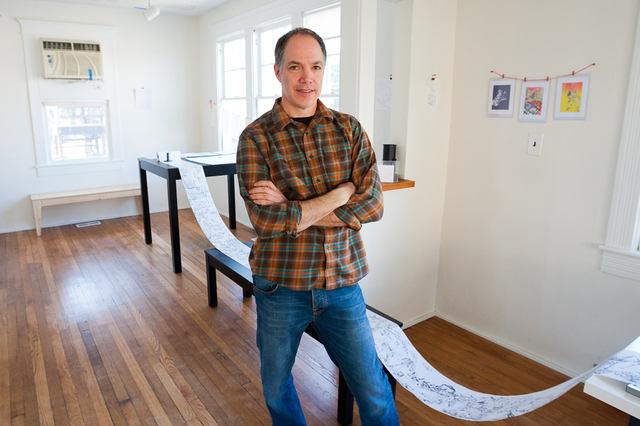
RhizomeDC, a new arts space in Takoma, opened last month with the hope of serving as a hub for local creativity and collaboration. During Takoma’s annual Art Hop this past weekend, the venue showed signs of realizing that vision as artists and community members came together for the unveiling of the Shnth Room, an innovative sound-art installation that invites visitors to interact with a walk-in music synthesizer.
A non-profit organization spearheaded by president Steve Korn and a small group of volunteers, RhizomeDC previously put on arts events at venues like Pyramid Atlantic before acquiring and renovating a 2000-square-foot house two blocks from the Takoma Metro stop. During its first month of operation, the flexible space has hosted an eclectic, multidisciplinary array of programming including exhibitions, concerts, film screenings, poetry readings, performance art, classes, and workshops.
“Our focus is on promoting creativity and knowledge-sharing as a way to bring people together,” said Korn, whose own artistic specialization is in computer music. “The vision was to have a space where it was unstructured and it wasn’t hierarchical and defined ahead of time what it was going to be, but have it be open and see what people can do here, see what would happen if you had a space focused on creativity and experimentation.”
Korn noted that most of the people who have gotten involved with RhizomeDC thus far come from the immediate Takoma neighborhood and its robust arts scene. But as the space hits its stride, he hopes to tap into the wider creative community in D.C. and attract a larger, more general audience.
“We want to demystify technology and experimental art and make it something that people can approach and be a part of,” he declared.
A collaboration between Korn and several other artists affiliated with RhizomeDC, the Shnth Room exemplifies those aims. Installed in a 10 x 11-foot space on the second floor of the house, it’s one of approximately 200 shnths in existence worldwide (the unconventional spelling evokes the sounds of computation and permutation, according to Korn). But it is the only one that is room-sized.
Visitors play the instrument by interacting with an array of wall, floor, and window-mounted interfaces connected to a circuit board mounted in an obelisk in the center of the room. These include planks of sycamore, maple, and zebrawood with piezo contact microphones behind them, a panel of four leather-covered, nipple-like buttons, several furry floor mats, and a pair of antennae—one colorfully spiral-shaped and one wired through a cluster of empty Old Chub beer cans.
Touching, pressing, or even moving around these interfaces creates signals which are processed by the central synthesizer in accordance with code written by Korn (using the Shnth-specific programming language originally written by Peter Blasser). The resulting sounds emanating from corner-mounted speakers range widely depending on how many people are in the room and what they are doing, forming an unpredictable collage of electronic timbres that encompass ambient hums, oceanic swooshes, percussive clangs, robotic beeps, dischordant feedback, plucky strings, and pulsing beats.
A dynamic synesthesia is activated as the visual and tactile materiality of the woods, metals, skins, and fabrics plays off of the sonic textures. Korn highlighted the disconnect between the familiar materials and the often incongruent sounds, which he sees as demonstrating the power of digital code to transform perception and experience.
The Shnth Room seemed like a big hit, with a steady stream of visitors dropping in to enjoy the installation and to inquisitively talk with a couple of the artists who were on hand. Perhaps more than anything else that has been presented at the new space, the project seemed to achieve RhizomeDC’s aim of drawing people into a creative, collaborative process in an accessible and engaging manner.
The installation will remain on view through May. At some point, Korn and an ensemble of colleagues plan to give a performance in the Shnth Room during which they will render musical compositions written specifically for the instrument.
RhizomeDC is located at 6950 Maple Street, NW. More info and a calendar of programming can be found on their website.