
 (Courtesy Dick Bangham)
One day in 2010, Scott Mueller was home sick from work. To cheer himself up, he popped in a DVD of Mr. Mike’s Mondo Video, a little-seen 1979 movie from the former Saturday Night Live head writer Michael O’Donoghue. The movie was originally conceived as an SNL spinoff, but NBC passed, thinking its subject material was too dark. Mueller was enjoying the gonzo comedy when he heard a familiar name announced as a guest performer: Root Boy Slim.
Born Foster MacKenzie III, Root Boy was well known in the D.C. music scene as a blues-influenced underground rocker, but Mueller didn’t know much about him beyond his name. So he did what any self-respecting curious person does in the age of the Internet: he high-tailed it to Root Boy’s Wikipedia page, and dove in.
What Mueller found surprised him. MacKenzie attended Yale, but his post-graduate career didn’t follow the stereotypical path of an Ivy Leaguer. One of his fraternity brothers in college was none other than George W. Bush, who threw MacKenzie out of the club after catching him smoking marijuana. The tidbits kept on coming, and Mueller was fascinated.
“I was just like, somebody should make a documentary about this guy. I’m kind of surprised,” Mueller says. “Why aren’t there more articles?”
Now Mueller is knee deep in creating the very documentary he initially assumed someone else had made. Boogie ‘Til You Puke: The Forgotten Legend of Root Boy Slim aims to shed light on a D.C. icon whose legend has faded in the years since his death at 48 in 1993. Mueller and his collaborators will show scenes from the project, which isn’t yet completed, at a DC Music Salon event at the Shaw Library tomorrow night.
 (Courtesy Dick Bangham)
Mueller didn’t immediately set out to make a Root Boy Slim documentary. He told his friend David Barnes he thought someone should, so Dave mentioned it to local documentarian Jeff Krulik. It turned out Krulik knew someone else who had already started making a Root Boy documentary, so Mueller gave up hope. But Krulik insisted the two Root Boy heads meet.
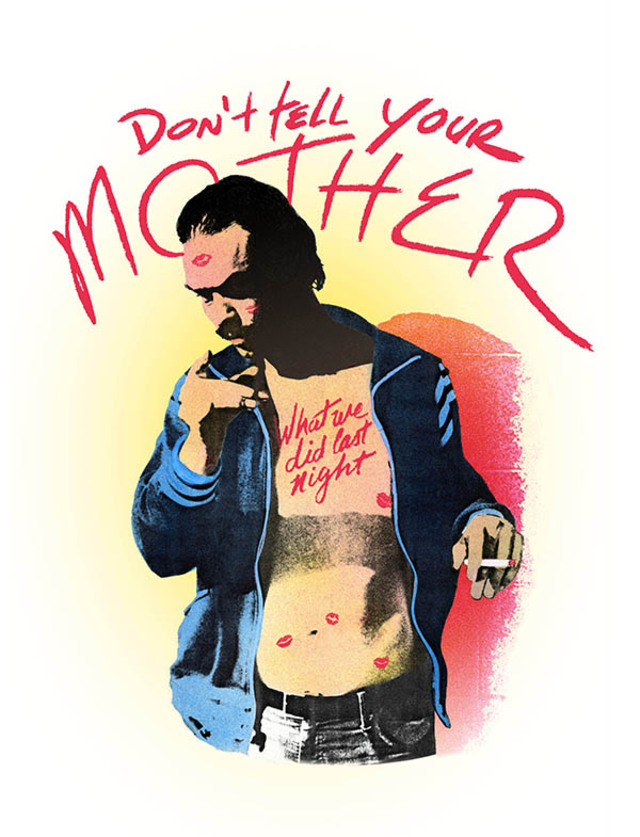
The person who’d gotten a head start on the Root Boy project was Dick Bangham, who designed album covers for Root Boy and worked with him through much of his D.C. heyday in the late 1970s. (Bangham’s artwork is also featured at an American University exhibit open now.) Mueller and Bangham quickly gelled as a duo, and with help from Barnes, they set out to tell Root Boy’s story through interviews and archival footage.
Bangham was working as an album cover designer and illustrator for local publications in 1977 when he met Root Boy through a friend in the record industry. The three spent a day listening to Root Boy’s demo tape. Then they played a game of Scrabble, and Root Boy asked Bangham and his friend to make him famous.
A band quickly formed, and Root Boy started knocking out as many as six songs a day at times, blowing Bangham and company away with his efficiency.
“He was just so outrageous and the band was so tight and there was so much anticipation,” Bangham says. “He really got people involved and connected with people.”
A few months later, they had an album’s worth of material and a record contract at Warner Brothers, thanks to Steely Dan lead singer Donald Fagen, who connected Root Boy with his producer, Gary Katz. Back in D.C., Root Boy inspired a passionate following, with fans designing props for Root Boy’s eccentric concert setups. “It just evolved into a real freeform psychodrama stage show,” Bangham says.
Bangham recalls watching Root Boy transform from a “preppy” college graduate to a drug-addled, flamboyant performer seemingly overnight. The young talent sometimes struggled to transform his creative ideas into accessible products, but with help from Bangham and others, he would arrive at “something that resembled a song.” Onstage, he would sometimes forget the words to his own songs and make up new ones on the spot. Later, Root Boy would be diagnosed with schizophrenia and face severe mental health struggles.
“Most people who met him, he left an indelible impression on him, even for the good or they would run in horror from him,” Bangham says. He has exclusive access to footage and other memorabilia that will be featured in the documentary.
 The back cover of Root Boy Slim’s Warner Bros. debut.
 Bangham’s memories of the period are vivid. Fans brought empty “Froot Loops” boxes and scratched off the first letter to support Root. Once, Root Boy got an opportunity to perform at the Roxy on Sunset Boulevard in front of several Warner Brothers executives and Hollywood stars like Chevy Chase. He bombed, torpedoing his chance at a lengthy major-label career. “We’d have a head of steam, something wonderful would happen and we’d blow it, mainly because of him,” Bangham says.
Hearing these stories convinced Mueller and his friend that there would be an audience for the documentary. After starting strong in 2011, Mueller and his team took a few years off to focus on some personal developments, but now they’re back and looking to turn their raw footage into a finished product.
The team hopes the movie will be finished in time for the 40th anniversary of Root’s first performance with his Sex Change Band in 2017, or at the latest by the 40th anniversary of the Warner Brothers deal in 2018. Between now and then, Mueller says he’ll be focused on cutting down the 30 hours of interviews and 10 to 15 interviews of archives already available, as well as talking to more people and seeking out more relics from the past.
Now that Root Boy has been dead for more than two decades and memories of his heyday haven’t translated to younger generations, Bangham says he feels responsible for sharing the musician’s raucous story.
“Because it was such a pivotal moment in my life and because I’ve been sitting on this stuff all these years, I feel almost obligated to put it out there,” Bangham says.
Dick Bangham and Scott Mueller will talk about their work in progress and show clips of Root Boy on Wednesday, April 13 at 7 p.m. at the Watha T. Daniel/Shaw Neighborhood Library. Free.
Watch Root Boy Slim perform “Boogie ‘Til You Puke” in Mr. MIke’s Mondo Video: