Rachel Kurzius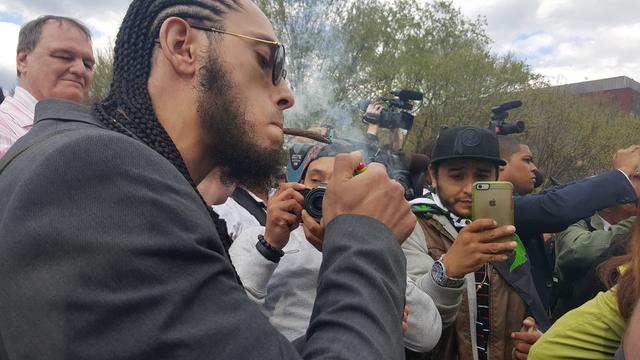
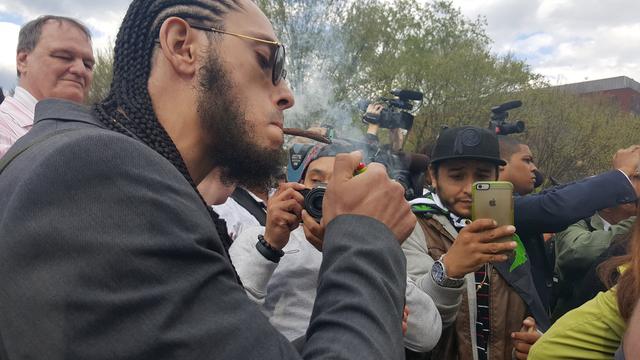 Protesters smoke up in front of the White House on April 2, 2016. (Photo by Benjamin Strahs)
There was one moment of drama, when it seemed like the expected outcome of today’s vote on permanently banning private pot clubs in D.C. could be thwarted.
Ward 7 Councilmember Yvette Alexander, who has been a stalwart vote against said clubs, voted “no” on the legislation. Advocates for marijuana had only needed to flip one vote to change the outcome.
But alas, Alexander made a mistake. She quickly changed her vote to “yes.” And on a 7-6 vote, the Marijuana Decriminalization Clarification Amendment Act of 2015 passed.
Alexander probably wasn’t activists’ best bet, anyway. Just before the vote, she gave a full-throated “absolutely not” to At-large Councilmember Vincent Orange’s motion to table the legislation.
The bill mirrors emergency legislation passed shortly after D.C. legalized marijuana, because the ability to smoke pot in places where the public is invited, like restaurants or bars, has been a legal gray area for Initiative 71. The council briefly lifted the ban in January, but changed its mind about 10 minutes later amid concerns about the ability to regulate cannabis clubs.
While it looked like a permanent ban was cruising towards passage, in February the council passed a temporary ban instead and established a task force to make recommendations in 120 days.
But two weeks ago, Judiciary Chair Kenyan McDuffie reintroduced the permanent ban, which passed 7-6 on first reading. The same councilmembers—Mary Cheh of Ward 3, Brandon Todd of Ward 4, McDuffie, Alexander, LaRuby May of Ward 8, Chair Phil Mendelson, and At-large Anita Bonds—voted in favor of it today.
Opponents of the ban have called the bill “draconian” and overly broad in its scope. Ward 1’s Brianne Nadeau pointed out that it makes penalties for businesses who allow pot smoking more onerous than underage drinking.
Another of their concerns? That the legislation undermines the task force, which will meet for the first time this Friday. Nadeau, one of two councilmembers on the task force, called the permanent ban a “slap in the face,” and said it would circumscribe the recommendations.
But Mendelson, who voted for the ban, said that the task force “has plenty it can do and would not be emasculated by the ban.” He said that “a delay (in passing the ban) gains little but delay … I am sure whatever we do today we will revisit and we should revisit. Until we have that ability (to regulate), we should maintain the status quo.”
But Nadeau disagreed. “This narrative that the permanent ban can be revisited is false as long as the (Congressional) rider is in place,” she said. “A task force with a 120-day timeline is supposed to be planning for the present, not the future.”
At-large Councilmember Elissa Silverman also argued that the task force came about because of the “pot club issue,” and while it can also tackle broader social use issues, like smoking in public, that was not its initial purpose.
“Today’s vote suggests that Councilmembers would prefer to hide behind congressional authority to deflect their responsibilities, rather than do the work of legislating themselves,” said Kaitlyn Boecker, Policy Coordinator, Drug Policy Alliance. “We hope the Council is prepared to take full responsibility as medical marijuana patients lose rights, businesses face draconian penalties, and marijuana-related arrests increase under this new law,”
The legislation next needs the signature of the mayor, who supports it.
A Washington City Paper poll this winter found that 61 percent of District residents support “regulated places where adults can legally consume marijuana.”
Data released by the Drug Policy Alliance found that racial disparities continue in marijuana-related arrests in D.C., even as decriminalization and legalization have decreased the total number. Of the 259 public consumption arrests from July 17, 2014 (when public consumption became a criminal offense) to the end of 2015, 81.9 percent of them were of black people.