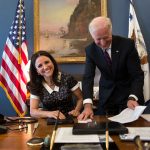
 Julia Louis-Dreyfus (HBO)
By DCist contributor Peter Tabakis
Now entering its fifth season, Veep has always been more outrageous than the worst of Donald Trump’s antics on the stump, and proudly so. If anything, reality is catching up to television at a disquieting clip.
In a recent interview with “The New Yorker Radio Hour” podcast, Julia Louis-Dreyfus noted that the show debuted in 2012 as a “political satire.” Given the comic surrealism of the current election cycle, she quipped that Veep has become “a somber documentary … If you took language that these guys [are] saying, you put it in our script — we would get notes from HBO saying, ‘it’s too broad, it’s over the top.’”
Maybe, but I doubt it.
Unlike other shows set in the nation’s capital, Veep refuses to pander to the notion of Washington as a place of grand speechmaking and cunning machinations. Our majestic federal city can, to the shock of no one, double as a den of careerism and buffoonery—much like the Bay Area of HBO’s own Silicon Valley and the Lower Manhattan of recent films such as The Wolf of Wall Street and The Big Short.
Veep is the quintessential Washington show not merely because it lampoons the idea of elitism, in this case of the political variety. Its wonderful, motley cast of narcissists are instead presented as white-collar drones, no brighter or more capable than those who work in buildings that lack gleaming marble facades. The series transplants the daily foibles of The Office out from a corporate office park in Scranton and into the seat of American government. The stakes may be higher, but the absurd particulars are the same.
The show returns in top form on Sunday at 10:30 p.m. Its creator and former show-runner, the great Armando Iannucci, has handed the baton to David Mandel, a television veteran whose credits include minor productions such as Seinfeld and Curb Your Enthusiasm.
The creative transition is almost imperceptible. The show continues its comic mastery with rat-a-tat verbal outbursts and expletive-laden acrobatics that approach balletic elegance. The narrative transition, on the other hand, is seamless. Sunday’s episode opens in the direct wake of the season 4 finale. Selina Meyer (Louis-Dreyfus) is still the POTUS, but her hold on the Oval Office hangs in the balance. She’s locked in an electoral disaster that could result in Tom James (Hugh Laurie), her running mate, ending up as the new commander in chief.
Mandel steers Veep into a parody of the ballot wars of the 2000 election, with Nevada playing the role of Florida. As such, a handful of core characters (Anna Chlumsky’s tightly wound Amy, Reid Scott’s unabashedly entitled Dan, Timothy Simons’ shamelessly clownish Jonah) remain far-flung from the executive mansion, the show’s comedic center of gravity. New faces attempt to fill the void, the best of which are John Slattery (playing a Wall Street tycoon) and Martin Mull (as a political fixer on the decline).
But, as with season 4, the latest episodes of Veep run into the same central problem of its HBO sibling Game of Thrones: too many characters who traverse concentric orbits. The show’s earliest seasons, so limited in scope and rich in zippy dialogue, could have been reproduced on the stage. Veep has understandably settled into the familiar trappings of a long-running television series. It’s stretching its narrative limbs, for better or worse.
Minor quibbles aside, the show endures as the smartest and funniest on TV (a distinction that notably excludes an upstart such as Unbreakable Kimmy Schmidt). By a supreme bit of luck, this season inadvertently mirrors the procedural chess maneuvers, the gambits and counterstrikes, of the current presidential primary contests. The show is as densely plotted as ever, but it ultimately rests on the foundation of back-and-forth insults, with a target resting on every character’s back.
Julia Louis-Dreyfus still stands astride Veep’s excellent ensemble cast. She has taken Selina Meyer on a parallel, if much darker, character arc as Amy Poehler’s Leslie Knope on Parks and Recreation. Selina began as an inept, though lovable, bureaucrat and has blossomed into a highly capable, and increasingly despicable, politician.
David Mandel brings in some story tangents—a new romantic interest, a dying relative—that would seek to humanize another character. But Selina has turned into a living and breathing reflective surface: Little things like love and loss can’t stick to her any longer. In that way, Selina offers us a peek into a scattered, Trumpian White House. Veep twists Lord Acton’s famous quote “Power corrupts, for sure.” It also turns a delightful loser into a thirsty, and oblivious, commander in chief. The most important question is: Does the latest season of Veep deliver big laughs in spite of all of this plotting and plodding? Yes, absolutely.