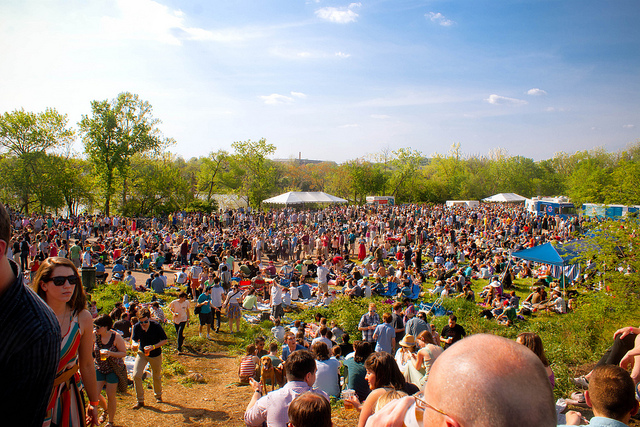
 The Kingman Island Bluegrass and Folk Festival in 2013. (Photo by Caroline Angelo)
By DCist contributor Scott Harris
It’s been a pile of mud, a public dump, and a squatter’s haven. Now it’s home to the region’s hottest bluegrass concert.
Officials like to refer to Kingman Island in Northeast as a hidden gem, but it’s coming into more people’s view every year thanks to the Kingman Island Bluegrass and Folk Festival. When the festival’s seventh installment takes place April 30, organizers expect 15,000 attendees. Considering the first concert hosted about 300, that’s not a bad trend line.
It’s the latest chapter for an island with a checkered past and a future, organizers hope, that advances Kingman Island as a place not just for concerts but education and environmental reclamation.
As a concept, the festival began in 2007, when Tommy Wells, fresh off his election to the D.C. Council, toured the island, about half of which resides in Ward 6.
“I went out and saw what an amazing place it was,” said Wells, who is now director of the D.C. Department of Energy and Environment. “I started thinking about getting more people out on the Anacostia River and I thought we could hold a bluegrass festival here.”
The idea of a focus on folk music came from Wells’ own roots, and those of the city.
“I grew up in Alabama going to bluegrass festivals,” he said. “I was aware that there were lots of new local bluegrass bands. When I first came to the city in 1983, WAMU [88.5 FM] was all bluegrass. After World War II, D.C. was the capital of American bluegrass.”
Even so, the festival didn’t see exactly see overnight success. In the first few years, it was little more than a few canvas tents to shield fans from June’s mid-Atlantic swelter. This year, though, 46 bands will perform on six stages.
“Before we were really just playing in a meadow,” said Claire Blaustein, a D.C. resident and fiddle player for bluegrass band By And By, which has performed at every Kingman Island festival. “Now there are so many people, and there’s so much music. It’s such a positive day. This is the big show of the year for a lot of the bands here.”
The festival’s local ties go beyond musical history. The D.C. branch of Living Classrooms Foundation, a Baltimore-based nonprofit providing outdoor education and job training programs, is the festival’s primary backer and beneficiary. According to Alex Quarles, the festival director and Living Classrooms’ director of development for the national capital region, every dollar raised from the festival goes back into the island or to education activities exclusively for D.C. schoolchildren.
“We had no idea it would get this big,” Quarles said. “It’s been amazing for the island. It gets people on to the site. People don’t find it or stumble on it naturally. But that’s the beauty because once you’re there you don’t know you’re in the middle of D.C.”
Last year 8,000 K-12 students took part in some educational activity on Kingman Island, Quarles said. Topics range from wildlife to STEM fields to workforce development, where students construct and maintain docks and other island structures as a hands-on training exercise.
Being a fairly wild place in the middle of a large urban setting, the island affords students and educators some unusual opportunities.
“You can see connections happening with the students about how their actions affect their environment,” said Rachael Shearouse, a Living Classrooms educator who has led various courses on the island. “It’s an a-ha moment. They start out not wanting to get their shoes dirty, then at the end of the visit they’re covered in mud and don’t want to leave.”
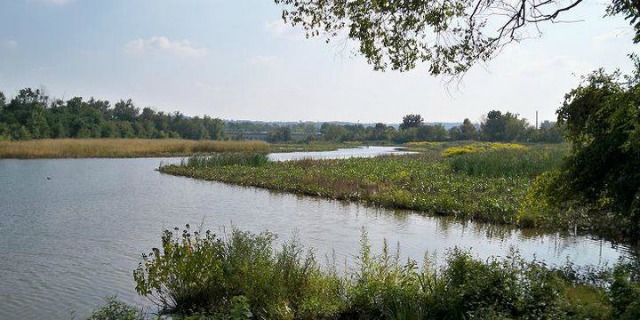 Kingman Island
It’s a pretty broad portfolio for an island that began life as an inconvenient heap of river-bottom silt. Made of materials dredged from the bottom of the Anacostia River by the Army Corps of Engineers and completed in 1916, Kingman Island has for decades presented conundrums and controversies for planners that have struggled to control of its fate.
Proposals for residential developments, an airport, an amusement park, parking lots for RFK, and even a jail were vigorously debated, but they never came to fruition. After a time, the island fell into disrepair and overgrowth. Residents used it as an illegal dumping ground. A squatter’s colony took root.
Eventually, though, city leaders regained control and a kind of reverse development ensued. Officials envisioned a wildlife refuge that would complement efforts to rehabilitate the Anacostia River. During cleanups on the island, volunteers unearthed washing machines, car parts, and tons of other detritus. Asphalt remains as a reminder of the island’s past, though workers are gradually removing it.
In 2005, then-Mayor Anthony Williams proposed an environmental education center for the site. Drawings were created but the project was never fully funded.
Wells said he hopes that’s something the city will remedy.
“I would love to see a state-of-the-art outdoor education center there that has a net-zero energy footprint,” Wells said.
Such a facility—as well as new pedestrian bridges, a boathouse, and an amphitheater—are among the proposals for Kingman and nearby Heritage islands as part of plans to redevelop RFK after D.C. United decamps for its new home at Buzzard Point. Still in the early stages of development, the city’s convention and sports authority has floated a wide range of uses for the land, including an arena or new NFL stadium, that would draw tens of thousands of people to the area, and almost certainly raise Kingman Island’s profile.
In the meantime, the festival probably serves as the biggest advertisement for the island. Officials with Living Classrooms, which has a contract with the city to manage the island, see plenty of possibilities, including more music events, in the island’s future.
But don’t expect a D.C. version of Randall’s Island or Governor’s Island, the two New York City islands that have become prime concert venues in recent years.
“It’s all about bringing people onto the island and enjoying the space without destroying or devaluing the value of being there,” Quarles said. “How do we grow in a way that doesn’t cause damage to the island? We want more events but we don’t want it to be only a music festival space…We want to stay true to the grassroots nature of the island, a place where you can still bring your kayak.”
In the meantime, the festival only grows, as does the potential of the island that holds it.
“I never thought it would turn into this big of an event,” Wells said. “This is now one of the biggest bluegrass events for the region. People come up to me all the time and say they loved the festival or they never knew the island existed. It has really created a greater interest, and people beginning are really beginning to view it as an asset.”