By DCist contributor George Altshuler
 Jacqueline Dupree
When Jacqueline Dupree takes photos around Navy Yard, she has a system. At the corner of L Street SE and Half Street SE, she points her high-resolution Canon camera toward a noisy 11-story construction site. She takes shots in three directions. South, south-southeast, southeast.
“Now I don’t sit here with a protractor,” she jokes. “But I’m pretty accurate.
She walks a few blocks to her home and adds the photos to her archive of 83,000 photos of the neighborhood. Dupree is nominally a hyperlocal blogger, but the site she maintains transcends what one would normally think of as a hyperlocal blog. With JDLand, Dupree uses photos, blog posts, and coding to tell the story of an area that is unrecognizable compared to the place she started covering in 2003.
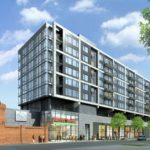
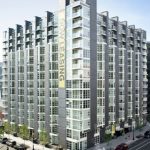
Case in point: On a walk in the neighborhood, Dupree pulls out her smartphone and taps the “Time Machine” button on her mobile website. It recognizes where she is and displays 16 photos in 22.5-degree increments that she took at the same intersection in 2006. Where there are now large apartment buildings, construction sites, and a hotel, the old photos show a run-down auto shop, a shabby warehouse, and overgrown brick buildings.
“I’m not comparing myself to him as a writer, but in a way I’m like Dickens,” Dupree says. “I’m writing a chapter a day of this greater story. I’m watching a neighborhood get built, and I’m doing it from beginning, to middle and, hopefully, to end.”
Dupree, who is 49 and works full time at The Washington Post, where she runs the publication’s internal server, has compiled a photo archive, designed the site, and written 3,480 blog posts (or 5.3 posts per week) entirely in her spare time.
Despite the 12,000 hits the site gets on an average week, and being recognizable as the only red-haired woman in the neighborhood who regularly takes photos of construction sites, Dupree explained that her main aim isn’t to amass a large following in the neighborhood.
“I think of my site as the business section for this area,” she said, adding that about half her readers are “in commercial real estate, D.C. government, or they’re Nats fans.”
Elise Bernard, who runs Frozen Tropics, a local blog in D.C.’s Trinidad neighborhood, thinks Dupree’s site is distinctive because of its longevity and her digital skills. Besides, Bernard believes, Dupree has a good story to tell. “The scope of development in that neighborhood has been crazy,” Bernard says. “Basically there’s an entire neighborhood there that’s been completely remade.”
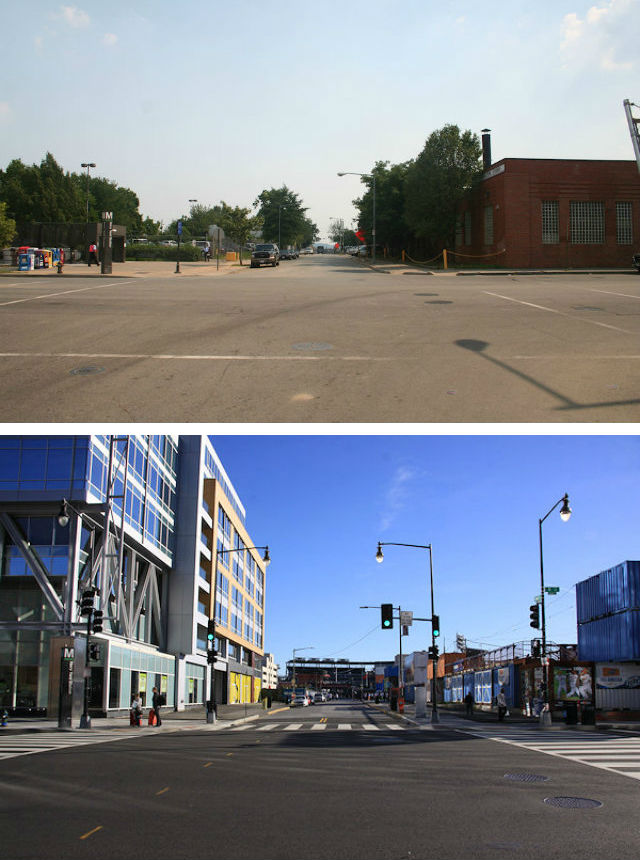 JDLand has been chronicling the transformation of Navy Yard since 2003. The intersection of Half and M streets SE, for example, looks practically unrecognizable from July of 2006 to October of 2014. (Photos by Jacqueline Dupree)
Dupree’s site is also distinctive because of what Bernard calls Dupree’s “documentary style.” Unlike some other neighborhood blogs, Dupree goes to great lengths to keep her personal opinions to herself and report the news objectively.
Michael Stevens, the president of the business association that operates in the area, said he and his staff have been following JDLand for nearly a decade. Much like Bernard, Stevens admires the “neutrality” of Dupree’s website.
Dupree’s thoroughness and objective stance have won her acclaim locally and even nationally (in 2008, she won the national Knight-Batten prize for citizen journalism), but her objective approach also meant that in an interview she declined to offer an opinion on the loaded issue of gentrification in the neighborhood.
“I am at heart not someone who gets hepped up by these types of arguments,” she said.
Dupree lives with her husband in Capitol Hill, the neighborhood just north of the area she covers. She said that when she bought her house in 1995, there was “never a reason” for her to go south of the Southeast Freeway.
Still, she had always been interested in real estate (she maintained a site about new developments in D.C. beginning in the mid-1990s). One afternoon in January of 2003, she put 60 photos that she had taken in what was then known as Near Southeast on JDLand.com, which was then just her personal website, to show her father the area.
“I thought it would be really cool to see what the neighborhood looked like before,” she explained. “You could start to see the writing on the wall that things were going to start happening down here.”
She had “no grand plan” for the website. But then in 2004, the Washington Nationals moved to the area, and the team let Dupree take pictures of the stadium. Her site got 350,000 page views in the four weeks leading up to the opening.
“It didn’t crash the site, but it crashed me,” said Dupree, who said she spent 50 hours a week on the site during that period.
Dupree spends less time on the site then she used to, and she said she could even consider walking away from JDLand once the spate of development slows and the story she’s telling comes to an end.
“I see a day where I can say 99 percent of this neighborhood is built and my work is done,” she said. “Because people will be able to look at my website and say, ‘here is the before, here is the middle and here is the after.’”