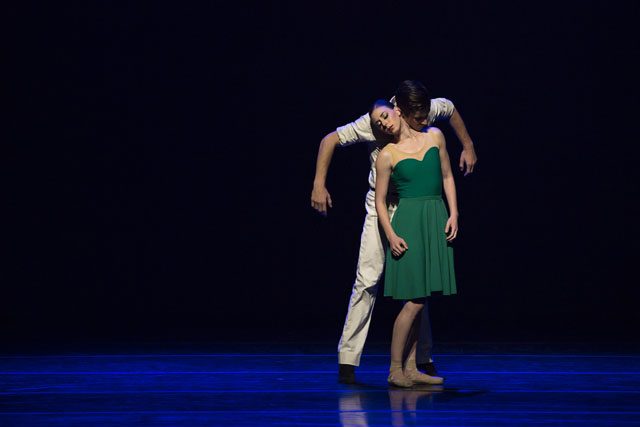
 From The Washington Ballet’s Bowie and Queen, Grace-Anne Powers and Gabriel Gaffney Smith perform “Dancing in the Street” (Jennifer Zmuda/TWB)
By DCist contributor Elena Goukassian
A Georgetown Nutcracker. The Great Gatsby en pointe. A rock ‘n’ roll ballet. After 17 years with the Washington Ballet, Artistic Director Septime Webre steps down at the end of this season, but not before transforming what many see as an outdated and inaccessible art form.
Before he hands over the company, Webre has one last ballet to offer. An homage to a pair of flamboyant rock ‘n’ roll iconoclasts, Bowie & Queen (in performance from May 4-15) is part of a series that may attract new audiences to ballet. “Our canon is very eurocentric, and it’s always good to include works that reflect our contemporary society, like Latin works, jazz, and rock ‘n’ roll.
Webre took over TWB in 1999 after making waves with Princeton’s American Repertory Ballet, turning it from a tiny company to a regional contender in six short years. When he arrived in Washington, Webre thought it was essential “to become more connected with the social fabric of the city.” To that end, he collaborated with DC Public Schools on educational programs and adapted standard repertoire to the city, setting the annual Nutcracker in Revolutionary War-era Georgetown.
A great administrator and an ambitious choreographer, Weber expanded the repertoire through a new series dubbed The American Experience, full-length ballets based on iconic works of American literature such as The Great Gatsby, The Sun Also Rises, and “The Legend of Sleepy Hollow.” He cites the Washington Ballet’s premiere of The Great Gatsby in February 2010 as one of his favorite memories at the company. “It was the first time I started from scratch with a new musical score,” he said. “I had no road map other than the original literary work.”
The company crossed new territory in a more literal sense during a tour of Cuba, where Webre’s mother grew up. “The trip to Cuba in 2000 was a real highlight,” he says. “We were the first U.S. ballet company to perform in Havana in sixty years!”
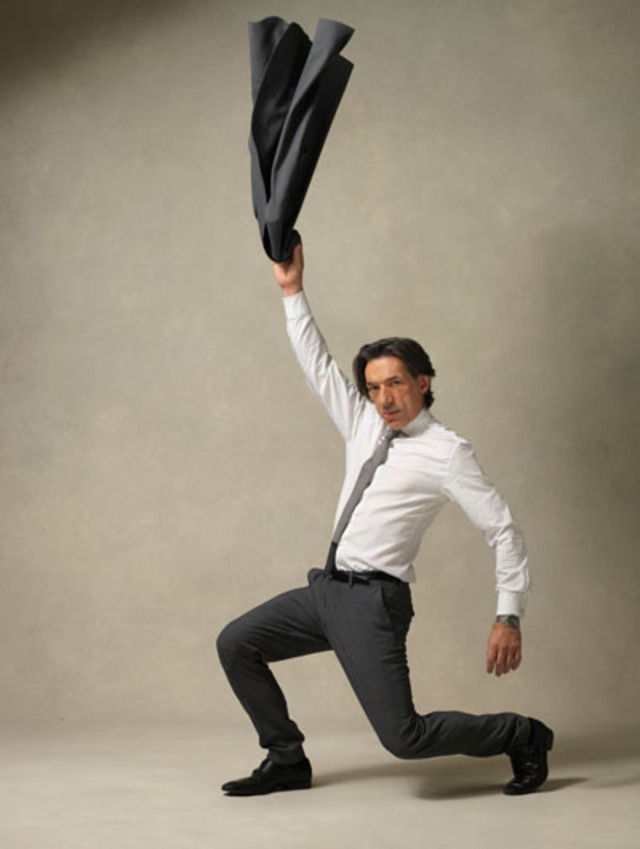
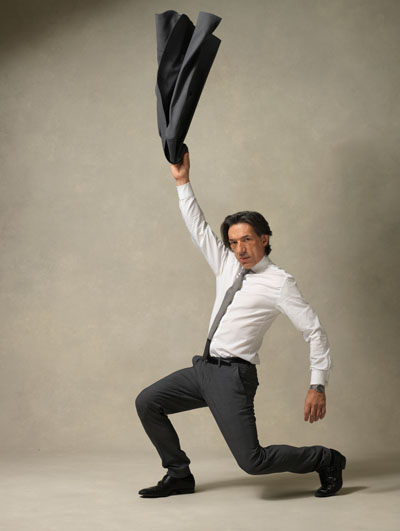 Septime Webre (Dean Alexander/TWB)
When asked his favorite performance from the past 17 years, Webre insists, that “the one I’m working on at the moment is always my favorite.” Still, two works hold a special place in his heart. He looks forward to The Nutcracker every holiday season, always delighted by local children who play soldiers, mice, and—of course—little cherry blossoms. “George Washington as the Nutcracker was my idea,” says Webre, who was a history major in college and still considers himself a history nerd. He set the ballet in Georgetown as a nod to history and to the local community. “It’s a reflection of the city,” he says, noting that every year the production includes new, timely political jokes for the adults in the audience. “It’s important to reflect the city and for audience members to see themselves in the work.”
His other most treasured ballet is one he choreographed himself. Carmina Burana premiered in his first season with the company and became its signature ballet. Webre dusted it off and revived it for the penultimate performance of his final season. “Putting on Carmina Burana is a more emotional experience for me this time around. The work itself is the same. What’s different is my state of mind. These have been very meaningful years to me. I’ve had a great time with the dancers and savor every moment.”
Of course, it hasn’t always been all cherry blossoms and swan feathers. Webre hasn’t always been able to afford live music for performances, and he regrets a prolonged and damaging union struggle that started around Nutcracker season in 2005. “I wish that when dancers joined the union, we had reached a contract right away.” Always looking forward, he concludes, “But all’s well that ends well,”
After leaving the company, Webre will stay in town, and he plans to keep busy, collaborating with the Washington Ballet and traveling for other projects in New York, Istanbul, Cape Town, Tel Aviv, and Winnipeg. Closer to home, he’s following in the footsteps of the “pocket operas” he’s created for the InSeries, and theatre works he has created for Arena Stage and Imagination Stage. “A natural theatrical inclination makes theater very compelling to me,” Webre says. “I’m actually a natural storyteller; it’s in my blood.”
Confident the Washington Ballet will remain in good hands, Webre has high hopes for Julie Kent, who is retiring from New York’s American Ballet Theatre to take the reins in D.C. “I know Julie and respect her immensely,” Webre says. “I know she’ll be inspiring to both dancers and audiences alike.”
As Webre has transformed ballet for Washington audiences, the company’s final work under his direction transforms rock ‘n’ roll for the TWB audience. The first act of Bowie & Queen, “Mercury Half-life,” uses 15 Queen songs, while “Dancing in the Street,” weaves three David Bowie performances (“Good Morning Girl,” “I’m Not Losing Sleep” and “Dancing in the Street”) into a love story.
Webre didn’t choreograph the pieces, leaving it to Trey McIntyre and Edwaard Liang—both of whom have a history with the Washington Ballet. Webre says, “It’s like ending with family.”
Bowie & Queen runs from May 4-15 at the Kennedy Center’s Eisenhower Theatre. $32.25-$130. Buy tickets here.