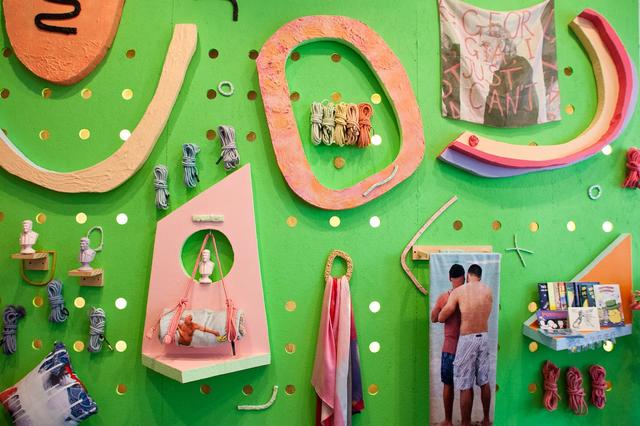
Gift Shop, a vibrant group exhibition that opened to a festive reception at Transformer on Saturday, offers a “hyperaccessible” context from which to reconsider the fraught relationship between art and commerce and the intersections of aesthetics and commodity fetishism.
Curated by Joseph Orzal and Nora Müeller, who collaborate under the collective moniker NoMüNoMü, the installation features work by a diverse, interdisciplinary group of like-minded artists from the D.C. area.
This is hardly the first show of its kind. Claes Oldenburg’s The Store, Keith Haring’s Pop Shop, and The Shop by Tracey Emin and Sarah Lucas, are direct art-historical antecedents. Orzal and Müeller are well aware of such reference points, but for this project, the District natives worked from a perspective specific to Washington’s museum-rich, tourist-heavy environs.
The idea for the exhibition grew out of Orzal’s experience working at the Corcoran Gallery and conversations with staffers at other local museums. Noting that gift shops are a major source of revenue for art establishments, he observed that patrons often spent more time in museum stores than in the exhibition spaces, and sometimes seemed more interested in buying commodified souvenirs of their visits than in the art itself, which much of the public finds inaccessible and inscrutable.
In response to this cultural logic, Müeller asserts that the goal for the Transformer show is to “change the whole dialogue altogether, changing the space from what is a formal gallery to a gift shop, something that they would feel more comfortable engaging with, still upholding a fine-art aesthetic, but changing the mechanism in which we’re communicating with the public.”
Toward that end, the works in the exhibition display what she calls “hyperaccessibility.”
Alex Von Bergen’s Tan-line Gradient studies, for example, is a series of 14 ceramic mugs much like those one might find in a typical museum gift shop, but instead of Rembrandt self-portraits or The Starry Night, they are printed with images of Kim Kardashian and isolated body parts of anonymous sunburnt beach-goers. Kaliq Crosby’s t-shirts feature not museum logos or Warhol Marilyns, but timely images of Prince. Rather than scholarly tomes and glossy catalogues, reading material on offer included comics by The DC Conspiracy, and de rigueur Klimt or Kandinsky-patterned textiles are supplanted by Amy Hughes Braden’s Silk Butthole Scarf.
This, according to Müeller, is “art for people to engage with in a form that they can feel comfortable, that they can use, that they can wear.”
The works are presented for sale on brightly-colored shelves and wall mountings designed by PLAKOOKEE’s Rachel Debuque and Justin Plakas. Florid hues and dynamic shapes echo the kitschy vibe of many of the individual pieces it houses, and the scene evokes boutiques, garage sales, and thrift shops as much as it mimics the look and feel of traditional museum stores.
Visually striking on its surface, Gift Shop also presents an opportunity to revisit questions of longstanding philosophical and art-theoretical import. Reframing art from the rarified, often elitist spaces in which it is normally encountered, the exhibition prompts consideration of how the context in which an object is encountered shapes the way it is perceived and determines its aesthetic, conceptual, and economic worth.
“A big part of it is the question of value,” Orzal said. “With art and the art market and how it’s blowing up, why and how are these things valuable?”
Orzal points to Wilson Butterworth’s $1 mini-busts of President Reagan as an example of “taking the value out of something that is overvalued.” On the other end of the spectrum, Orzal himself put two pairs of bootleg Yeezys on pedestals at a price point of $5,000 each. Now that they bask in the aura of art, he seems to ask, are they worth more than they would be on eBay?
These are matters that have been pondered since Duchamp’s infamously seminal interventions, but Gift Shop doesn’t take a heavy-handed approach, allowing visitors to draw their own conclusions, or to ignore the intellectual baggage altogether in favor of just browsing, shopping, and enjoying themselves.
“Fun is always part of our mission,” Müeller said on Saturday, as unique items and limited-edition works sold briskly to an enthusiastic crowd. “Part of our definition of what makes good art is that it can be serious, but at the same time hilarious, at the same time beautiful, at the same time engaging, at the same time challenging. We try to bring all those strands, but fun is not secondary.”
Gift Shop is on view at Transformer, 1404 P Street, NW, through June 18. Gallery hours are Wednesday through Saturday, noon to 6 p.m.