By DCist contributor Bridget Dicosmo
“There are plenty of other fish in the sea” still resonates in the dating world, but the saying may be a misnomer when it comes to actual fish. Overfishing and environmental concerns have led to increased scrutiny about sustainable seafood, meaning seafood harvested in ways that are environmentally friendly and support fishing communities that are dependent upon it for the local economy. Here in the D.C. area, we are lucky to have an abundance of sustainability-conscious restaurants, including BlackSalt, Fiola Mare, and SER, that can help take out some of the guesswork.
It can be tricky to know if that fish staring at you through the glass at the fish counter is actually sustainable. Since buying seafood can be as much of a financial investment as a filet mignon, it pays to know what you’re getting. “The average person should care as much about where their seafood came from as their beef or wine,” says Ryan Bigelow, program engagement manager for Monterey Bay Aquarium’s Seafood Watch program in California. “If I’m paying $30 for a steak, I want to know something about it.”
If you’re looking to reduce your fishy footprint, there are ways to score quality seafood that is gentle on the planet and also makes the most of your purchase.
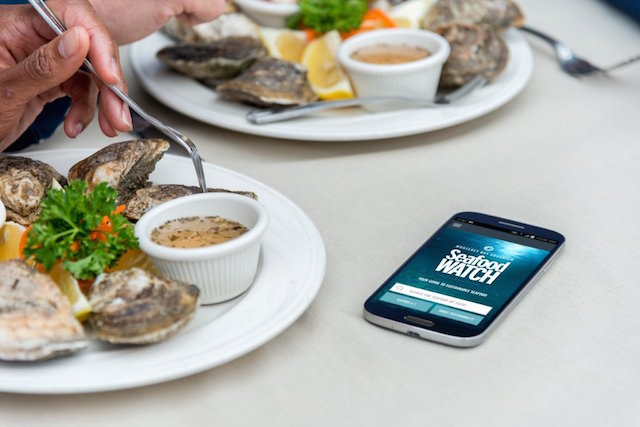
A good place to start is the Seafood Watch app, developed by the Monterey Bay Aquarium, which provides information right at your fingertips about how to choose fish responsibly, whether on the menu or at the grocery store.
While that kind of technology can be a useful tool, it’s equally important to know how to talk to fishmongers. When buying fish, Bigelow says the top three questions you need to ask are where was it caught, how was it caught, and what it is—information that zeroes in on the most important factors surrounding sustainability, such as species or fishing methods. (Here’s a good primer on the various fishing methods.)
But if you’re pressed for time or the market is crowded, Bigelow says that it’s almost as effective to simply ask, “Do you sell sustainable seafood?” Starting the conversation gets consumers thinking about the issue while also letting vendors know that it’s important to you.
“A fishmonger should be happy to answer questions and be transparent about their product,” says TJ Tate, director of the National Aquarium’s Sustainable Seafood Program. “If they aren’t, find a new fishmonger.”
Better labeling on packaged fish can be helpful, if you know what to look for. “Labels have given the consumer the power to make informed choices,” Tate says. And they’ve gotten better, providing information about seafood certification, its country of origin, or possibly even trace it back to the very boat on which it was caught or harvested. Gulf Wild, This Fish and MSC are three reliable brands that provide different types of labels assuring the consumer some degree of sustainability.
But there’s also “quite a bit of seafood fraud” out there, Bigelow warns. And knowing the actual water body where the fish originated (also known as traceability) is vital to sustainability. For instance, Bigelow points out that you might walk into the freezer section and “see ‘wild Alaskan salmon—from China’, and you’re immediately confused.” Manufacturers only have to choose whether to name the place where the fish was caught or the place where it was processed — another reason why asking questions is so important.
“Being able to trace our offerings to their sources makes this process a much easier one,” says MJ Gimbar, fishmonger at Black Restaurant Group, which includes Republic and Pearl Dive Oyster Palace. Gimbar says the group looks at third party audits and ratings, then does their own research using National Oceanic and Atmospheric Administration’s FishWatch.
But wild seafood isn’t the only game in town. Seafood farming and aquaculture can get a bad rap, but that shouldn’t always be the case, says Tate: “Some of the most sustainable seafood sources come from farms, and oysters are a prime example.” Here in the Chesapeake Bay Watershed, bivalves are enthusiastically embraced by diners, chefs, local governments, and businesses, making them a mainstay of the local economy.
Farm-raised mussels and oysters are offered at all of Black Restaurant Group’s locations, says Gimbar, adding, “Eating more bi-valves, especially oysters, helps clean our waterways and get those environments back to their natural states.”
Tate agrees, calling oysters a “delicious, sustainably grown and harvested product that can be traced back to its source. Win, win, win.”