 Rachel Sadon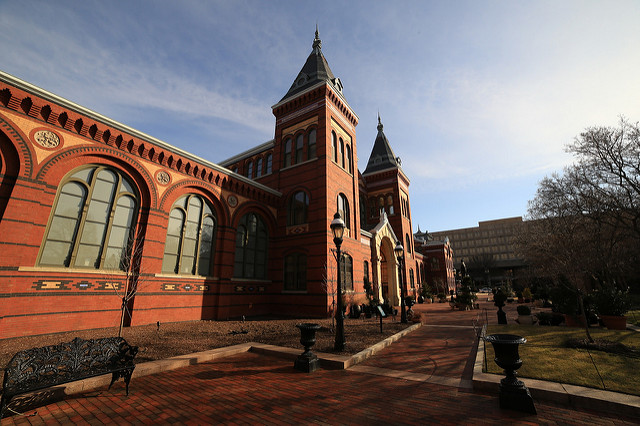
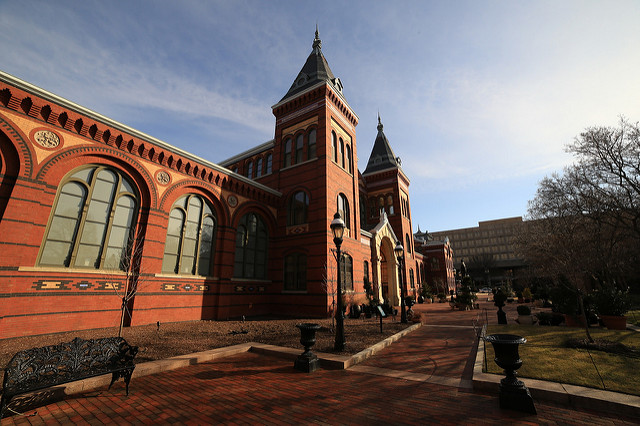 (Photo by Beau Finley)
The closest the public currently gets to enjoying the Smithsonian’s Arts and Industries Building is on the carousel out front, which has continued its quotidian business of ferrying children around during the exhibition hall’s lengthy closure. But for the first time in more than a decade, the Smithsonian Institution’s second-oldest building on the National Mall will welcome visitors inside.
Without a dedicated home of its own, the Smithsonian Asian Pacific American Center is mounting CrossLines, a two-day art exhibition, at the Arts and Industries Building over Memorial Day weekend. Subtitled “a culture lab on intersectionality,” more than forty artists will present new works that explore the connections of race, class, gender, sexuality, and other identities.
Only about half of the artists are Asian Pacific American, which is a shift for a center that’s generally focused its digital and pop-up exhibitions squarely on that community. But as the national discourse has broadened and begun to acknowledge how systems of oppression are linked, “we’ve been hearing people who are interested in talking about issues that aren’t specific to Asia Pacific Americans as just a racial issue,” says Adriel Luis, a curator at the center. “We’re interested in exploring how our experiences relate to Black Lives Matter or LGBTQ rights, for example.”
To that end, the center has invited painters, crafters, storytellers, spoken word performers, cartoonists, muralists, dancers, scholars, and DJs to “do their thing.” The idea is for an exchange of ideas—across mediums, between artist and audience, through performance. “We’re not expecting it to be a quiet place, with people walking around with their hands behind their backs,” Luis says.
It is a fitting event for the reopening of the building, which was originally called the National Museum Building. Designed by Adolf Cluss (of Eastern Market and Franklin School fame) and completed in 1881, it was built to house the U.S. National Museum after it outgrew the Castle next door. Visitors thronged to the new museum, where exhibits on geology, zoology, medicine, anthropology, art, history, ceramics, printing, transportation, and textile sat in grand mahogany display cases.
“It really was a display of a grand vision of America at the time,” according to Luis. With CrossLines, “we’re kind of remixing that and thinking about what it means to be American now and how that has changed.”
After the natural history collections were moved in 1910, it was renamed the Arts and Industries Building. The hall continued to highlight American icons (including the Star Spangled Banner) and technology, like a small collection of airplanes that eventually went to the National Air and Space Museum. After closing for renovations in the mid 1970s, the venue hosted a centennial exhibition followed by temporary and experimental exhibits. But by 2004, the building was showing its age in the form of a collapsing roof.
The Smithsonian sought private aid to redevelop it before undertaking a $55 million renovation. At one point the institution partnered with the U.S. Patent and Trademark Office to create an innovation-focused pavilion, but that fell through. The Arts and Industries Building has also been floated as the site of a proposed Latino cultural museum. But should Congress ever get it together to make that happen, they would need to add a significant amount of space either underground or elsewhere to make it work.
With the renovation work now complete, the historic structure in left in limbo. Currently lacking proper heat controls, the building can’t be used as a fine art museum, according to Smithsonian spokesperson Linda St. Thomas. “Until they come up with the funding to make it a proper museum,” she says, the institution will use it for temporary things “here and there.”
In addition to CrossLines, the Arts and Industries Building will host the marketplace for the Folklife Festival (highlighting Basque Country this year, it kicks off on June 29 through July 4, then picks back up July 7 through July 10). The Smithsonian is also discussing the possibility of a Hirshhorn exhibit there later this year, St. Thomas says.
In its current state, the space offers many possibilities. “It’s beautiful. Even though it has been under renovation, they kept the floor and the walls kind of raw,” Luis says. That lends itself nicely to the Asian Pacific American Center’s expansive vision for CrossLines, which will spread out over three of the four halls in the 100,000 square foot space and stay open from 10 a.m.- 9 p.m. on both nights. They hope the exhibit will draw crowds from creative communities in D.C. that don’t usually head over to the National Mall on weekends.
It should certainly help that about a third of the artists in the show hail from the D.C.-area. “We really see this as a good opportunity to open up the space for D.C. artists who have been doing some great work but haven’t had a chance to show at the Smithsonian,” Luis says.
CrossLines will run from May 28-29 from 10 a.m.-9 p.m. at the Arts and Industries Building (900 Jefferson Dr SW). Free.