By DCist contributor Christina Smart
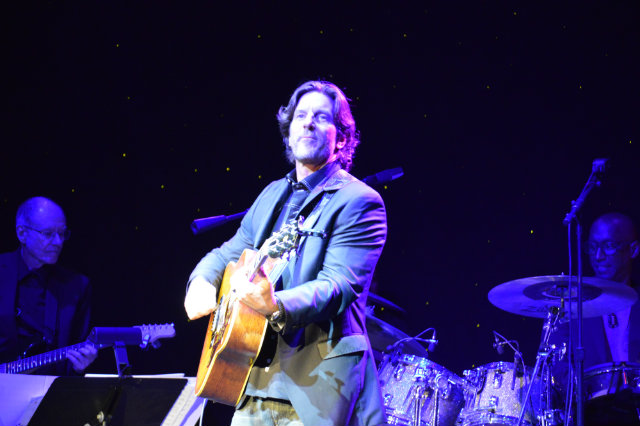
Songwriters of all genres descended on Washington on Tuesday night as The ASCAP (American Society of Composers, Authors and Publishers) Foundation presented its eighth annual “We Write the Songs” event at The Library of Congress. Hosted by ASCAP Foundation President and Academy Award winning singer/songwriter Paul Williams, the evening included performances by several of ASCAP’s top songwriters, including R&B singers Brian McKnight and Monica, MoZella, Brett James, and Desmond Child.
As festive as the performances were, the evening served a larger purpose. These ASCAP songwriters highlighted the importance of updating a long-outdated consent decree with the Department of Justice, which was originally established in 1941 and last updated in 2001. In the United States, royalties from the performance of musical compositions are collected and distributed by the Performing Rights Organizations (PROs), of which ASCAP is one. The latest version of the decree went into force before the iPod hit the masses, and, more importantly, Spotify and Pandora started their streaming services. Under this system, songwriters get paid a fraction of a penny with each stream.
Progress for an update to the decree has been slow-going as songwriters battle decades of outdated legislation, lobbyists for streaming services like Pandora and Spotify, and the stereotype that professionals within the music industry lead a jet-set lifestyle.
“I think that people think if you’re on television and if you’re on stage and if you’re on the Grammys, that you’re rich,” said R&B singer Brian McKnight. “That’s not the case. We’re not saying we want to be rich but we want something that’s fair, and right now, it’s just not fair.”
Songwriter Brett James, who has written songs for artists including Taylor Swift, Kelly Clarkson, Carrie Underwood, and Tim McGraw stated, “American songwriters, especially the non-performers who we are representing now … we’re a pretty small group. If you take all the professional American songwriters that actually make a true living at it you could probably stick them in a third of the Google building. Therein lies the challenge, because big tech is not a fan of paying content creators.”
To give an example of how poorly songwriters are paid for their craft through streaming, James continued “I did a song with Kenny Chesney called ‘When the Sun Goes Down.’ It was number 1 in country radio and it received 45 million streams on Pandora and my share was $1,200.” For those of you at home doing the math, that equals 0.00002667 cents per stream.
ASCAP Foundation President Paul Williams remains determined to make change happen.
“The needs we have are immediate,” said Williams. “When three-fourths of our income as music creators is regulated by the government, operated by a consent decree that was created in 1941, we’re in trouble. We want everybody to roll up and say ‘Yes, this is something that will make a difference in songwriters’ lives.’”