
Legal jargon and political procedures may work fine on stage. But do they make a good movie?
The 2014 Broadway production of All the Way, Robert Schenkkan’s account of President Lyndon B. Johnson’s first year in office, may not have sounded like a good candidate for television adaptation, and New York Magazine’s largely favorable assessment noted that the play’s focus wanders too far afield. On TV, it feels simultaneously overstuffed and undercooked.
HBO’s All the Way was first announced as a multi-episode miniseries, with Steven Spielberg himself serving as executive producer. It’s unclear when the plan changed, and from a creative standpoint, maybe it shouldn’t have. This stand-alone movie boasts excellent performances and thought-provoking political drama, but it feels a little smaller than it should, given its moment in history.
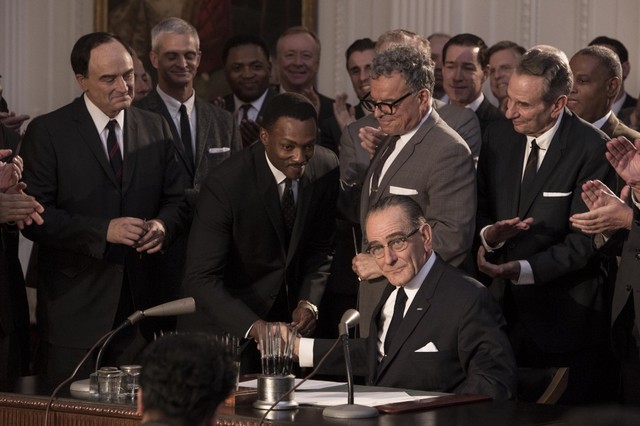
Directed by Jay Roach from a script by Schenkkan, All the Way is a spiritual companion piece to Selma, Ava DuVernay’s captivating film about Martin Luther King’s iconic civil rights march. Lyndon B. Johnson was a supporting character in that movie, played with cartoonish abandon by the British thespian Tom Wilkinson. Here, he has more dimension — and convincing, folksy Texas swagger — courtesy of Bryan Cranston, reprising his lead role from the stage play.
Cranston’s transformation into the 36th president is visually stunning, an arduous prosthetic process expanding the contours of his face and adding the wrinkles of an elder statesman. The Emmy-winning star of Breaking Bad may well earn another trophy here, transcending mere imitation to craft a fully formed human out of a colorful iconography. Cranston’s Johnson is shrewd and brash, with a minimum of self-consciousness and a maximum of self-confidence. He’s also a human being with understandable reservations about assuming the presidency before he takes office, and equally sympathetic desires to extend his term once he’s in it.
The balancing act between morally right and politically effective drives a plot that focuses primarily on Johnson’s civil rights efforts, which the movie’s first half zeroes in on exclusively. All the Way devotes roughly equal time in both quantity and quality to Johnson and to activists like King, played with requisite dignity by Anthony Mackie. By the second hour, the focus splinters, obscuring the civil rights issues that seemed to be at the movie’s core and presenting a more muddled picture of Johnson settling into his role while preparing for re-election.
Roach’s staging of the film, perhaps hampered by Schenkkan’s theater-minded teleplay, doesn’t take advantage of the cinematic medium, largely sticking to predictable close-ups and seated conversations in offices. The supporting performances also rely heavily on makeup and prosthetics, but they’re delivered with class from a fine cast including Melissa Leo, underused as Lady Bird Johnson; Frank Langella, perpetually stoic as the conservative senator Richard Russell; Bradley Whitford as the unflappably loyal Congressman Hubert Humphrey; and Stephen Root as the conniving FBI director J. Edgar Hoover.
All the Way shares some of the same attributes and deficits as Confirmation, the recent HBO movie that also reflected on textbook historical issues. Schenkkan’s script digs admirably deep into legislative minutiae and avoids the sentimentality and hagiography that often plagues political biopics (there’s a whiff of those qualities in Spielberg’s otherwise outstanding Lincoln, for instance). Cranston’s performance acts a vessel both for ideas about presidential power and for a sympathetic understanding of one man’s quest to triumph over party squabbles.
What’s missing is a unique perspective. Especially in the second half, the straightforward plot unfolds with little care taken to showcase surprising moments or take a breather for a sense of place and time. A viewer who knows going in that All the Way starts at the assassination of John F. Kennedy and ends on the night of Johnson’s election will have a pretty solid sense of what’s in store. The biggest jolt for viewers might be the simultaneous realization that American politics has changed radically in 50 years and that it also hasn’t changed all that much. If nothing else, All the Way serves as a reminder of how far America has come and how far it has to go. Its view of history might be familiar, but it remains provocative.
All the Way premieres on HBO on Saturday, May 21 at 8 p.m.