 Rachel Sadon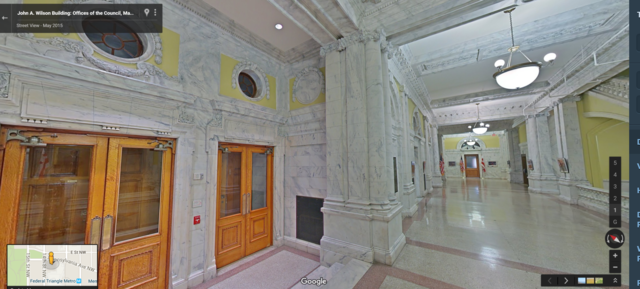
 Via
Via
Eight angels and eight devils adorn the ceiling of the D.C. Council’s chamber in the John Wilson Building (make of that what you will), and you can now check them out without lugging a ladder downtown and causing a security kerfuffle. Google added the seat of city government to Street View last week, offering impressive close ups and 360° views of the five story structure.
Previously called the District Building, “it opened in 1908 and was treated as a landmark and a destination for decades, and then it sort of fell off the radar screen,” says Josh Gibson, the public information officer for the D.C. Council (and the man behind their quippy Twitter account). “But I think it is one of the most beautiful buildings in D.C.”
And it is largely thanks to Gibson that you can take a virtual gander. He got in touch with Google last year after realizing that they offered a virtual walk in the Parisian statehouse. The team was planning to be in D.C. anyway, and so early one morning, they showed up at the Wilson Building and started scanning. Almost exactly a year later, the interior views showed up on Street View.
In addition to impressive close-ups of the building’s architectural details, virtual visitors can check out the art collection, which is curated by the D.Commission on the Arts and Humanities (Google’s technology unfortunately blurred out the faces in busts and portraits, though).
Few of the views are grand as the atrium or the mayor’s ceremonial room, but having the more mundane hearing rooms and hallways digitized serves a more quotidian purpose. “It’s a service to residents, who might be thinking ‘Oh I’m going to testify before the Council and I don’t even know what it looks like or where it is,'” Gibson says. “They can get a sense of what they’re getting themselves into.”
As for those angels and devils, he’s been wondering about them ever since former Councilmember Tommy Wells copped to staring at the ceiling at his farewell fete (starts at the 3:15 mark here).
“My sense is that a lot of the architectural detailing of that time was symbolic (for example, the statues that ring the top of the Wilson Building each represents a different field of art/study),” Gibson says. “I think it, in a way, was like the clipart of the time, where they had certain go-to graphics they’d go to (angel, devil, flower, bow, etc.) and those were the tools they’d use in creating each ceiling.”
Other local landmarks you can visit virtually instead of battling tourists include Arlington Cemetery, the White House, President Lincoln’s cottage, Congressional cemetery, and the National Cathedral.