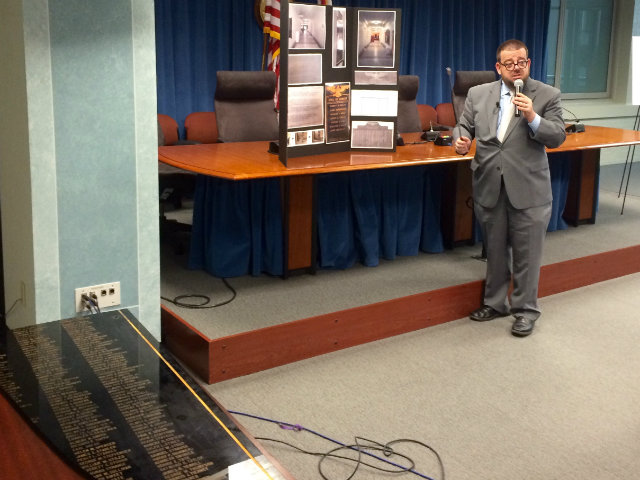
 Council spokesperson Josh Gibson presents his findings about the plaque. (Photo by Cuneyt Dil)
By DCist contributor Cuneyt Dil
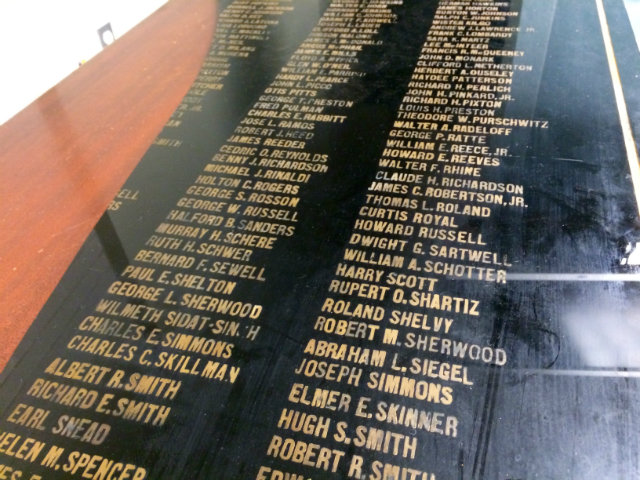
Nearly 2,000 names written in gold leaf on a plaque, but why? The D.C. Council has solved the mystery.
In November 2010, then-council Chairman Vince Gray called on the public to help identify a long forgotten plaque. Shattered pieces of the sign were stowed away in a fifth floor closet at the John A. Wilson Building, home to the D.C. Council and mayor.
In total, the plaque has 1,869 names. Roughly 10 feet wide and 5 feet tall, it used to hang on a first floor wall. Even in 1997, when the plaque was brought down (and cracked into fragments during the process) during the Wilson Building’s renovation, no one knew what it commemorated. Local reporter Mark Segraves found it again while poking around in 2010.
It took longer than expected, but Josh Gibson, the council’s public information officer and Twitter mastermind, found the answers. After two years of on-and-off research, he announced Friday that the plaque lists the names of District government employees who served in World War II. Newspaper archives of the Washington Star and Washington Post tell the story. And an outdated spelling of words—‘employees’ was spelled ‘employes’ in a 1942 Star headline—drew out the search process for Gibson.
“A large glass plaque bearing the names of 829 District government employes who are in military service will be unveiled [today],” begins that Star article, from Oct. 2, 1942. As World War II went on, names were continually added.
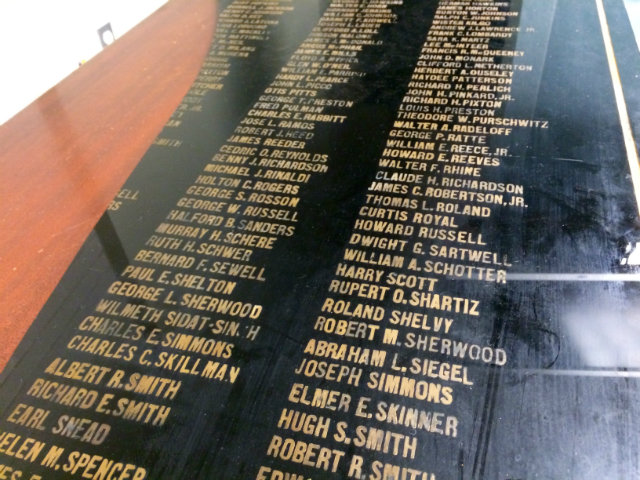 Photo by Cuneyt Dil.
In 1959, the city’s leaders updated the top panel of the plaque to read “Those who served” in the war. That panel, which Gibson suspects featured an image of an eagle, is the only piece missing. The rest of the plaque has been laid out together and sits at the Wilson Building now, after being in the D.C. Archives since being rediscovered.
“I put the puzzle back together,” Gibson says, after Gray’s call for help in 2010 didn’t get any answers. “We had TV and media coverage to get details, but no one had any.” He notes that there are names of employees who served in all branches of the military, and it includes women and African Americans. Gibson’s hope is that someone has a photo of the top panel—or that if someone took it in 1997, that they can bring it back. “We will not ask questions, we will not prosecute,” if someone comes forward with the missing piece, he says.
Either way, Gibson’s research gives him enough of a clue to reconstruct what the top panel may have looked like. Archived documents say the words “Roll of Honor” titled the plaque, and other similar war memorials have an eagle, he found. Gibson’s hope is to have a repaired plaque in time for Veteran’s Day this year, pending, in true council fashion, a look into costs and feasibility.
Gibson said that anyone who recognizes the names on the plaque should reach out to the council. “This stumped the District government, the D.C. media, and the general public.”