Rachel Kurzius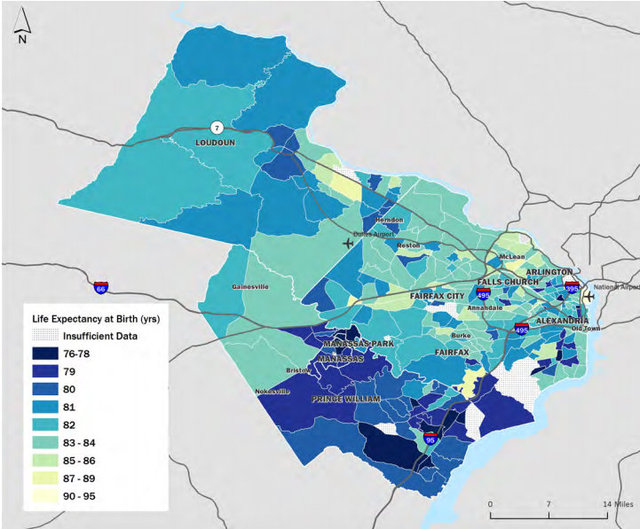

Loudoun and Fairfax counties were named the country’s happiest, but some people get to smile longer than others.
A new report from the Northern Virginia Health Foundation and the Virginia Commonwealth University Center on Society and Health examines the four counties that comprise Northern Virginia, and finds large gaps in life expectancy from neighborhood to neighborhood.
For instance, while residents of Fairfax County’s Western Lorton have an average life expectancy of 89 years, those in Eastern Lorton, right next door, live on average to be 79. The decade gap reflects “geographic disparities in socioeconomic status and often reflect the presence of minorities with poorer access to economic and health care opportunities,” the report says.
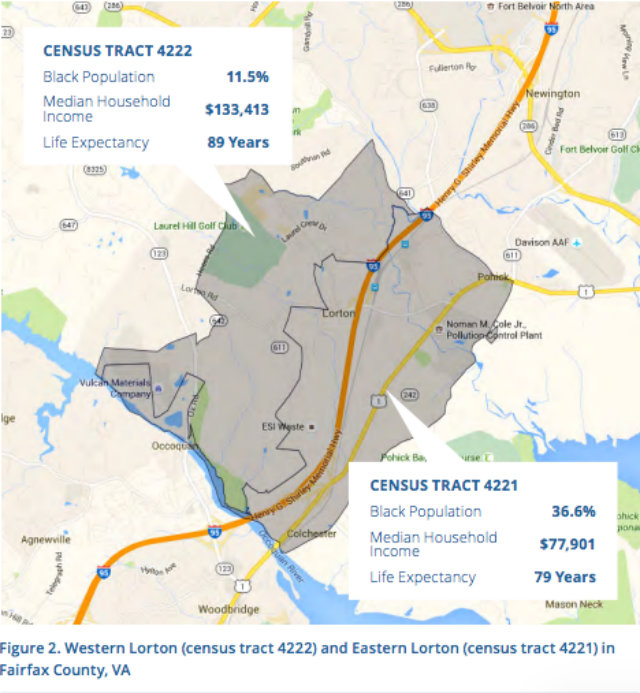 Image courtesy of the Center on Society and Health and the Northern Virginia Health Foundation.
In nearby Manassas, the gap grows wider still. With a life expectancy of 76 years, that’s a 13-year gap with Western Lorton. As of 2012, the U.S. average life expectancy was 78.8 years, whereas the report puts the regional number at 84 years.
“Northern Virginia is one of the most prosperous places in the country, with counties that consistently rank the highest in the state when it comes to health. But a closer look reveals how good health is not shared equally across neighborhoods in our region,” said NVHF President and CEO Patricia N. Mathews in a release. “There are very real inequities threatening the health and wellbeing of our residents,”
The report says it uses life expectancy as “a proxy for other health measures,” noting that personal choices like smoking or exercise are only part of the equation for a long life. “Even with the best intentions to lose weight or exercise, success often depends on factors outside our control, such as socioeconomic circumstances and the environment.”
Location matters because conditions like access to health care, safe and affordable housing, a good education system, non-polluted air, crime rates, and more can vary by neighborhood, the report notes.
But an impoverished or low income neighborhood doesn’t necessarily mean a shortened life expectancy. The Columbia Heights region of Arlington has an 83 year life expectancy, one of the highest in the county, despite being one of the poorest areas, and two-thirds of its residents are Hispanic. The report calls this the “Hispanic Paradox,” wherein “Hispanic and Latino Americans often have poor educational status and lower incomes but higher life expectancy and lower rates of certain diseases than non-Hispanic persons.”