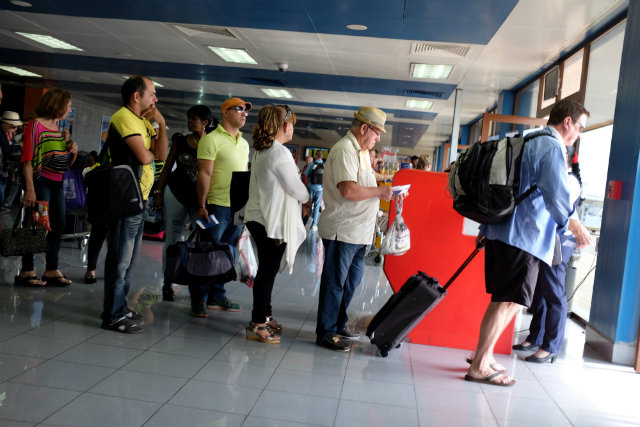
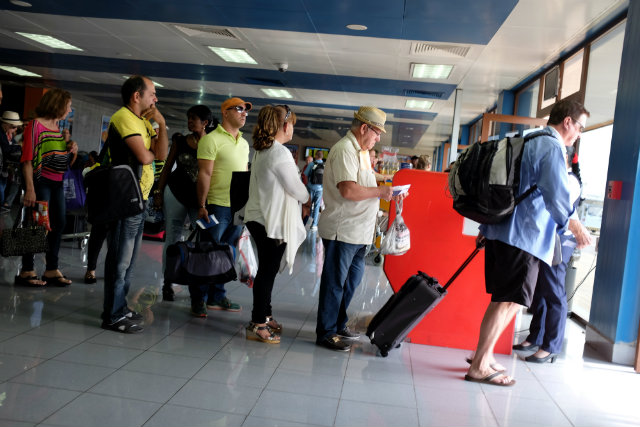
 Miami-bound passengers have their tickets checked as they prepare to board a charter plane at José Martí International Airport on March 1, 2015 in Havana. (Photo by Joe Raedle/Getty Images)
For the first time in more than 50 years, Americans will be able to take commercial flights to Cuba. After a bit of mudslinging by carriers, the U.S. Department of Transportation has approved six airlines to schedule trips to the island nation: American Airlines, Frontier Airlines, JetBlue Airways, Silver Airways, Southwest Airlines, and Sun Country Airlines.
As early as this fall, 90 roundtrips flights between the U.S. and nine Cuban international airports could be available every day. From the states, passengers can take off from Miami, Fort Lauderdale, Chicago, Philadelphia, and Minneapolis/St. Paul. The Cuban destinations are Camagüey, Cayo Coco, Cayo Largo, Cienfuegos, Holguín, Manzanillo, Matanzas, Santa Clara, and Santiago de Cuba.
The department is also allowing 20 daily roundtrip flights to Havana. Later this summer, officials will announce which carriers will make those trips and when they will begin.
Before launching their services, the airlines have to be approved by the Cuban government. Most of the carriers plan to begin services later this fall, and will start selling tickets much earlier.
Those looking to visit for leisure are still out of luck as tourist travel still officially remains prohibited. Instead, travelers must have one of 12 reasons for entering Cuba such as visiting family, conducting official government business, participating in a journalistic assignment, education, and more.
Some carriers have been providing public charter flights to Cuba for a number of years, according to Caitlin Harvey of DOT. This includes flights from BWI Thurgood Marshall and Dulles airports in the D.C. region. But today’s announcement marks the first time that the U.S. is authorizing scheduled commercial services in more than five decades, Harvey says.
In December 2014, President Obama announced plans to begin normalizing relations with Cuba, including a relaxed travel ban.