 Rachel Sadon
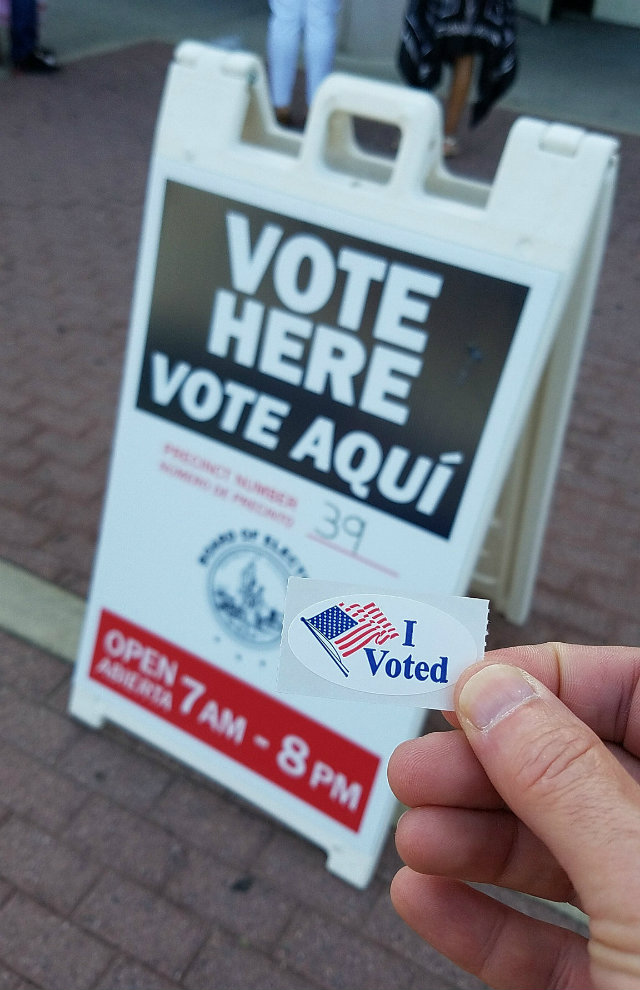 Photo by Oren Levine
This post has been updated
In a bruising night for allies of Mayor Muriel Bowser, three incumbents lost their seats and a fourth faced a strong challenge.
As was widely expected, Vincent Gray made a comeback in Ward 7, besting his former protege, Yvette Alexander. And after losing by just 100 votes in last year’s special election in Ward 8, Trayon White came out on top of LaRuby May this time around. Most surprisingly, though, Robert White overcame a long tradition of vote-splitting to unseat At-large incumbent Vincent Orange.
Even in Ward 4, where former Bowser staffer Brandon Todd held on to his position, challenger Leon Andrews put in a strong showing.
In the presidential race, Hillary Clinton coasted with 78 percent of the vote to Bernie Sanders’ 21 percent as the rivals headed into a private meeting. Both have advocated for D.C. statehood.
Nearly the same number of people cast ballots—close to 100,000—as the contested mayoral primary in 2014 (the general election that year saw 177,000).
In the most closely watched race, Gray won a decisive victory over Alexander, with nearly double the votes. “My mother always told me if you create a problem, you solve it… today we solved a problem, ladies and gentleman,” he said in reference to his original endorsement of Alexander. Gray hasn’t dismissed persistent rumors that he might run for mayor once again.
Trayon White took 50 percent percent to LaRuby May’s 43 percent.
And surprising many election watchers, Robert White was able to overcome Vincent Orange in a close race—just 2,253 votes—that featured another challenger, David Garber.
“We feel great about the momentum of the campaign, and how we resonated across the city. That’s what was really important: we pulled votes from every part of the city,” White told DCist at a packed party on U Street that was also attended by four current councilmembers, Ward 1’s Brianne Nadeau, Ward 3’s Mary Cheh, Ward 5’s Kenyan McDuffie, and Ward 6’s Charles Allen.
Orange conceded on Twitter, writing: “Best of luck to you in the General election and the beginning of new career as an elected official.”
As to what his win means for the mayor’s agenda, White says, “I never ran adverse to the mayor. I ran to be a voice for the people. I will always work for the mayor and support the mayor where I believe in her policies.”
The mayor, meanwhile, came to White’s party to congratulate him person. “I look forward to working with all the councilmembers,” Bowser said (she also tweeted a congratulations). When asked if she was concerned that the losses might reflect a mandate against her, she added, “I always look at what the voters have to say in each individual election.”
Even in Ward 4, Bowser’s home base, incumbent Brandon Todd faced a fight. Spending a significant amount of his own money, Leon Andrews was able to take 41 percent of the vote to Todd’s 49 percent.
Asked about the evening’s losses, Todd says: “It’s certainly unfortunate, but I for sure look forward to working with anyone the voters send to the council.” When asked how Gray’s reappearance on the dais might change the Council’s dynamic, he says: “I don’t have any concerns.”
Meanwhile, Ward 2’s Jack Evans, Del. Eleanor Holmes Norton, and Shadow Rep. Franklin Garcia all ran unopposed.
And because it wouldn’t be an election year without the D.C. Board of Elections muddling something up, early voting results were released in a confounding format (and claimed to count absentee and provisional ballots) before the glitch was fixed several minutes later.
Reporting contributed by Rachel Kurzius and Christina Sturdivant.