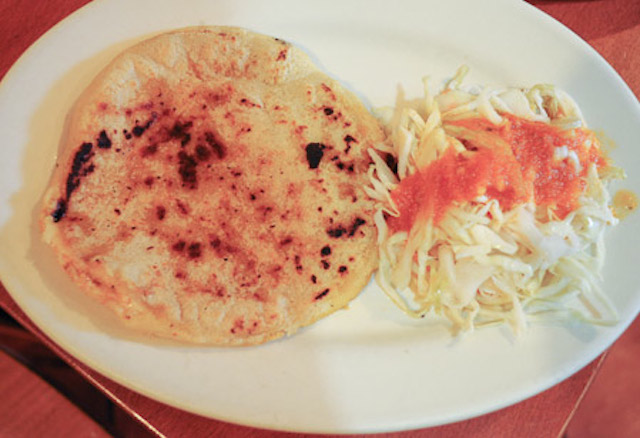
 (Photo by Geralyn Lobel)
By DCist contributor Johanna Mendelson Forman
At the first ever PupusaFest last year, 10,000 pupusas just weren’t enough; by mid-afternoon, they had sold out of every last one.
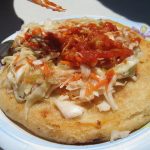
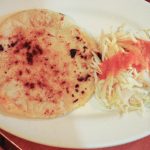
If Washington, D.C. has its own food terroir, then Mt. Pleasant and Columbia Heights should be designated the home of the pupusa. This savory disc of maseca (corn flour) filled with cheese, beans, or chicharon (chopped pork), then cooked on a grill until crisped and lightly browned, is a street food from El Salvador. But pupusas have been embraced far outside the Salvadoran diaspora — everyone in Washington seems to love a good pupusa.
And this Sunday, June 26th, some of the city’s best homemade pupusas will be found at the second annual PupusaFest at the Shrine of the Sacred Heart, a Roman Catholic church on 16th Street.
Last year, pupusa fans were turned away at the door after more than 1,500 people consumed the entire supply, but plans are already in motion to make sure no one walks away with an empty stomach this time around. “We will triple our forces this year,” says Father Moises Villalta, Sacred Heart’s pastor, noting that a team of expert pupusa makers from the community will be on hand to ensure a constant supply — and they’ll be a bargain at three for $5.
A predominantly Central American parish, Sacred Heart has been a center of the Latino community for generations, serving as a cultural hub for the area’s 250,000 Salvadorans. Many of them came here in the 1980s, fleeing the civil war in their homeland, and pupusa-making is an important part of preserving their Salvadoran heritage. “The new generation is learning the tradition of pupusa making,” says Father Villalta. “This is something that mothers are passing down to their daughters.”
While the mixing of the dough, preparing the fillings, and grilling them to crispy perfection is a staple of El Salvador’s cuisine, what sets these stuffed corn pillows apart from their Mexican cousin, the gordita, is the shredded pickled cabbage, or curtido, that accompanies the pupusa. Tangy and spiked with chiles, the curtido is the “secret sauce” of the pupusa.
PupusaFest helps generate some much-needed revenue for a parish dedicated to community service, raising $10,000 last year. Proceeds from this year’s event will be earmarked to modernize the kitchen at the church.
If you can’t make it to PupusaFest, check out our guide to Central American cuisine on 14th Street NW, north of Columbia Heights. El Tamarindo (1785 Florida Avenue NW), Restaurant Judy (2214 14th Street NW), Taqueria Distrito Federal (3463 14th Street NW), and Gloria’s (3411 14th Street NW) are just a handful of local pupusa hot spots in pupusaria heavy Northwest; in Southeast, you can check out Tortilla Cafe (210 7th St SE), La Plaza Restaurant (629 Pennsylvania Ave SE), and Las Placitas (1100 8th St SE). And if you want to learn how to make them at home, check out this pupusa lesson from Catalina Canales of Capitol Hill’s Tortilla Cafe, when she made them for Guy Fieri on Food Network’s “Diners, Drive-Ins, and Dives”.
PupusaFest, Sunday, June 26th, from 8 a.m. to 5 p.m. at the Shrine of the Sacred Heart, 3211 Sacred Heart Way (corner of 16th Street and Park Road NW).
Johanna Mendelson Forman is the creator of the Conflict Cuisine® and an adjunct professor at American University.