
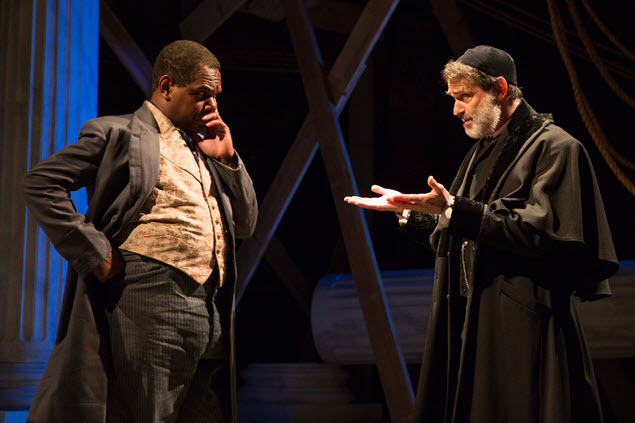
 Shylock (Matthew Boston, right) works out the terms of his loan with Antoine (Craig Wallace). Photo: Theresa Wood
By DCist Contributor Seth Rose
The Merchant of Venice rivals perhaps only The Taming of the Shrew for the title of Shakespeare’s most contentious play. Adding a whole new layer of controversy to the show takes some courage and a lot of talent, but that’s just what director Michael John Garces at the Folger Theatre has done with his production of Aaron Posner’s Reconstruction-era Merchant Of Venice adaptation District Merchants. Buoyed by the strength of Posner’s script and some inspired performances, the Folger team has crafted a retelling that makes some worthwhile additions to Shakespeare’s story without succumbing to bloated over-production or excessive self-importance.
Much of this success comes from the fact that the script often doesn’t feel like an adaptation at all. Like much of Posner’s recent work, Merchants is more of a remix, a riff on the original text that keeps some characters and the basic plot structure intact while modernizing the language and shifting the time and place. In this case, the events move from Elizabethan Venice to a (“more or less”) Reconstruction-era District. Shylock (Matthew Boston) remains a Jewish moneylender who, as in the original, demands his pound of flesh as collateral for a defaulted bond. In a pair of clever twists, however, the lendee Antonio has been reimagined as Antoine (Craig Wallace), a wealthy black man in the city. Portia’s (Maren Bush) white-passing suitor Bassanio (Seth Rue) hides his blackness even as she hides her gender to practice law.
The Merchant of Venice is a show best known for its exploration of antisemitism. The mean and vindictive Shylock neatly fits the role of the antagonist, but many interpretations nonetheless see him as a tragic figure lashing out against the endless petty cruelties heaped on him by his Christian neighbors even before he demands his bloody bond. Taking Shylock out of this context and putting him into one where his tormentors aren’t wealthy white Venetians but a historically put-upon class themselves shines a brilliant new light on both the character and his circumstances. It takes the relatively simple question of “Is Shylock a sympathetic character?” and multiplies the complexity by framing the injustices he has experienced against the racism he himself perpetuates. The often-overlooked gender dynamics of Portia’s disguise as a man also take on a new level of depth as Portia is forced to reconcile her feelings for a man she thought was white when she knows her colleagues only respect her because they think she is a man.
In one of the show’s few instances of “untranslated” Shakespearean text, Shylock delivers part of his iconic “Hath not a Jew eyes?” monologue, only to be abruptly cut off by Antoine responding “Your people enslaved mine, what the fuck do I care whether you laugh when I tickle you?” It is a moment as powerful as it is clever, and it exemplifies how Posner has dodged the moral simplicity (one way or the other) that has plagued portrayals of Shylock over the years. In his world, neither Shylock nor his antagonists are monsters or paragons. Rather, their behavior is shaped by their prejudices, which in turn are shaped by the grim circumstances of the world around them. In a real world increasingly concerned with the spread of similar injustice, this is a worthy lesson.
Shakespearean adaptations so often use their setting changes as little more than trite window dressing (Hamlet in the Roaring Twenties! Othello in Ancient Greece! Twelfth Night onboard the Titanic!), but Merchants treats its change as integral to the story it is trying to tell. The result is a story that absolutely would not work as a “standard” adaptation, yet still feels like an earned addition to the classic text. Little of the original is lost in translation, and a great deal is gained by Posner’s riffs. Anyone else looking to adapt The Bard should take note of this approach.
District Merchants plays through July 3 at the Folger Theatre. Tickets, $35-75, are available online.