 Werner Herzog (Pat Padua)
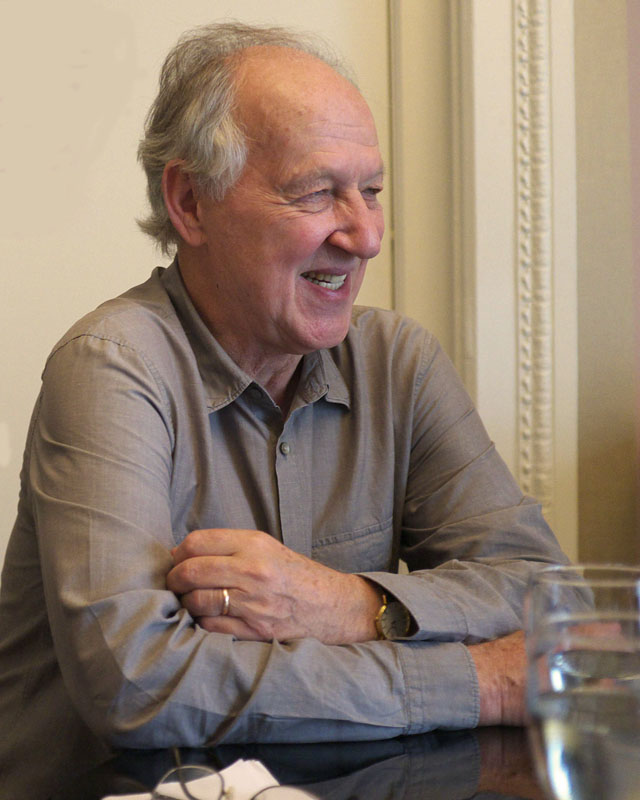
Director Werner Herzog doesn’t give interviews, he has conversations. DCist had the opportunity to have a conversation with the director last Friday in a roundtable discussion with Jason Fraley (WTOP), Jason Dick (CQ Roll Call), and Alan Zilberman of (BYT and WCP).
I was the one who got him to talk about cat videos.
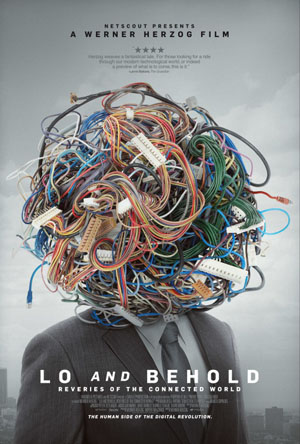
The 73-year old director was in town for AFI Docs, where he was honored as the 2016 Guggenheim Honoree and screened his new documentary Lo and Behold: Reveries of the Connected World. Herzog cuts an intimidating figure, inspiring nervousness among even jaded members of the press who have long held him in awe. But he is a gracious figure, and amicably approached the group of journalists waiting outside his hotel room. The man who pulled a steamboat over a mountain to make Fitzcarraldo is a formidable example of Teutonic intensity, but he also has a sense of humor.
DCIst: One of the great fears expressed in Lo and Behold is the worry that all this technology that we’re so dependent on will go away, leaving us helpless. Do you feel any sense that—I’m thinking of the resurgence of vinyl and of people raising their own chickens—that people are in some way preparing for this inevitable failure?
Werner Herzog: I think there’s not enough preparation for the failure of the internet. We are starting to comprehend that it can be stopped or wiped out because of let’s say massive solar flares. That would mean we cannot do any financial transactions anymore. You cannot buy a hamburger because the cash register is connected to the internet. You cannot make any phone calls because the electrical system would be down. You cannot pump gasoline anymore, you cannot flush your toilet anymore, you have no drinking water from your tap because it’s all dead. No light. Nothing. No elevator functioning. No website.
There are alarm signals out there that we have to somehow stabilize ourselves by reducing the complete and total dependency on the internet. I often hear we should get rid of cash money, that it would be so much easier electronically. I think that’s just wrong. We should maintain cash money because it is self-authenticating. You can tell this $100 bill is not a fake. My advice is to keep a lot of small denominations. You still can buy a hamburger when the cash registers are down, but if you have a $100 bill nobody can give you change. The dependence on electronic money and transactions by the internet is fine and useful and very easy to handle but it has its dangers.
DCist: Many years ago you said that we live in a world where there are no adequate images. We are inundated with images now, everyone has a camera, everyone can make a movie with their iPhone. How do you feel about that?
Herzog: When you look at four thousand million people on this planet who are using their cellphones and doing photos and selfies, you realize that there is such a thing as real high caliber art photos, and they do not come from these four thousand million users. It encourages me as a filmmaker to go out and search for the other image that is not exposed on your cellphones. But there are surprises coming from your cellphones. All of a sudden somebody discovers surprising new terrain. But it’s very rare.
I welcome what I see sometimes on the internet. YouTube has wonderful little things that nobody had on his radar. Of course we know cats can be very crazy, and 60-second crazy cat videos are just very delightful.
What I’m doing is something that illuminates you in a different way. In Cave of Forgotten Dreams, even in Lo and Behold there are moments where it’s not some completely new imagery but you look into a certain depth of what constitutes us as human beings right here and right now.
Alan Zilberman: You mention dumb internet cat videos—
Herzog, objecting: —Wait a moment. If I have a bad night I want to see a cat video before I even touch my coffee in the morning. It just makes you feel lighter.
Zilberman: Well I was wondering if you were aware of yourself as a pop culture phenomenon?
Herzog: I have entered into the consciousness of wider pop culture by playing a villain in Jack Reacher or playing a guest role on The Simpsons. When I was asked to join The Simpsons I had to ask do they talk? I had seen it only in newspapers as a comic strip. They said, “Are you pulling our legs? The Simpsons have been on television for 24 years. Of course they talk.” I asked if they could send samples so I could understand how cartoonish they talked, and they told me your voice doesn’t have to be cartoonish, just keep your accent. It was my apotheosis in American pop culture. On Parks and Recreation I play a cameo role and it’s very funny. The kind of humor that I have echoes very visibly in almost all my films. It’s a very unusual kind of humor and a very dark humor. You can see this in the action movie with Tom Cruise, Jack Reacher, where I was paid handsomely for being frightening. And I knew I could do that. Though in my private life I am absolutely not the kind of guy you see on screen. My wife would testify and swear to God or anyone that I’m a fluffy husband.
DCist: Your films have often dealt with the relationship between man and nature. One of the fluffiest examples I can think of is the talking animal movie. You’ve done a number of cartoon voices, have you ever thought about making something like that?
Herzog, after pausing to think: That’s a very interesting question and idea. And I think of cartoon movies like Penguins of Madagascar [in which he has a voice role as a documentary filmmaker] . There is a new style and new form that has really evolved beautifully. And it connects to children. And it connects to families. And that’s what the appeal of it is. Yes, if I could make a real good film for children that would be wonderful. But you really have to be in this world. It would probably be better to write a book for children. Whoever manages to really captivate children in storytelling and characters would be, not the king of the world, but the crown prince of the world.
This was a partial transcription of the conversation. Listen to the entire audio of the roundtable on WTOP.