Rachel Kurzius
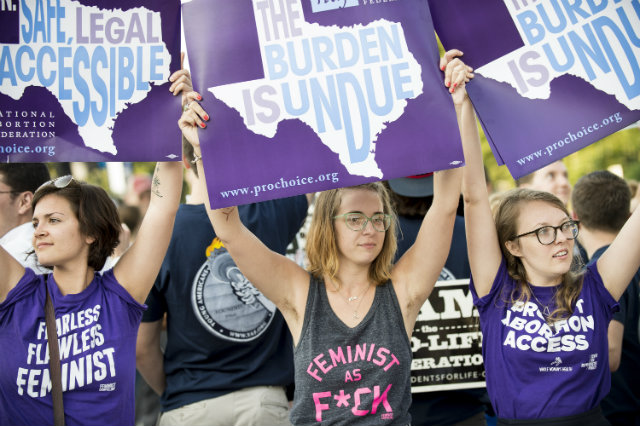 Pro-choice activists outside the Supreme Court today. (Photo by Pete Marovich/Getty Images)
In a 5-3 decision, the Supreme Court struck down provisions of a Texas law that created burdensome restrictions on abortion clinics, affirming that unnecessary hurdles to the procedure are unconstitutional.
The Texas law, known as House Bill 2 (or HB2), was passed in 2013 and outlines a series of regulations for clinics that provide abortions. The two measures in question require doctors who perform abortions to have admitting privileges at a nearby hospital and compel clinics to have the same standards as hospitals. It has already made abortions more expensive and complicated to obtain, and would have shut down all but about 10 clinics in the state.
Justice Stephen Breyer, writing for the majority, affirmed what reproductive health advocates have been saying about the restrictions—that they do not protect women’s health but instead, by “plac[ing] a substantial obstacle in the path of women seeking a previability abortion, each constitutes an undue burden on abortion access … and each violates the Federal Constitution.” He was joined in his opinion by Ruth Bader Ginsburg, Sonia Sotomayor, Elena Kagan, and the court’s swing vote, Anthony Kennedy.
“When directly asked at oral argument whether Texas knew of a single instance in which the new requirement would have helped even one woman obtain better treatment, Texas admitted that there was no evidence in the record of such a case,” writes Breyer.
Indeed, Texan women of means have been traveling to other places, like D.C., for abortions since HB2’s passage. “What we see as medical professionals, as these laws are put into place, is that it’s barely hidden contempt masquerading as concern,” Dr. Jamila Perritt told DCist. “These laws don’t help women, they hurt women. And those who are most vulnerable are hit the hardest.”
But Texas Attorney General Ken Paxton maintains that HB2 “was an effort to improve minimum safety standards and ensure capable care for Texas women. It’s exceedingly unfortunate that the court has taken the ability to protect women’s health out of the hands of Texas citizens and their duly-elected representatives,” Paxton said in a statement.
The lead plaintiff in the case says that “justice was served” by the decision. “Today the Supreme Court affirmed what we at Whole Woman’s Health have known all along—that every woman, no matter where she lives, deserves compassionate, respectful, and comprehensive care from a clinic she trusts,” Amy Hagstrom-Miller, president and CEO of Whole Woman’s Health said in a statement.
From The Guardian:
At the heart of this case was a two-decade old dispute over how strictly states can regulate abortion, so long as they claim to be doing so for health purposes. A 1992 Supreme Court decision, Planned Parenthood v Casey, gave states the right to restrict abortion to protect women’s health as long as it didn’t create an “undue burden” for women seeking abortion. “An undue burden exists,” that decision reads, “and therefore a provision of law is invalid, if its purpose or effect is to place substantial obstacles in the path of a woman seeking an abortion.”
This ruling will affect other states that have followed suit in passing what’s often called Targeted Regulation of Abortion Providers (TRAP) laws, a death by 1,000 cuts that makes it hard for clinics to stay open. An identical law passed in Mississippi was stayed pending this decision, and the future of Wisconsin’s admitting privileges law is now in question.
Here’s how some of the crowd outside the Supreme Court reacted to the news:
Watch the moment the crowd outside #SCOTUS learned TX #abortion restrictions were struck down pic.twitter.com/qo0eIZQ1Se
— Kayla Epstein (@KaylaEpstein) June 27, 2016
Presumptive Democratic nominee Hillary Clinton responded to the news by calling it a victory for women.
This fight isn’t over: The next president has to protect women’s health. Women won’t be “punished” for exercising their basic rights. -H
— Hillary Clinton (@HillaryClinton) June 27, 2016
Proponents of the Texas law and others like it vow to fight on.
I’m disappointed in the Court’s decision. But our fight to protect women’s health & promote life will not stop here. pic.twitter.com/sG0TyuT521
— Paul Ryan (@SpeakerRyan) June 27, 2016
This post has been updated.