 Photo by Rich Renomeron
Study after study has illustrated that in urban areas across the country, including in the District, the rent is too damn high. Apartment List, an apartment search site created by renters and landlords, compared the rising costs of rent, which surpass the rate of inflation, to how much money people are are actually bringing home over time.
About 43 million American households, or 37 percent of the total population, are renters, according to the study. Across the country, inflation-adjusted median rents have risen by 64 percent between 1960 and 2014, the report says, but average household incomes only increased by 19 percent during that time period.
If rents had only risen at the rate of inflation in the past several decades, the average renter would be paying $366 less each month. But that’s not what’s happened, according to the study. And nearly half of American renters are considered “cost-burdened households”—spending more than 30 percent of their incomes on rent.
In the District, residents have continued to bank more money than people in most cities, however, average rent prices have increased much faster. Between 1980 and 2014, District residents saw a 33 percent increase in median incomes from $45,103 to $60,181 (the national average during this time was 15-25 percent), according to Census data retrieved by Apartment List. The average inflation-adjusted cost of rent in the city rose from $842 in 1980 to $1,566 in 2014—that’s an increase of 86 percent.
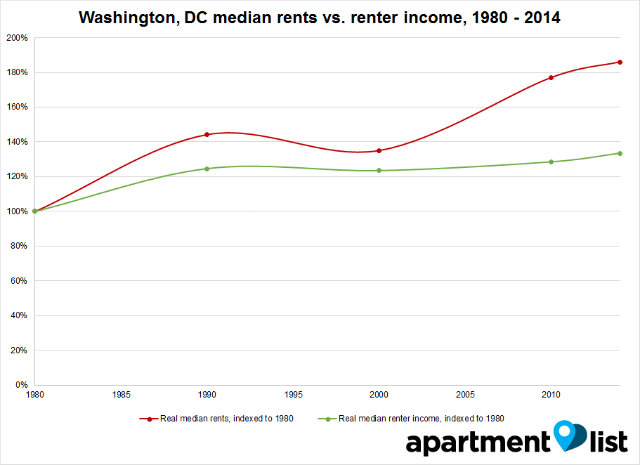 Chart courtesy of Apartment List
D.C. is joined by Boston, San Francisco, and New York as cities where residents’ incomes have risen rapidly, but not enough to keep up with the costs of rent.
The study also notes outliers in the midwest, Detroit and Indianapolis, and in the south, Houston. In these cities, people experienced declining incomes while rents have risen by up to 25 percent. And Austin is the only place where the growth of incomes outpaced rising rental costs, according to the study.
When looking at data by decade, the average costs of rent rose the fastest during the 1960s with an 18 percent increase, followed by the 1980s at 16 percent. The biggest breaks came in the 1970s and 1990s when the country’s average rent increases came in at 4 percent and 2 percent respectively. And the most challenging period across the country was from 2000 through 2010 when median household incomes fell by 9 percent, while average rents rose by 12 percent.
Apartment List also points out that housing markets are “inherently local.” And depending on the region, cities could do a number of things such as add more housing inventory and affordable units, as well as increase wages in order to create a balance.