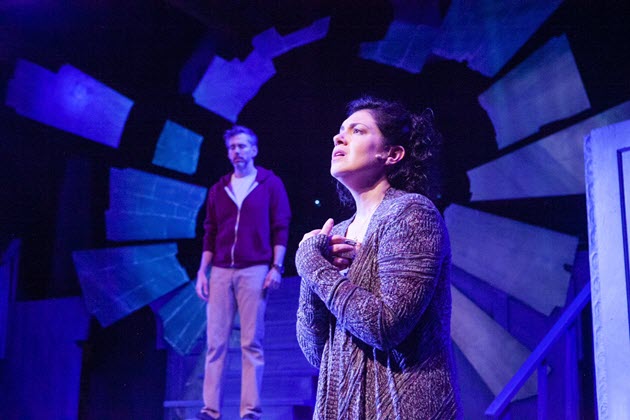
 Chad Wheeler & Kari Ginsburg in Next to Normal. (Photo by C. Stanley Photography)
Even casual fans of contemporary musical theater know that it doesn’t shy away from controversial subject matter. Whether it be the sexual awakening of teenagers, the devastating impact of AIDS on bohemian communities, or the crippling legacy of the Nazis on war-torn Germany, Broadway musicals should never be dismissed as a genre reserved solely for dancing cats and singing mermaids.
But there was something about Next to Normal that pushed the boundaries of the medium even further. The groundbreaking show from Tom Kitt and Brian Yorkey presented the distressing effects of mental illness on one suburban family, and left audiences rattled by its fresh and heart-wrenching story. The team’s efforts were awarded with a Pulitzer in 2010, an all-too-rare feat for musicals (though one that little-known show about rapping Founding Fathers also managed to achieve this year).
Maybe it’s this particular production, or maybe it’s because the show’s been around for awhile now, but Keegan Theatre’s version of Next to Normal doesn’t feel quite as edgy or shocking as the pre-Broadway workshop that graced Arena Stage way back in 2008. It does feel realistic, even familiar, and that’s disquieting in its own way. Kari Ginsburg’s struggling Diana could be any of us, torn apart by a tragedy that her mind’s been unable to cope with for nearly two decades. Her struggle is sympathetic, even as it has a ripple effect on everyone around her, from her steadfast-but-in-denial husband, Dan (Chad Wheeler), to her neglected stress ball of a daughter, Natalie (Caroline Dubberly). Mark A. Rhea and Colin Smith have put together a production that’s light on flash, but heavy on heart (though the electricity-invoking lighting that accents the Act 2 opener is still a nice touch).
Diana’s battle with bipolar disorder and other related symptoms isn’t a black-and-white disease with an easy solution, and Next to Normal excels at capturing that complexity. Ginsburg achingly describes her longings for the highs and lows of life again in “I Miss the Mountains,” which she sings after she’s been drugged into a state of numb equilibrium. In “Superboy and the Invisible Girl,” Dubberly deftly captures the anger and envy she feels toward her older brother (David Landstrom, unsettlingly cherubic), who has commanded the majority of her mother’s attention her whole life. “Wish I Were Here” finds eerie parallels between a mind plagued by disease and another by drug use.
All of this is challenging stuff, and Keegan has assembled a cast largely up to the demands of Next to Normal (Wheeler occasionally falters on a note here or there, but that doesn’t keep him from bringing the audience to tears as he pleads for Diana to gamble on an experimental treatment in, “A Light in the Dark.” Diana’s tricky vocals sound effortless in the hands of Ginsburg, and Dubberly and her kind stoner boyfriend Henry (Christian Montgomery, endearing and well-cast) have some of the show’s sweetest moments together.
Diana’s ultimate path towards managing her disease may not be what many psychotherapists would choose for her. But it’s harder to argue with some of the show’s final lyrics: “Give me clouds, and rain and gray. Give me pain, if that’s what’s real, it’s the price we pay to feel.” The world may be ugly at times, but Next to Normal unflinchingly refuses to look away from reality, even when it gets messy.
Next to Normal runs through July 10 at Keegan Theatre. Tickets ($45-$55) are available online.