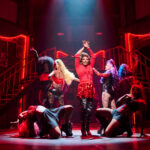
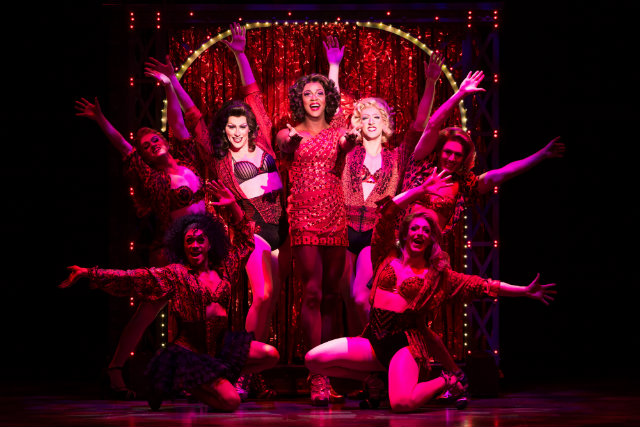
 Kinky Boots National Touring Company. (Photo by Matthew Murphy)
By DCist contributor Allie Goldstein
It’s the classic business school case study: Struggling shoe factory owner meets drag queen, glitterizes product, strikes it rich, and becomes a better person in the process. Well, maybe not. But that is the premise of Kinky Boots, the 2012 Broadway musical now playing at The Kennedy Center. In its own words, this is a show for “ladies, gentlemen, and those who have yet to make up their minds”—and anyone and everyone is encouraged to show up in high heels.
Cyndi Lauper won a Tony for her composition of the music, which is of the belt-it-out-in-the-shower variety, even when some of the lyrics are a little cringe-worthy. In the same vein, Harvey Fierstein’s script, based on the 2005 movie with the same title, is syrupy with clichés, though the pat life lessons occasionally come off as inspirational when sung at the right pitch. It’s hard not to be a bit moved (at least to dance) by songs like “Sex Is in the Heel” when an ensemble of Angels in drag is unveiling colorful shoe designs on poster board and high-kicking with gusto. In “The History of Wrong Guys,” Tiffany Engen’s performance as the small-town love interest Lauren stands out in its slapstick hilarity. Director and choreographer Jerry Mitchell also won a Tony for Kinky Boots, and his skill is best highlighted in songs like “Everybody Say Yeah,” in which the cast slides and shimmies across conveyor belts, as well as a slow-motion boxing ring scene in the second act that could stand alone as performance art.
Still, a couple of musical numbers, like “Step One,” in which Charlie (Adam Kaplan) laments the future of his Northampton factory, beg for a fast-forward button. David Rockwell’s set design emphasizes the upstairs-downstairs power dynamic of the factory owner and its workers, though these visual tiers begin to break down towards the end of the first act when Charlie descends his perch to bust some moves down on the factory floor and Lauren climbs her way up the literal and figurative company ladder. But the woes of a once-wealthy shoemaker just seem sort of shrug-able next to the struggle of a disowned high-heel-wearing boy who, as a grown-up Lola, still struggles to feel as glamorous in her own skin as she looks.
It’s partly the strength of Ghee’s performance that turns some of the scenes that could go either way—singing a solo to an estranged father in a nursing home, for instance—into tear-jerkers rather than eye-rollers. But it’s also partly because Lola’s story resonates more clearly with the current cultural moment: one in which “those who have yet to make up their minds” are more visible than they ever have been in America, spurring celebration but unearthing some latent ugliness.
Fierstein couldn’t have predicted the recent North Carolina law that requires transgender people to use the public bathrooms associated with their biological sex (not the gender they identify with), but the bathroom scene in which tough-guy Don (Aaron Walpole) teases Lola that “all they have is Ladies’ and Men’s” toilets seems weightier as a result. The opportunity to address the issue head-on wasn’t lost on the playwright or on Lauper, who earlier this month released their own Broadway-style response to North Carolina lawmakers with a YouTube rendition of “Just Be” as “Just Pee.” (It’s time to take a step back and laugh at our own absurdity,” Fierstein said of the video. “…sometimes we go to the bathroom just to pee.”)
The inherent tension of Lola’s character—the drag queen who wants to stand out but also fit in — is skillfully exploited in Kinky Boots, even if it is through too-easy one-liners. On a red-lit stage, Lola doesn’t have any problem strutting her stuff, and she’ll throw in a gratuitous trilled ‘R’ in regular conversation. But she’s still battling insecurities and turns meek in a suit: “Put me in men’s clothing and I can barely say ‘hello.’” Still, the leading drag queen is confident in her belief that she’s just like everyone else—if only others would be themselves. When they first crash into each other on the street, Lola advises Charlie that “you’re never more than 10 steps away from some kind of cross-dresser.” The success of Price and Son’s shoes later hinges on Lola’s convincing Charlie that “these boots are mainstream.”
Putting aside the fact that dancing in thigh-high, heeled boots should maybe be a late addition to the Rio Olympics (lest the cast set their quick-stepping sights on D.C.’s own High Heel Race), the sentiment of Kinky Boots—that we’re all fighting the same inner fight towards self-acceptance, no matter what we wear—rings true enough in the end. Plus, no number of predictable plot twists could take away from the surprise of designer Gregg Barnes’s costumes, with Lola debuting a series of delectable wardrobe hybrids that might best be described as “business-kinky.” If nothing else, it’s worth seeing this show for the visual feast.
Kinky Boots runs at the Kennedy Center through July 10. Tickets are available online.