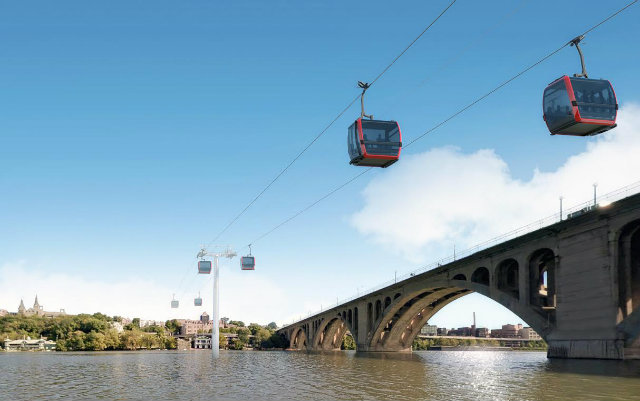
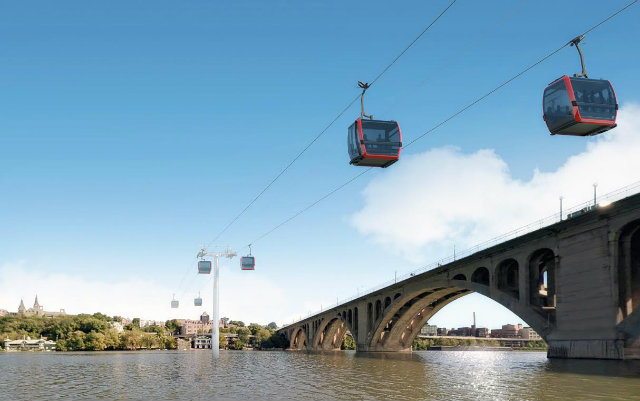
 A rendering shows what a gondola between Rosslyn and Georgetown could look like.
By DCist contributor Cuneyt Dil
Is a gondola over the Potomac River really a good idea for Rosslyn and Georgetown? Local leaders hope to have the answer by early fall.
The Rosslyn Business Improvement District hosted the first public meeting on the budding project last night. About 100 residents came out to hear from officials who presented examples of aerial gondolas and sought feedback on whether people would even want one here.
The out-of-left-field idea originated from the Georgetown BID’s 15-year action plan in 2013. When the Georgetown BID first approached their counterparts over the river with the idea, Mary-Claire Burick, president of the Rosslyn BID, thought the idea was “a little nuts.”
Now, years later, a public-private partnership that includes stakeholders from Virginia and District have raised $205,000 for a feasibility study. The results are due in early fall, said Otto Condon of ZGF Architects, which is taking the lead on the project.
The idea of towers planted into the Potomac and cables carrying passengers over the river certainly draws amusement. But Condon says that gondolas, which have grown in popularity worldwide, can be much cheaper and quicker to build than, say, a new Metro station. Arlington has also toyed with the idea of a hybrid gondola/monorail system as a possible replacement for its cancelled streetcar project.
“It’s a transit tool which gets people off the streets,” Condon said, while presenting pictures of gondolas in Singapore.
For it to be successful, he said, it must encourage economic development and work with the broader transit network. A four-minute ride would connect the Rosslyn Metro station to Georgetown. And the distance between stations, a little over half a mile, is ideal for such projects, he added. Some considerations for the rider experience include whether cable cars would have air conditioning or if they can fit bicycles.
“Usually they chuckle first, then maybe some skepticism comes out,” Burick said of people’s reactions to gondolas. “But I think if people take the time to actually understand that this is a valid transportation system that is being used in other urban cities across the world, and you start to learn a little more about it, you realize that it actually does have merit in it and it’s worth exploring.”
But this is D.C.—Georgetown, no less—where such a project will face a tangle of byzantine federal regulations and agencies. Mix in historic preservation concerns, and it becomes difficult to tell if a gondola would ever pass muster. The project would touch National Park Service land and have to come before an array of historic panels.
After a 20 minute presentation about gondolas from Condon, residents walked around five poster boards to give input on different aspects of the project — from design to station locations to the regulatory process. One resident offered that if the gondola doesn’t connect to the core of Georgetown where restaurants are, it won’t be useful. Another said gondolas would “ruin” the waterfront.
Robert Bullock, a Rosslyn resident, said a gondola wouldn’t change his Metro commute to downtown D.C. “But it’s something of a pain to get to Georgetown very easily,” he noted.
Hilary Kacser, who lives in Georgetown, said she’d be worried about the project’s price tag — and that buses are a more flexible alternative. Currently, there’s a Circulator bus line connecting Georgetown and Rosslyn to Dupont Circle. She added that an engineering expert at the event made a “good case for the gondola having a high capacity to move people.”
Officials from both sides of the river said repeatedly this isn’t an idea they’re trying to “sell” residents; they want to first see if people want it. Another meeting (likely in Georgetown this time) is planned once the feasibility study results are released in the fall.
“Our hope is that the feasibility study comes back and says that this is a really good idea and that this is the least expensive and most efficient way to get the equivalent of a metro station into Georgetown,” said Joe Sternlieb, president of the Georgetown BID.