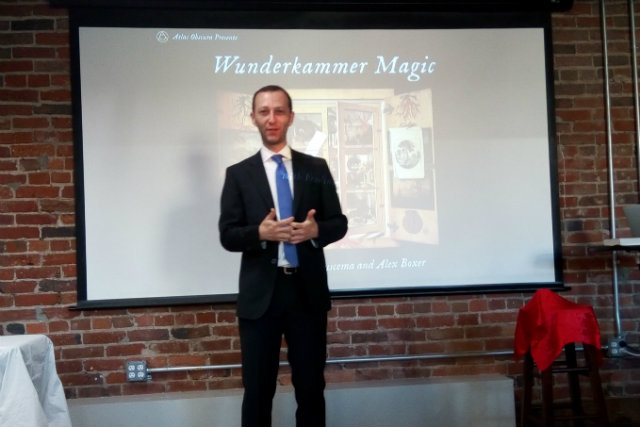
We get a lot of emails about upcoming events over here at DCist. They’re usually fairly straightforward affairs, unless you are still ticked by the idea of a pop-up restaurant or a [insert pop culture reference here] burlesque show. But every once in a while, we get something that truly intrigues. Last week it was the promise of the Wunderkammer (or “chamber of wonders”) Magic with the “acclaimed Italian author Ferdinando Buscema, Europe’s foremost expert on ‘magic-experience-design.'” So we sent DCist historical intrigue correspondent Rachel Kaufman to find out.
6:24 p.m.: As I walk into The Loft in Chinatown for “a very special evening of Wunderkammer Magic” on Thursday I’m still not sure what I’m about to see. Is it a lecture? A magic show? Neither? Both?
I review the facts at my disposal.
Fact the first:
A wunderkammer or a “cabinet of curiosities” was originally not a cabinet, but a room, because people in ye olden times used different words for stuff. The “wonders” in it were things that olde-time people didn’t know how to categorize. So basically a wunderkammer is a room full of stuff.
These rooms included art collections, maps, weird rocks, animal bones and horns, relics, and whatever else the rich owner wanted to throw in. (So basically it was like walking through The Mansion on O Street?) Eventually many of these things became the basis for museum collections. (So maybe nothing like walking through The Mansion on O Street?)
Fact the second:
One of the most famous old wunderkammers was owned by a guy named Ole Worm, which I will insist to my dying day is pronounced “Ol’ Worm,” because it’s better that way.
Fact the third:
Our hosts are: The Obscura Society, the “real-world exploration arm” of Atlas Obscura, a website known for articles about weird places like that one island in Japan full of cats. Obscura Society “field agent” and historian of technology Alex Boxer and Ferdinando Buscema, a magician turned corporate consultant, are presenting.
6:25 p.m.: Nope, I got nothing.
6:30 p.m.: Inside the venue, people are drinking sarsaparillas (how quaint!) and eating popcorn.
6:35 p.m.: I spot Buscema standing in line for a drink. Stars! They’re just like us! Buscema catches me watching him though and mugs for the camera. Busted.
7:01 p.m.: The program starts promptly, as promised. Ok, what are we going to learn today?
7:02: Boxer is talking about historic wunderkammer—for a recap of this, just scroll up a few paragraphs and read what I already wrote.
Boxer does share an absolutely fantastic description of an early wunderkammer. This is long, so read the whole thing here, or this summary:
“In the museum of Mr. John Tradescant are the following things: two ribs of a whale…a goose which has grown on Scotland on a tree….a number of things changed into stone…two cups of rhinocerode…a bat as large as a pigeon….a hat band of snake bones.” This guy would have been right at home on Extreme Hoarders. His collection eventually went to Oxford where it remains to this day.
7:05: The projector on which Boxer is giving his Powerpoint keeps wiggling, making it hard to focus. C’mon, I’m actually super into this part.
7:10: Apparently one of the most important, or at least prevalent, items in a wunderkammer is a taxidermied crocodile, which is somehow related to the practice of hanging crocodiles in apothecary shops—at this point the narrative gets a little confusing. But the fact remains that at least one Italian church and a few in Spain still have stuffed crocs hanging from their ceilings. So Boxer pulls out a foot-long taxidermied gator. Cute.
7:12: Tonight we are going to learn about three wonders. The first wonder is The Synchrony of Clocks, which is what happens when two pendulum clocks (or metronomes, or other swinging things) are put together on the same surface. Even if they start out of sync, they eventually begin swinging at the same rate. Here’s an explanation. It’s actually kind of cool and you can understand why 17th-century people thought there was some sort of magic involved.
7:20: A couple abortive attempts to demonstrate the effect live. It’s not Boxer’s fault—the table isn’t level. But someone in the audience shouts out, “Maybe it’s because you have an alligator instead of a crocodile.” (Smartass.) This leads to an impromptu discussion on the etymology of the word alligator, which, since I majored in English, I’m super into. (Boxer successfully demos the “magic” trick in this video.)
7:31: Buscema takes the stage and starts out by talking about the synchronized metronomes and winds up talking about telepathy? He pulls a “volunteer” named Trish out of the audience and successfully “guesses” numbers she is thinking about in her head. Sorry Trish, I’m not buying your story.
7:38: The second wonder is the astrolabe. We don’t get to look at a real astrolabe, but Boxer has built a neat digital one, which you can play with here.
7:43: Buscema again starts out talking about astronomy and quickly transitions to astronomy. I’m starting to see the pattern—first Boxer gives some interesting history, then there’s a sort of related Magic Trick! Again, a “volunteer” from the audience chooses a card at “random” and Buscema guesses it perfectly. Amazing!
7:48: The last wonder of the night is something called “combinatoric wheels of knowledge” which is almost a Googlenope! Apparently ancient people thought that by putting a bunch of ideas on nested wheels and then spinning them, they could generate new knowledge by combining old knowledge in new ways. Sounds a lot like IBM super computer Watson’s approach to recipe generation; it probably worked about as well (which is to say not at all). Still, these things helped people invent cipher wheels and most of cryptography, or at least cryptography up until computers were invented? Probably? Cryptography is complicated and I’m sure a DCist reader who works for the NSA will correct me.
7:53: It’s time for another Magic Trick! This time a volunteer named Julie has a chosen password “metaphysically brute-force attacked,” which sounds kind of gross, by a magic wheel with LEDs on it.
7:58: “Any questions?” Silence.
7:59: “Wait, were you serious about questions?” Yes, yes they were. Ok. Glad we got that straightened out. We move on to questions.
8:04: It only took five minutes for someone to ask whether coincidences were just coincidences, or “if there’s something really happening.” Hang on—there’s wonder and then there’s superstition. Surely these people didn’t come here because they think magic is real.
8:05: “Can synchronicity be used for evil?” Wait, what? Buscema answers in a way that makes it really difficult to tell how much he actually believes. We’re now learning about “the shadow side” of magic. This is getting very strange, but just then the Q&A period wraps up. Phew.
8:07: Look—the takeaway from this day is that just because we have our fancy computers and digital watches doesn’t mean there aren’t interesting things in the world. If we keep our eyes and minds open we may come across all sorts of stuff. “It’s like adding more Legos to your box,” Boxer says. “The more you have, the more you can build.” Inspiring curiosity and wonder is something I can totally get behind.
8:09: I corner Julie near the bathroom. Just out of curiosity, I decide to ask her about her role in the “magic.” I mean, I know a magician never reveals his secrets—and assume that applies to prepicked volunteers—but I figure if I use all my journalistic persuasion I might be able to get something out of her.
“You and Ferdinando worked out the password in advance, right?”
“Of course,” she says. “I don’t know how the other stooges worked it out, though.”
Welp. Magic is dead and we live in a cold and unfeeling world. Thanks, Julie.