 Photo by Christina Sturdivant
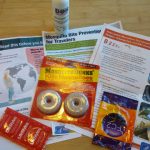
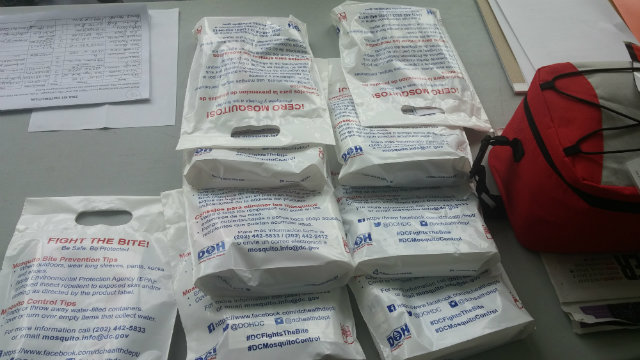
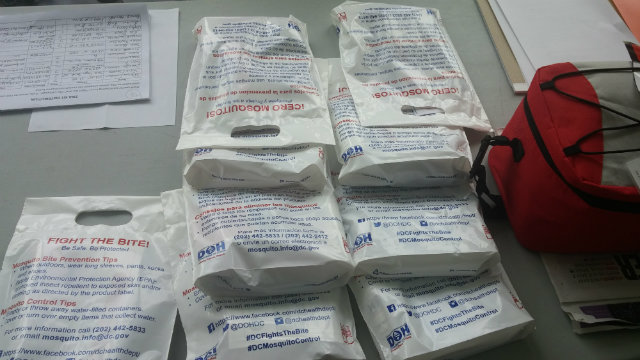
Since becoming Zika ready two months ago, I’ve been applying my government-approved bug spray every day. If you’re not equipped for what’s been called a public health emergency of international concern, you can pick up some prevention items this Saturday. The D.C. Department of Health is hosting its second citywide Fight the Bite event to give residents free Zika prevention kits stocked with insect repellant, mosquito dunks, condoms, and information sheets. Officials will also be at sites, in all 8 wards, to answer any questions.
The first Fight the Bite event yielded 1,446 Zika prevention kits being distributed, Marcus Williams of D.C.’s health department told DCist in May. On Saturday, District residents can pick up kits at the following locations:
- Ward 1: Columbia Heights Community Center (1480 Girard Street NW)
- Ward 2: Stead Recreation Center (1625 P Street NW)
- Ward 3: Palisades Recreation Center (5200 Sherier Place NW)
- Ward 4: Petworth Recreation Center (801 Taylor Street NW)
- Ward 5: Turkey Thicket Recreation Center (1100 Michigan Avenue NE)
- Ward 6: King Greenleaf Recreation Center (201 N Street SW)
- Ward 7: Fort Davis Recreation Center (1400 41st Street SE)
- Ward 8: Barry Farm Recreation Center (1230 Sumner Road SE)
Mosquitos have infected 12 District residents with the virus, all of whom contracted it during international travel, according to the health department. There haven’t been any local mosquito-borne Zika virus reported in the states, according to the Centers for Disease Control and Prevention. However, there have been more than 2,500 cases of local mosquito-borne transmissions in the U.S. territories of Puerto Rico, the Virgin Islands, and American Samoa.
The CDC reported the first Zika-related death, which took place in Puerto Rico in February. The patient, a man in his 70s, developed a severe case of thrombocytopenia that caused internal bleeding.
Amid continued investigations of a possible link between the Zika virus and microcephaly, a birth defect causing a baby’s head and brain to be smaller than expected, the Centers for Disease Control and Prevention is tracking the number of pregnant women who’ve been infected. As of June 30, there were 320 pregnant women infected with the virus in the states and D.C. and 279 in U.S. territories. Research has also found that a man with Zika can transmit the virus through sexual intercourse, including vaginal and anal sex, and likely, oral sex.
Prior to 2015, Zika virus outbreaks were found in areas of Africa, Southeast Asia, and the Pacific Islands. But last May, the Pan American Health Organization issued an alert about the first confirmed Zika virus infections in Brazil. Since then, outbreaks have occurred in more than two dozen countries. The virus will continue to spread and “it will be difficult to determine how and where the virus will spread over time,” according to the CDC.
D.C.’s community events are taking place from 10 a.m. until 1 p.m. on Saturday.