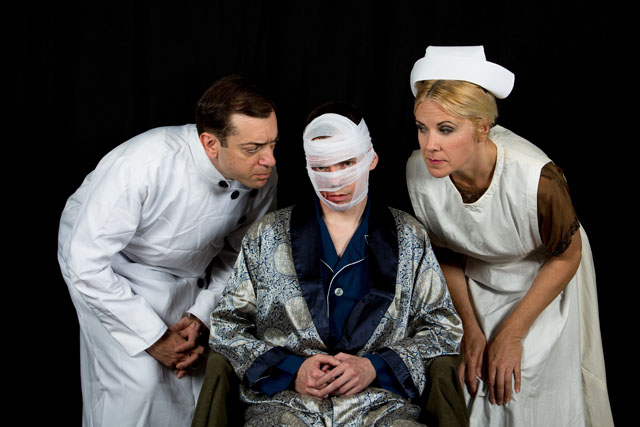
 Zach Brewster-Geisz, David Dieudonne, and Jennifer Restak (Tony Hitchcock/Molotov Theatre Group)
“Tonight’s journey is not for the faint-hearted,” an actor announces. On opening night of Blood, Sweat and Fears: A Grand Guignol Sick Cabaret, that line takes on a double meaning.
It is swelteringly hot in the DC Arts Center’s intimate theater. The air conditioning is out, but the diehard fans of Molotov Theatre Group don’t leave. They barely even complain. One by one, they pack the seats of the tiny space.
Professor Richard Hand sits in the front row, so close to the stage, the actors excuse themselves as they brush by him while taking their places.
The preeminent scholar on Grand Guignol theater, Hand has written three textbooks on the topic with co-author Michael Wilson. The pair, who translated this English version of Blood, Sweat & Fears, are currently working on their fourth volume.
Their research brings Hand to this cozy performing arts space in Adams Morgan on a humid Thursday evening. Molotov Theater Group will be the subject of an entire chapter in Grand Guignolesque (University of Exeter Press), their upcoming textbook about contemporary horror theater companies.
Hand says Molotov, like Thrillpeddlers in San Francisco and London’s Theatre of the Damned, is “extremely important.” These are among the few theater companies that are trying to keep Grand Guignol alive.
Sometimes that means taking classics from the old repertoire, as Molotov has done with this production. But Hand says he’s also interested in modern interpretations of the horror genre. He points to past Molotov productions, such as last year’s Neighborhood 3: Requisition of Doom, a drama about a psychologically addictive video game that spells trouble for players’ neighbors.
“That’s what I really want to explore is how they use the formula and the tradition of the Grand Guignol, but also how they do it for the 21st century.”
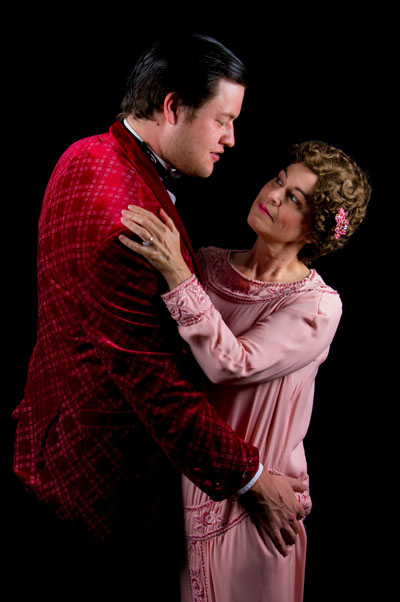 Gray West and Annette Mooney Wasno (Tony Hitchcock/Molotov Theatre Group)
Set in the 1920s, Molotov’s production of Blood, Sweat & Fears features a trio of short one-act plays from the Theatre du Grand Guignol, the Paris theater for which the genre is named. Although the three plays are all over 100 years old, the thrills are still fresh. Each deals with timeless issues: claustrophobia, fear of disease, infidelity, revenge; but the production is not a constant stream of terror.
Read the Wikipedia page on Grand Guignol and you may get the impression that the genre is all about blood spatter, but it is more nuanced than that. Theatergoers who come expecting Saw or Hostel-level gore would be left surprised. There is blood, but the genre is marked less by its use of red food dye and more by a formula known as “the hot and cold shower.”
Molotov Co-Founder and Artistic Director Alex Zavistovich says the calling cards of a Grand Guignol show are time distortion, ambiguity, and a moment of horror. The timing element is clearly utilized in the opening play, The Lighthouse Keepers, in which the climax is slowed down so viewers experience every agonizing second. If the acting seems overly dramatic, that’s the classic Grand Guignol ambiguity at play. The Stanislavsky Method didn’t make its entrance until ten years after the height of Grand Guignol, Zavistovich says. “What was popular at that time was vaudeville.”
As for the moment of horror, that is also present throughout the production, though less obvious in the laughter-inducing Tics—Or, Doing The Deed. “You can have horror in comedy,” Zavistovich says. “If you’re about to give a very important lecture and right before you go on stage, you spill coffee all over your blouse, you have just experienced a moment of horror.”
The comedic moments land well and give the audience members room to laugh and relax between the show’s tense moments. Zavistovich calls Tic and the transitions in between plays “a palate cleanser [that] keeps the patrons off guard so that the last, truly horrific one, really would knock the legs out from under them.”
The closing scene, The Final Kiss, is easily the most cringe inducing. It’s one of the great classics of Grand Guignol, and Hand has seen it performed by companies all over the world. That might explain why he doesn’t flinch during the lip-biting moments of suspense or the gasp-inducing violent end.
“I like the artistry of it and the pace and the rhythm, so I enjoy that,” he says. “But it can still send a shiver down my spine.”
He’s using this production as a case study for his textbook, but the real focus is on the tenacious company behind it. “I’ve been in touch with a lot of companies that try [Grand Guignol] as a one off, and then they drop it, but [Molotov] hasn’t given up. They keep going with it,” he says.
Impressed and intrigued by Molotov’s longevity—the company has been at it for about nine years—Hand says he’s interested in the story of how a horror theater company operates in the 21st century.
The Grand Guignol community is pretty close-knit, and within that world, Molotov is a major player. But within the larger landscape of Washington area theater, the company is practically a footnote. “We are better known internationally than we are in our own hometown,” Zavistovich says.
He hopes the textbook curates “a greater awareness that what we do is entertaining, challenging to pull off, and worth getting to know better.” Don’t wait until Halloween to check them out.
Blood, Sweat & Fears runs through July 31 at DCAC, 2438 18th Street NW. Buy tickets here.