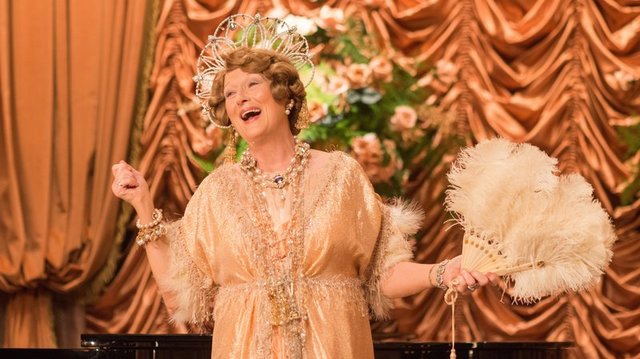

The movie is called Florence Foster Jenkins. The star is Meryl Streep. So why is the most celebrated actress of her generation a supporting character in her own star vehicle?
As can be expected by this point in her decorated career, Streep turns in excellent work in this drama from Oscar-nominated director Stephen Frears (Philomena). She plays a New York socialite who aspires to opera stardom despite a legendarily shrill singing voice. Her first appearance onscreen finds her descending from stage rafters wearing a dazzling angel costume. In Streep’s hands, what could have been a comedic caricature becomes a fully realized character, complete with a backstory rife with pathos and a range of emotions complex enough to warrant her own starring role.
But Nicholas Martin’s script tells Jenkins’ story through the eyes of St. Clair Bayfield (Hugh Grant), Jenkins’ husband, who’s emotionally devoted to his wife but steps out in the evenings to stay with his girlfriend (Rebecca Ferguson), for reasons that only become clear midway through the movie. Grant’s screen presence withers next to Streep, and it’s difficult to feel sympathy for his character given that Florence has the movie’s most dramatic arc and carries the most troubled baggage.
The decision to foreground Bayfield is one of several choices that mar the intrinsically intriguing story at the heart of this moving but frustrating film, set in the 1940s and based on a true story. Several of the characters’ backstories are shrouded from view until crucial moments, which provokes more confusion than curiosity. The movie’s handling of Florence’s singing is also a mixed bag, though admittedly it’s walking a difficult tightrope, with the dual requirements of drawing laughs from the absurdity of the situation and encouraging sympathy for her lack of self-awareness. (in Marguerite, about a fictionalized Jenkins, Catherine Frot beautifully conveyed the sympathy of this character). At my screening, the audience giggled with delight each time Florence displayed her pipes, suggesting that perhaps the former is more successful than the latter.
Other disappointments dot the margins. Ferguson was a standout in Mission: Impossible — Ghost Protocol last year, but she doesn’t get much to do in her brief appearances. Meanwhile, Simon Helberg strives for a memorable supporting turn as Cosme McMoon, a gifted but meek pianist who reluctantly joins forces with Florence as she revs up her concert career. But the Big Bang Theory actor relies too heavily on techniques he’s likely internalized on his CBS sitcom: outsized facial expressions, lines delivered with the knowledge that they’re laugh lines, a general appearance of discomfort that seems to be coming as much from the actor as the character. His performance demands to be liked — but I didn’t.
To be fair, the script admirably avoids many of the cliches associated with the genre. The story doesn’t revolve around Florence dramatically improving her abilities or the public gradually realizing that her flawed voice is actually beautiful. Her terrible singing is terrible from beginning to end. The climactic performance at Carnegie Hall doesn’t hit the expected sentimental notes, which come a few scenes later. And the movie doesn’t shy away from Florence’s more singular foibles, including her unabiding adoration of potato salad and her insistence that visitors never sit on the chairs outside her music room.
But, as usual for movies starring Meryl Streep, she is the star even when relegated to the background of important scenes. Her characterization is typically committed and nuanced, emphasizing Florence’s vocal tics and dotty personality as well as her generous spirit and romantic whimsy. Streep wisely doesn’t hinge the performance on the revelation of Florence’s backstory, which means it remains funny and full-throated even after the sad state of affairs in the Jenkins household is out in the open. The fact that Meryl Streep can routinely command meaty roles in aspiring crowd-pleasers like this is heartening, given that the entertainment industry generally relegates actresses of a certain age to thankless supporting roles.
This supporting role isn’t thankless, but it is underutilized. When Florence Foster Jenkins is about Florence Foster Jenkins, it’s a knockout. When it’s about St. Clair Bayfield and other minor players, though, it’s a flop.
—
Florence Foster Jenkins
Directed by Stephen Frears
Written by Nicholas Martin
With Meryl Streep, Hugh Grant, Simon Helberg
Rated PG-13 for brief suggestive material
110 minutes
Opens today at Landmark Atlantic Plumbing, Landmark Bethesda Row, Angelika Mosaic, Regal Gallery Place, Loews Georgetown, Regal Majestic, AMC Mazza Gallerie, AMC Courthouse, AMC Shirlington, and other area theaters.