 Rachel Sadon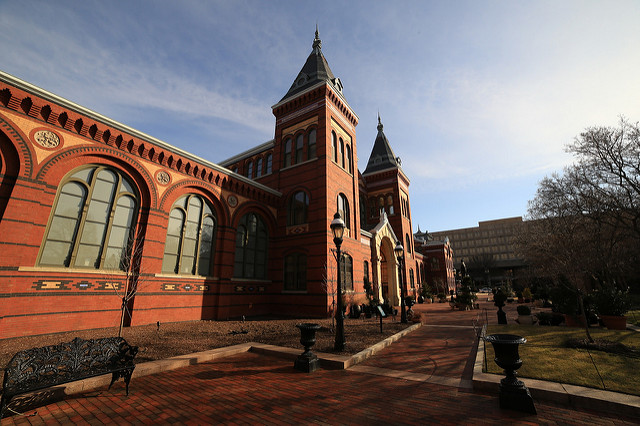
 (Photo by
The possible uses for a breathtakingly open, sunlight-dappled, historic building on the heart of the National Mall are endless, and Rachel Goslins knows it all too well. As the newly named director of the Arts and Industries Building, it is now her job to figure out which ones are the best—for the Smithsonian, for the millions of visitors that pass through, for Washingtonians, and for entrepreneurs and innovators.
“The awesome responsibility, the crushing sense of responsibility I feel—this is the last untapped space on the National Mall,” Goslins says of her new charge. “I have the responsibility of figuring out what to do with probably some of the most valuable real estate in the United States.”
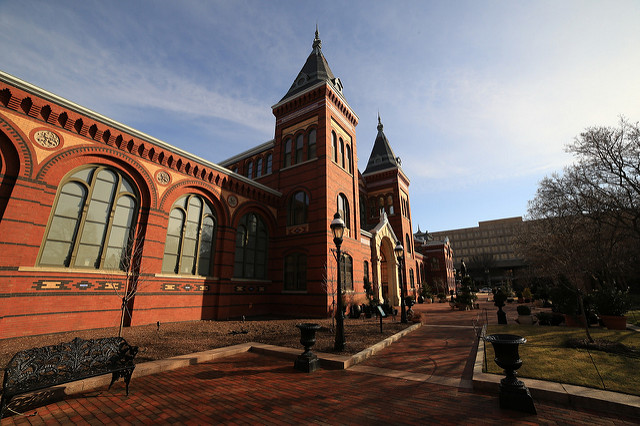
For the last decade, the public has largely known the Arts and Industries Building as that perpetually closed palace next to the merry-go-round. But for much of its history, it was among the Smithsonian’s most important buildings, housing collections that now live on at the American History and Air and Space museums.
The plan that Goslin has been tasked with is “forward-looking instead of backward-looking,” she says. “The Smithsonian is telling the story of what has happened. But part of the mission of what we’ll do in this building is telling the story of the future.” The means a focus on innovation, creativity, and entrepreneurship. There will also be a dedicated space for a Latino gallery, drawing on resources from across the Institution that don’t have a single outlet.
“[Smithsonian Secretary] David Skorton said ‘I don’t want this to be like anything the Smithsonian has done before,'” Goslins says. “He really wants to use this as the testing ground and a laboratory for new ways to engage.”
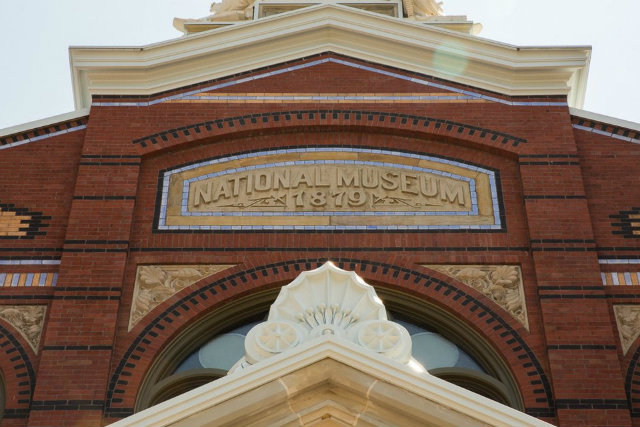 The Smithsonian’s Arts and Industries Building was originally the home of the U.S. National Museum. (Photo by Benjamin Strahs)
Designed by Adolf Cluss (of Eastern Market and Franklin School fame), the Arts and Industries Building was built to house the U.S. National Museum after it outgrew the Castle next door. Completed in 1881—and known as the National Museum Building at the time—it is the Smithsonian Institution’s second-oldest facility on the Mall.
Its first visitors came in throngs to see exhibits on geology, zoology, medicine, anthropology, art, history, ceramics, printing, transportation, and textiles set in grand mahogany display cases. “It really was a display of a grand vision of America at the time,” says Adriel Luis, a curator at the Smithsonian Asian Pacific American Center.
After the natural history collections were moved in 1910, it was renamed the Arts and Industries Building and continued to highlight jewels in the Smithsonian’s collection—including the Star Spangled Banner and vintage airplanes that eventually went to the National Air and Space Museum.
After closing for renovations in the mid 1970s, the venue hosted a centennial exhibition followed by temporary and experimental exhibits. But by 2004, the building was showing its age in the form of a collapsing roof.
The Smithsonian sought private aid to redevelop it before undertaking a $55 million renovation. At one point, the institution partnered with the U.S. Patent and Trademark Office to create an innovation-focused pavilion, but that fell through. The Arts and Industries Building has also been floated as the site of a permanent Latino cultural museum (should Congress ever agree, they would need to add a significant amount of space either underground or elsewhere to make it work.)
Those two themes will anchor the next chapter of the building’s history, which Goslin says the public is likely to see within the next couple of years, not decades.
That kind of timeline is lightyears in Smithsonian time, and it is possible because the new director hasn’t been tasked with figuring out the Arts and Industries Building’s forever future. The permanent use will involve a conversation at the Congressional level and significant funding to retrofit the building.
“I’m not sure what it will be in 20 years. There’s lots of opinions for its ultimate fate,” Goslin diplomatically notes. In the meantime, “we’re looking at uses and ideas that would kind of feed off the energy of the space, of this warehouse-like, kind of popup feel.”
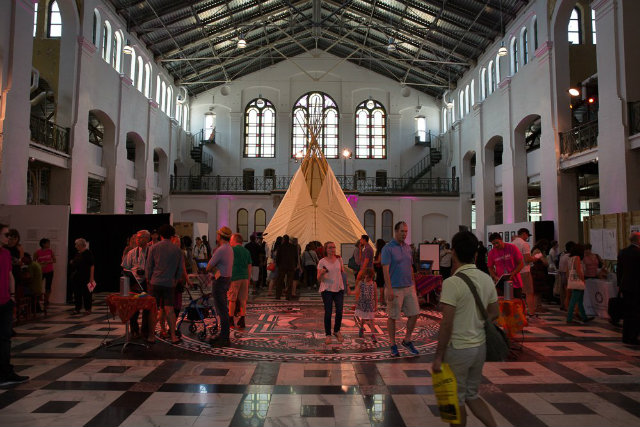 The main hall of the Smithsonian’s Arts and Industries building during the two-day CrossLines exhibition in May. (Photo by Benjamin Strahs)
That sort of creative, kinetic energy was on full display at the Arts and Industries public coming out party in May—a two-day art exhibition, called CrossLines, put on by the Smithsonian Asian Pacific American Center.
For the first time in 12 years, visitors spread throughout a space that might bring to mind an airplane hangar if it wasn’t for the stone floors, wrought-iron steps, balcony overlooks, and Byzantine designs. Or, as Goslins puts it, “the building itself is this extraordinary piece of architecture—part Victorian castle, part Moorish castle, part fishmarket.”
It made for a fine backdrop for CrossLines, which was billed as “a culture lab on intersectionality.” Artworks interspersed with live screen printing, poetry readings, tea service, a lowrider rickshaw tour, a food-based pharmacy, live painting, and performance art made for a bustling hall.
The innovation-focused future of the Arts and Industries Building will be “closer to CrossLines than it is the Air and Space Museum, but somewhere in the middle,” Goslins says. “I hope to preserve a lot of [CrossLines’] energy, but it will have a slightly more polished tone and consistent visitor experience.”
In another twist on the usual National Mall museum, Goslins and Skorton hope that part of experience will consistently draw locals—even when they don’t have out-of-town visitors in tow.
“We’re talking a lot about how do we create somewhere where D.C. creatives and hackers and entrepreneurs in the innovation space want to hang out, participate in events, hear a lecture, meet each other for coffee and talk about their ideas,” Goslins says. “We hope to create a community space that doesn’t really exist in D.C. for folks in that field.”
And another part of the space will be used to experiment with ways to tell the Latino story. As the conversation about a permanent museum continues, the hope is that the Arts and Industries Building can provide a “landing pad for that community on the National Mall” in the meantime, according to Goslins. Given the constraints of the building, though, it is unlikely to be a standalone gallery or mini-museum.
For both pieces of the puzzle, there will be a heavy emphasis on experimentation and new ways of storytelling. “I’m hoping to be able to use the space to pilot new ideas and approaches to engaging the people that come through our doors in a way that will benefit the other Smithsonian Institutions,” Goslins says.
It is certainly a tall order. But then again, she asks, “how often do you get a chance to both kind of create something from scratch but also build on the platform of an incredible institution in one of the most beautiful spaces in Washington, D.C.?”