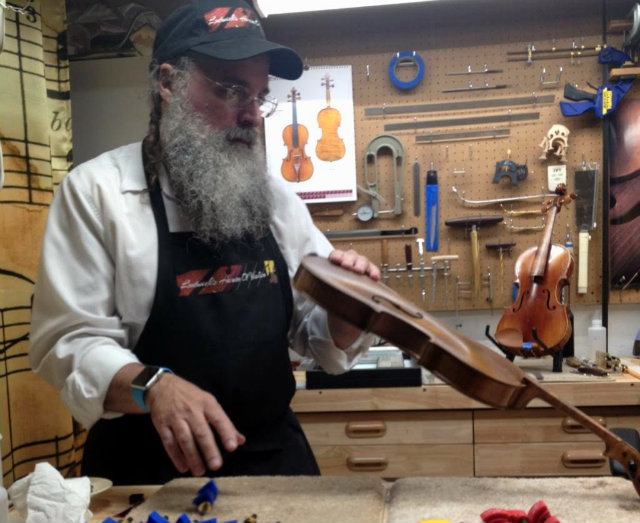
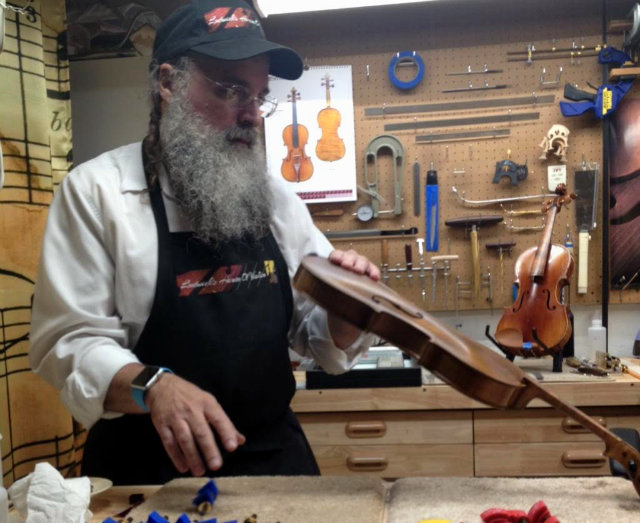
 Luthier ZZ Ludwick constructs a violin. (Photo by Ethan McLeod)
In the basement of his Silver Spring home, the bearded ZZ Ludwick sits in his workshop, carefully assembling the body of a cherry-colored violin.
Zev Zalman, or ZZ, is a luthier—a person who builds and repairs stringed instruments—and operates the one-man business Ludwick’s House of Violin.
In the adjacent room, more than a dozen instruments sit in their cases in need of repairs. “It’s like being able to bring back a voice that was silenced and just sitting there,” Ludwick says of the repair work.
Ludwick did not picture himself here 30 years ago. In May 1986, he was a 22-year-old bassist for the heavy metal band, SteelWynch, attending thousands of shows and playing many more in area bars and clubs.
One fateful night that year, filmmakers Jeff Krulik and John Heyn captured the raw footage for their short documentary Heavy Metal Parking Lot. The film shows dozens of fans preaching their love for heavy metal while getting wasted outside the Capital Centre in Landover, Md., before a Judas Priest concert.
A young ZZ Ludwick, shirtless and clad in suspenders, pops up just before the 15-minute mark.
“Ian Hill, I’m a former bass player, I’m an inspiration—you’re an inspiration of mine,” he says on camera, correcting himself. He playfully calls out lead singer Rob Halford before declaring, “Everybody else, you’re definitely dynamite. Okay, let’s rock, alriiiight!”
Heavy Metal Parking Lot from Jeff Krulik on Vimeo.
Over the last three decades, “Heavy Metal Parking Lot” has become a documentary cult classic. On the film’s 30th anniversary this past May, the University of Maryland hosted a screening and discussion for the film as part of a commemoration of an archive of Krulik’s work in an exhibit there.
As a result of the documentary’s pre-internet viral success, Ludwick’s face appeared in posters on Los Angeles street poles, advertisements in Penthouse magazine, and commemorative murals in bars, among other places.
Krulik has reconnected with a number of the film’s “stars,” and among all of them, he says, “ZZ is probably one of the most fascinating and dramatic story arcs of some transformation.”
Ludwick says that he doesn’t relate much to the version of himself shown in the film. He is a devout Hasidic Jew who is married with two daughters and a stepson, labors almost daily in his workshop, and no longer listens to metal. He has not touched alcohol in six years and has abstained from other substances for 11 years.
“It’s like, I look at it and it’s me, and it’s not me,” he says.
Ludwick says that while Heavy Metal Parking Lot offers an accurate impression of the party-heavy lifestyle for metal fans in the ‘80s, “for many of us players, that snapshot goes much deeper and darker.”
In one distinct memory, he recalls hearing a song from a solo album he assembled airing on the local radio station HFS during his shift at a pizza restaurant.
“‘Wait a minute, that’s me on the radio,’” Ludwick says he told a customer. “Then the song’s over and he says, ‘Excuse me,’ and I’m like, ‘Yeah, you want seasoning on your fries?’ Talk about coming down to reality.”
Ludwick took on bigger projects than his solo album. He played in numerous groups and collaborated with talented artists, among them renowned guitarist Johnny Rushmore in the band Johnny and the Poor Boys.
Still, tragedy and dissatisfaction diminished from Ludwick’s successes, he says. In 1995, his best friend passed away, sending him on a spiral. “When I lost him, I kind of freaked out,” he says.
In the next two years, he twice escaped to Hawaii to live with his brother, but felt more lost each time he returned home.
In 1999, after the organizers of the chaotic Woodstock ‘99 offered Johnny Rushmore a spot in the lineup, Rushmore asked Ludwick to back him on bass. Ludwick gladly accepted.
But on the eve of the show, Rushmore got into a fight with his drummer and called for a substitution, Ludwick says. The replacement drummer said he would perform only if he could bring his own bassist.
“I was pissed because my family thought I was already playing the show for months, and the night before the show, I get fired,” he says.
ZZ Ludwick grew up in a Jewish household in Silver Spring, the youngest of six children. In religious terms, he says his upbringing was more cultural than observant.
In 2001, he began exploring the roots of his faith and became observant in his Judaism, and roughly three years he became a follower of Breslov Chassidis.
In his observance, he learned the night before Woodstock ’99 occurred on Tisha B’Av, a Jewish calendar day that commemorates numerous calamities, among them the Holocaust, the Spanish Inquisition, and the destruction of two Jewish temples in Jerusalem.
He deems the coincidence a form of personal divine intervention. “Even though I wasn’t religious at the time, the good Lord said, ‘You ain’t playing this show,’” Ludwick says. “Man makes plans, and God laughs.”
Ludwick picked up the electric bass as a teenager in pursuit of becoming a rock star. However, his first instrument was the violin. He began learning how to play it at age eight, but gave it up after under peer pressure from bullies. “I was tired of getting bullied and chased around.”
In addition to loving Led Zeppelin and Jimi Hendrix while growing up, Ludwick acquired a taste for bluegrass music at his brother’s farm near Salisbury, Md.
In the late 1990s, upon returning from Hawaii, he decided to revisit that lost love and learn to play those soulful, twangy sounds.
Mandolin came first. He bought one and taught himself how to play, he says. About six months later came the banjo, which he studied for about a year.
He quickly became a skilled bluegrass player and cut his teeth playing in several groups. Most notably, as a member of the Jewish bluegrass troupe, The Sinai Mountain Boys, he performed at venues like The Kennedy Center and Strathmore.
In 2004, his fondness for stringed instruments led him down a new path. Seeking a way to combine his love for music with woodworking, a skill he picked up in three years of high school shop class, he began looking for jobs in which he could work with the builders of those instruments.
After several months, Bethesda-based Potter Violin Company hired him (the company moved to Takoma Park in April 2016). His work began in shipping, cleaning, and replacing strings on rentals. “It was not so much glamour, but at least I was making money in music,” he says.
Ludwick says one day, owner Dalton Potter called him up to take over duties for a repairman who quit. From there, he began his apprenticeship in violin repair. Potter and others in the shop apprenticed him for the next three-and-a-half years, showing him firsthand how to fix violins, violas, cellos, and, on occasion, double basses.
Ludwick left the company in 2012 and honed his skills at other shops for several more years. Then, in late 2015, a community member in Ludwick’s Kemp Mill neighborhood asked him restore a violin, a family heirloom.
After a successful job, he became hungry for more work. He assembled his own shop and got a contract with a Virginia music store seeking a luthier to repair instruments. With that work in place, he became licensed and founded Ludwick’s House of Violin in late 2015.
As a beginning instrument-maker, he is receiving plenty of guidance. Silver Spring-based luthier Howard Needham is assisting ZZ with building violins from scratch. Ludwick says Needham, a 35-year veteran of the craft, is especially helpful with minute details such as shaping corner blocks and bending ribs, among other aspects.
“I’m confident he will be a good violin-maker,” Needham says of his mentee. “We all miss things in the beginning. The test is whether you’re willing to go back and correct them.”
Sitting in Ludwick’s workshop in July, the contrast is stark between the classical music coming from his desktop speakers and the heavy metal soundtrack of older days.
Ludwick says the transition away from that lifestyle was natural for him.
“It had a strong negative vibe, a vibe of dark-side indulgence,” he says. “That wasn’t a part of who I was anymore.”
Krulik has stayed in touch with Ludwick over the years. He says the former bass player has transformed immensely. “He’s reinvented himself and done it with great conviction and passion,” he says. “It’s the real deal.”
Krulik visited Ludwick’s home workshop in May to interview him on camera. He says he is working on a project about ZZ’s life.
In addition to building and repairing violins, ZZ has been taking lessons to re-learn the first instrument he ever picked up. It’s the hardest one he has encountered, but the effort is worth it, he says.
“It’s really full-circle for me,” he says. “I’m getting back to my mentors now by going back to my lessons. For all these years, this has kind of been in my heart and I didn’t realize it.”