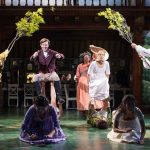
The early 19th century was not a wonderful time to be alive. In 1811, there was no air conditioning, no antibiotics, and limited prospects for upward mobility. Naturally, women had it harder—with statistically high odds of dying in childbirth and unable to do most things without a husband’s permission. Being unmarried was worse.
And yet there’s an undeniable pull to the Regency era: Jane Austen, new “modern” architecture, literature, culture, and, of course, fancy dresses.
The latter—along with a heaping dose of early 19th century culture—was on full display Saturday night at the Gadsby’s Tavern Jane Austen Ball.
There, the 100 or so guests spent the evening English country dancing (picture any ball scene from a movie adaptation of a Jane Austen novel and you’ll get the idea). The style eventually gave rise to the relatively more familiar contra and square dances, but it is much more sedate. Or, as Alexandria Assembly dancing master Corky Palmer put it, “English country dancing is where contra dancers go to retire.”
ECD is different from modern dancing in, well, about a million ways, but one important one is that it was done as much for the pleasure of someone watching as it was for the dancers themselves. There’s a reason why all those movies and BBC specials use aerial or wide shots of the ballroom: half the fun is in watching the dancers twirl in unison from the outside.
It is also surprisingly popular in this area, despite being around 300 years old. In addition to dances every Tuesday at Gadsby’s Tavern and regularly at Dumbarton House, there are balls approximately quarterly at the Tavern, with varying themes/decades represented, but all centering around the late 18th or early 19th century. And if you tell me you haven’t at least once wanted to dress up and go to a ball then you are either a liar or someone I don’t want to be friends with.
So to the ball I decided to go, along with a friend. Maybe Mr. Darcy, or at least a tall, eligible bachelor with an income of a kajillion pounds per year, or Colin Firth in a wet shirt would show up and whisk me away to a country manor in England. A girl can dream, anyway.
Tickets for this particular ball ran $45, and ideally a newcomer to English country dance should take at least one class beforehand (they are typically offered in the three weeks leading up to the event, $12 per class or $30 for all three). Would-be twirlers should be willing to dance with various partners, not just their own date.
I’ll be honest: some of the gentlemen I danced with were utterly charming. Others, not so much. Dude, ask the lady if she wants to waltz with you—consent is sexy. Besides, the waltz hadn’t been popularized yet, so not only are you a boor, you’re also historically inaccurate.
Once you have taken a class or two and learned the difference between a chassé and an allemande, you are ready to dance. Proper attire for ladies includes a floor-length gown, a shawl, and elbow-length gloves. Men wear breeches, tailcoats, and top hats. The venue is air conditioned, but it is only so effective when 100 people are crammed into the room and it’s 95 degrees outside. Staff at the ball don’t get off easy, as they must dress in period-appropriate servant’s wear. “I just love wearing seven layers of clothing,” one weary staffer told me.
Guests danced to live music (let no one say that this dance skimped on historically accurate entertainment) for about two hours, then took a break for “iced refreshments,” including a very welcoming scoop of lemon ice cream, then returned to the dance floor. Near 11 p.m., the dancers were still going strong but it was time to wrap up, so everyone remaining took to the floor for the final dance. I wasn’t able to find a partner, so I hung back in the doorway, enjoying a gust of A/C and watching the dancers twirl and spin, everyone a little tired and hot but nobody yet wanting to return to the present.
The next ball is November 12; check the Alexandria English Country Dancers Facebook page for more info and other events.