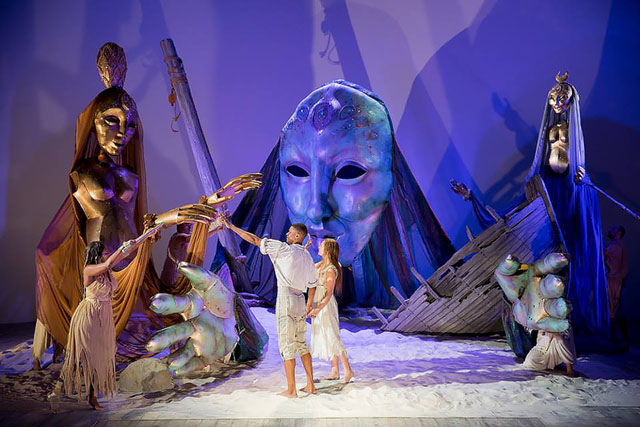
 Avery Glymph as Ferdinand and Rachel Mewbron as Miranda (Scott Suchman/Shakespeare Theatre Company)
By DCist contributor Seth Rose
The Tempest is one of Shakespeare’s greatest challenges for a director, with deep political implications that can be hard to pin down. Director Ethan McSweeny’s remount of Shakespeare Theatre Company’s 2014 production for this summer’s Free-For-All (an annual show where all tickets are free and distributed via lottery) makes the slippery script effortlessly entertaining. While its spectacle sometimes doesn’t leave it room to breathe, the elements bring to life the mysticism at the heart of the play.
That spectacle supports a fine cast. Broadway staple Patrick Page leads the pack as Prospero, bringing the right mix of mix of earthly gravitas and mercurial temperament to the venerated role. His daughter Miranda (Rachel Mewbron) and the shipwrecked prince Ferdinand (Avery Glymph) have an energetic chemistry, and the comic pair of Trinculo (Liam Craig) and Stephano (Dave Quay) earn their laughs in a script that needs some levity.
Crucial to any production of The Tempest are the two characters forced into Prospero’s service: the spirit Ariel (Sarah Topham) and the deformed native child Caliban (Clifton Duncan). Topham and Duncan bring skill and sympathy to their performances, but McSweeny seems not sure how to portray them at times.
The director calls attention to the cruelty of their situation: Ariel is physically tethered to the island through the same cord and fly system she uses to float around the stage, and we meet Caliban dragged from a trap door and chained to a rock. The latter introduction feels brutal and uncomfortable, but dissipates promptly and bears no dramatic fruit as Caliban loses his chains and spends the rest of the show as another fool to support Trinculo and Stephano. Ariel floats in and out of scenes as needed without any apparent resentment for her imprisonment.
Managing this dichotomy between Prospero’s lighthearted magic and his treatment of those beneath him is part of what makes The Tempest such a difficult play, and McSweeney should not be condemned for not getting the mix just right. To do justice to both the spectacle and the politics of the work is a profoundly difficult task.
A more consistent vision of Caliban and Ariel would have gone a long way towards presenting a more unified artistic vision. Luckily, this is not a crippling flaw, and unlike many productions of what may be the Bard’s most enigmatic script, McSweeney’s Tempest takes a much smoother journey than it’s shipwrecked characters.
The Tempest runs through August 28 at Sidney Harman Hall. Tickets are free but limited to the first 200 patrons.