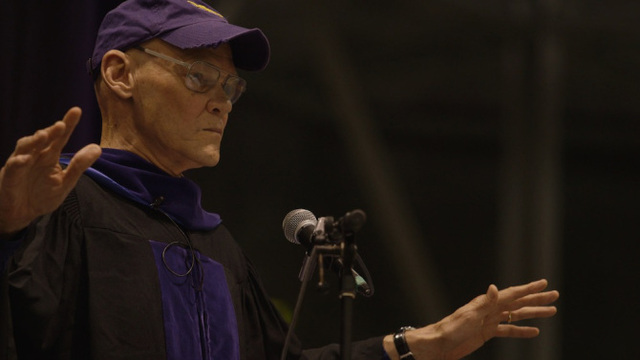
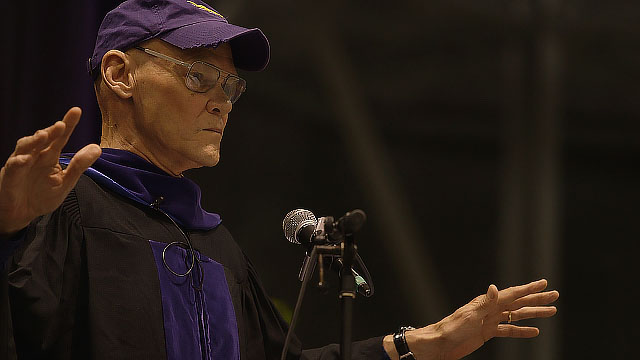
 James Carville (Railyard Films)
In case the 2016 presidential election hasn’t already convinced you that the polarization of political rhetoric is at record-high levels, the documentary Starving the Beast drives the point home.
The movie traces the stark and rapid decline of the public university system by examining case studies in Texas, Louisiana, Wisconsin, and North Carolina. Starting with Thomas Jefferson’s founding vision of post-secondary education, it traces the development and unraveling of that vision through decades of competing interests, corruption, greed, and ideological differences. A wide array of former university presidents, think tank representatives, and policy advocates serve as sources and talking heads.
By the end, I was even more exhausted by the election than I was when I started—which means, I think, that the movie accomplishes its goal.
The film’s title refers to a political tactic of driving down taxes with the goal of forcing the federal government to reduce spending. The phenomenon is evident throughout the film, which portrays the situation as an economic power struggle over an entity that was originally conceived to be for the public good and therefore immune from such dealings. Billionaires like the Koch Brothers make appearances in news footage and in recorded testimonies from government officials, including one from Senator “Bernard” Sanders, as he’s described on the title card that introduces him.
Sanders’ minute of screen time, devoted to a microcosm of his presidential platform, is a reminder of the ecosystem in which this debate is now situated. No one disagrees that students need to be educated, but everyone seems to disagree on the best way to achieve that goal. This kind of existential crisis is ripe for a juicy documentary, and Starving the Beast delivers. It could have easily added another hour onto its runtime, though writer and director Steve Mims packs a great deal of information and context into a tight space.
Provocative as its subject matter is, Mims and his team don’t do much in the way of stylistic innovation. There are talking heads aplenty, in addition to the aforementioned footage, majestic shots of the universities in question, and occasional fragments explained by voiceover narration. The content of the talking heads is largely fascinating, if a bit dense and technical. But it’s a shame more couldn’t be done with the format.
It’s also disappointing that Mims couldn’t have gone further out of his way to find a diverse range of voices. Nearly all of the talking heads are white and male, with one or two exceptions out of several dozen. Perhaps this homogeneous representation reflects the homogeneity of this arena, but the movie makes no explicit references to that element. Perhaps it’s not fair to knock a film for reflecting the limited world of its subject matter, but it also seems unfair to the viewer that the movie doesn’t address such doubts about limited perspective.
Either way, Starving the Beast is a compelling watch—assuming you’re not already in a funk from binging on cable news or monitoring election polls. This documentary pulls few punches, ending on a downbeat note with the future of the public university very much in doubt. But this movie makes it clear: That’s reality, and the first step to improving it is acknowledging it exists.
—
Starving the Beast
Written and directed by Steve Mims
Not rated
95 minutes
Opens today at Landmark E Street Cinema