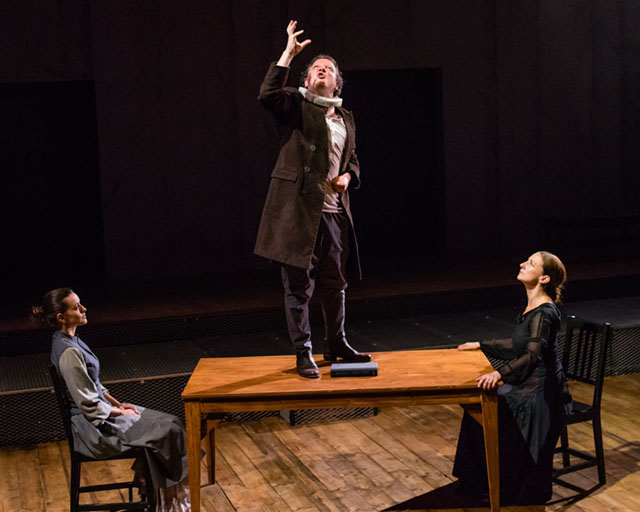
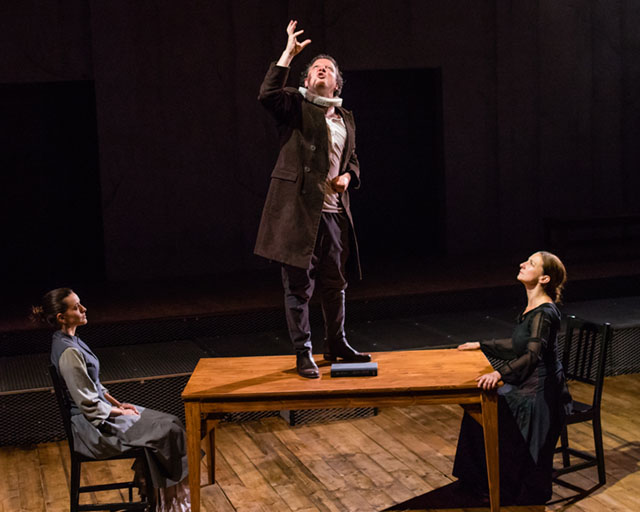
 Soraya Padrao, Oscar de la Fuente, and Luz Nicolás (Stan Weinstein)
By DCist contributor Elena Goukassian
Miguel de Cervantes’ Don Quixote is revered as one of the greatest works of literature and often cited as the first modern novel. But that doesn’t make a thousand-page book that traces the adventures of an old, delusional “knight” and his lackluster sidekick easy to read, even for Spaniards involved in a play about its mysterious author.
“Everyone knows Don Quixote, but not everyone reads it,” says José Luis Arellano, director of GALA Hispanic Theatre’s upcoming world premiere of Cervantes: The Last Quixote. “I’ll start to read it and try to finish, and finally say I’ll try again next year.”
This may be the best year to finally finish Don Quixote—on the 400th anniversary of the Spanish bard’s death. In fact, GALA commissioned The Last Quixote especially to commemorate the quadricentennial.
Almost 10 years ago, GALA’s co-founder/producing artistic director Hugo Medrano began to envision a Cervantes project. He initially considered putting on one of Cervantes’ plays, but soon found they required “way too many actors,” Arellano says. Ultimately, Medrano approached acclaimed Catalan playwright Jordi Casanovas to create a new piece for the occasion, a play that would start people thinking about how and why Cervantes’ life and works are still relevant today. As Arellano sees it: “Cervantes invented the modern world.”
The Last Quixote is a kind of murder mystery. In the beginning, Cervantes is found dead in the street. An old drunk insists it was poet Lope de Vega who was responsible, weaving stories of the tempestuous lives of these two contemporaries (and rivals).
The play is only partially based on historical facts—Cervantes’ life is veiled in mystery. Arellano compares it to the likes of movies like Amadeus and Shakespeare in Love, but with the added twist of an unreliable narrator—a device which is one of the reasons Quixote is considered the first modern novel.
The play explores Cervantes’ sexuality, tries to determine his true love and why he wrote Don Quixote (he published the second part of the novel only a year before his death). It also delves into relationships between Cervantes and the women he loved—his wife, daughter, and sister. There’s also a fake sequel in the play, unfolding a second mystery of who would write such a thing and why.
“The Last Quixote is structured like Don Quixote’” Arellano says. “It’s a big adventure full of small adventures. Cervantes discovers himself and we discover him. What’s the meaning of his Golden Age and what’s the meaning today?”
But the central relationship in The Last Quixote is between Cervantes and Lope de Vega. The real history of the two men is rather hazy, although we do know that Cervantes was jealous of Lope de Vega, who was already wildly successful by the time he was 25 years old—writing (and selling!) hundreds of extremely popular novels, plays, and books of poetry and living lavishly off the proceeds. Meanwhile, Cervantes was always broke and forced to take terrible day jobs in order to support himself—the worst was probably when he worked as a tax collector.
“Cervantes once called Lope a ‘monster of nature,’” says Eugenio Villota, Arellano’s friend from drama school and the actor who plays Cervantes’ rival in The Last Quixote. “Lope was the god of theater. Women loved him…and also men. He had 15 children and a big ego”—despite the fact that “he wasn’t very handsome,” Arellano interjects. In fact, Lope de Vega has even inspired a saying in Spanish: “When something is very good, we say that it’s Lope,” Villota says.
But both Arellano and Villota are quick to point out that although Lope de Vega was undoubtedly more successful than Cervantes at the time, years later it is Cervantes who is considered the greatest Spanish writer—the Spanish Shakespeare. “We look at Cervantes as a different kind of success,” Arellano says, who sees Cervantes as much more human and relatable than Lope de Vega. “We think of these authors as heroes, but it’s not true. Cervantes was a loser. All his life, he chose the wrong path—just like everyone else in the world. Maybe it’s not interesting to take the perfect path.”
Cervantes: The Last Quixote runs from September 8 through October 2 at GALA Hispanic Theatre. The play is in Spanish with English subtitles. Tickets are available here. On Friday, September 9, playwright Jordi Casanovas will speak at the Library of Congress in the Whittall Pavilion, Thomas Jefferson Building, at noon. Also on September 9, Casanovas will also participate in a discussion with the play’s director at GALA after the 8 p.m. performance.