Rachel Kurzius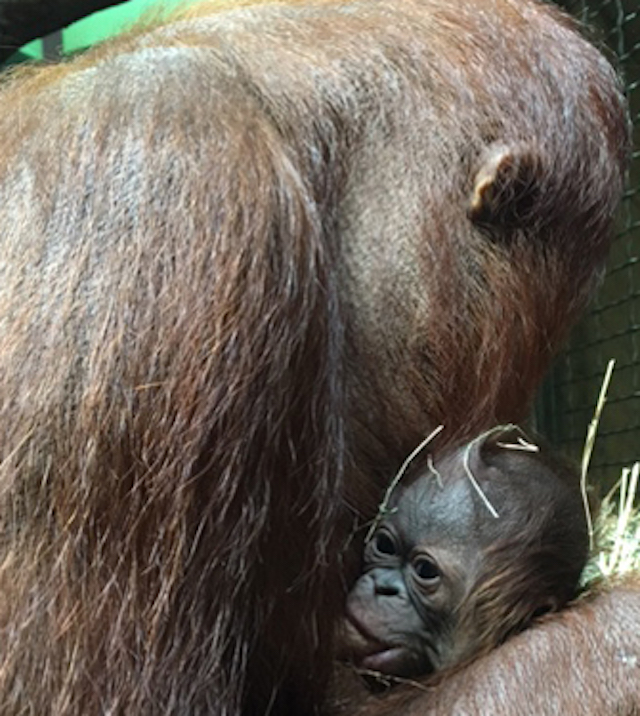
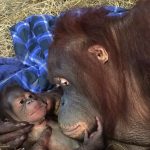
The public now has the chance to observe Redd, the baby orangutan born last week at the National Zoo.
Starting Tuesday, visitors can once again access the Big Ape House, where Redd and mom Batang live. It had been closed since Redd’s birth so the two could get some bonding time.
“This baby is incredibly cute and I really welcome people to come and see him,” says Meredith Bastian, the zoo’s curator of primates, in a video posted by WTOP. “The great thing about orangutans is they’ll be cute for a very long time.”
Zoo staffers warn folks that they’re not assured a spotting of the infant, though, because Redd and Batang also have access to off-exhibit enclosures if they want some privacy. The other five orangutans are around, though, either in the Ape House, outside, or at Think Tank.
“For the last few days, Batang has really decided to keep herself and Redd in the off-exhibit enclosure,” says zoo spokesperson Jen Zoon. Keepers are trying to entice her to return to her normal routine by putting her favorite foods, extra hay, and blankets “to encourage her to make the transition, but so far, Batang has elected to stay.”
Orangutan infants communicate w/their mothers through vocalizations, gestures & touch #OrangutanStory pic.twitter.com/DDz5Zgke1W
— National Zoo (@NationalZoo) September 13, 2016
This pregnancy was years in the making. Redd was the first Bornean orangutan born at the zoo in 25 years, the result of a recommendation from The Association of Zoos and Aquariums that Batang and fellow 19-year-old Kyle becoming a breeding pair. They’re the only two orangutans at the zoo currently capable of producing offspring.
Keepers trained first-time mom Batang during her pregnancy, as well as getting contingency plans in place by conducting surrogacy training for two other orangutans.
“It took a little while for [Batang] to get a hang of it,” Bastain says, but Batang is nursing and bonding with the kid. She adds that the mother-infant bond in orangutans is “closer than any other animal,” and the two are together 100 percent of the time.
Kyle, on the other hand, is not involved. “Kyle does not know he is the father,” says Bastain, though he may eventually be curious about Redd once they have access to one another.
Already, Batang and Redd’s enclosure is connected by what keepers call a “howdy door” (essentially a mesh door) to three other orangutans—Kyle, Bonnie, and Lucy.
“What [Batang] actually did today, which keepers thought was very cute, was she built her nest adjacent to the door where Bonnie and Kyle are, so Bonnie and Kyle could take turns looking through the door at Batang and Redd,” says Zoon. “Batang is very social by nature, so keepers were not surprised that she’s already interacting with Kyle and Bonnie.”
The baby was named “Redd” because orangutans are known as the “red ape,” according to the zoo. The International Union for Conservation of Nature considers Bornean and Sumatran orangutans critically endangered.
Great Ape House reopens 9/20 @ 9 a.m. Stop by & you might see orangutan Batang & her infant, Redd! https://t.co/GhUsDe3ik5 #OrangutanStory pic.twitter.com/XOiJadibjL
— National Zoo (@NationalZoo) September 19, 2016