 Rachel Sadon
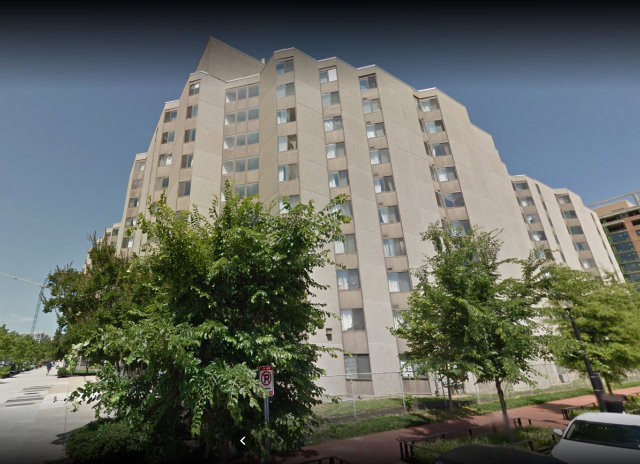 The battle over Museum Square, located at 401 K St NW, touches on a number of housing-related issues happening all over D.C. (Photo via Google Streetview)
The tenants involved in one of the city’s most well-publicized housing battles won a victory in court yesterday, both for themselves and for other renters who might find themselves facing an excessively high price to execute their rights under D.C. law.
The case of Museum Square touches on a number of issues, including the drastically diminished Chinese population in Chinatown and the disappearing stock of affordable housing in D.C. Legally, though, the issue being decided in the courts involves the execution of the Tenant Opportunity to Purchase Act, or TOPA, the strongest tool that renters have when faced with displacement due to a building’s sale or demolition.
The law says that tenants have the right to buy a building at the market price, as determined by a potential buyer. In the case of a demolition—as in Museum Square, whose owners plan to raze the building and replace it with new apartments and retail—the owner must make a “bona fide” sale offer first.
In 2014, Parcel One Phase One Associates (an affiliate of the the Bush Companies of Williamsburg, Va.) told the tenants—most of whom are elderly Asian Americans living on Section 8 housing subsidies from the federal government—that they would be forced out if they couldn’t buy the building for $250 million. At the time, Housing Complex reported that it had recently been appraised at just $36 million.
Several lawmakers found the $250 million sale offer figure to be excessive. Then-Councilmember David Catania and then-Mayor Vincent Gray worked on legislation to prevent a situation like this from happening again; Bush Companies sued them, alleging that they unfairly targeted Museum Square. At-large Councilmember Anita Bonds later successfully passed similar legislation allowing tenants to request an independent appraisal in the event of questions over sale prices (for a more comprehensive history, see this WAMU explainer; there are also separate issues regarding the now expired project-based Section 8 contract).
But it still left open the question of if Bush Companies’ offer is considered “bona fide.” The developer says the figure is based on the value of what could be built on the land—prime downtown real estate. In legal filings, it compared the situation to a case involving the Phillips Collection, which won a court battle over the sale offer it presented to the tenants of a building it had recently acquired (more than $6 million more than the price the museum purchased it at several years before).
A judge, however, sided with the tenants in 2015. A panel of three judges unanimously affirmed that decision yesterday in D.C. Appeals Court, ruling that the $250 million offer “was not based on an objectively good faith assessment of the value of the property at that time, even taking into account Parcel One‘s intended use.”
Though the company can still appeal to the panel to reconsider their decision, it is a major victory for the tenants and the future strength of TOPA (D.C. Attorney General Karl Racine filed an amicus brief in support of their case).
“The statute only works because it forces landlords to offer to sell these properties at a reasonable or bona fide price to the tenants. If they could do what the landlord did here and offer to sell at a grossly inflated and unreasonable price, that would take the teeth out of the statute,” says Jonathan Levy, the appellate director for the Legal Aid Society of the District of Columbia, which represented the tenants. “The opposite ruling would have had the potential to completely gut this statute and render it really close to meaningless.”
Museum Square Decision by Rachel Sadon on Scribd