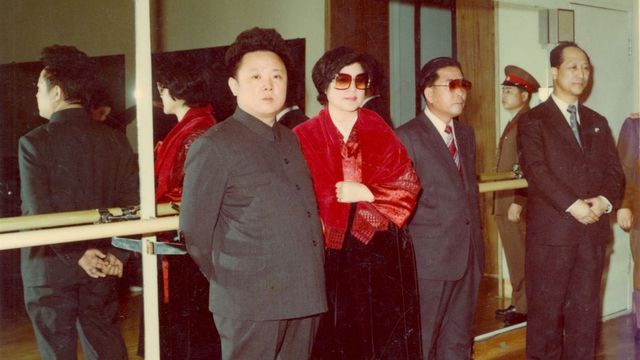

Art imitates life, some say. But the art on display in the new documentary The Lovers and the Despot is no match for what happens in the lives of its characters. If this story were fictionalized, the implausibility police would have a field day.
Filmmakers Ross Adam and Robert Cannan unravel the tale with patience and suspense. It would seem tempting to frontload the movie with some of its more shocking revelations, but a chronological structure suits its escalating series of developments. As South Korean actress Choi Eun-hee tells it, she met Shin Sang-ok, whom she would later marry and then divorce, on a film set in the 1950s. Throughout their marriage, Shin was more interested in his work, with little time or energy left over to be a caring partner.
Shin wasn’t the only one interested in his work. He was regarded as one of the finest South Korean filmmakers, and news of his acclaim traveled to North Korea, under dictatorial rule by Kim Il-sung and his son Kim Jong-il. The latter, as it turns out, was a major film buff, and felt that North Korea needed a strong artistic voice for its cinema. As is a dictator’s wont, he engineered a plan to kidnap Choi and lure Shin to the country in the 1970s. It worked.
Thanks to Choi’s vivid descriptions and the filmmakers’ thorough research, clips from Shin’s films and footage of the communist regime in North Korea bring this unbelievable story to unsettling life. It’s one thing to know in passing that the people of North Korea have been subject to oppression for decades, but it’s another thing to see it in action, and to hear about it from people in close proximity to it.
In addition to showcasing the breadth and range of Shin’s work, the clips also highlight one of the movie’s central ideas about the appeal of movies. Choi describes a particularly harrowing chase as feeling like it moved in “slow-motion, like in a movie.” Kim Jong-il talks repeatedly of his cinephilic tendencies, and his belief in the power of images informs his campaign as he wields greater and more terrifying power. Film production is the foundation upon which the lovers’ relationship was built, and it’s what keeps them occupied during their time in captivity. Even Shin’s most harrowing experiences, like an escape attempt via freight train, feel ripped from the cinema.
Of course, a story intertwined with film production has now become a riveting film itself. Adam and Cannan blend archival footage, talking-head testimony, muffled cassette recordings, and the occasional reenactment with ease, and they never lose faith in the power of their narrative. Facts and explanation reveal themselves in due course. Bright colors and dazzling displays carry a requisite sense of hollowness and despair in a story that is equal parts grotesque and romantic.
Perhaps the most interesting perspective wasn’t at the filmmakers’ disposal—Shin died in 2006. Pieces of the puzzle are missing, but “The Lovers and the Despot” does its best with the information available. The ambiguity of what really happened is fitting: within an authoritarian regime, clarity is unachievable. The best one can hope for is to adapt or escape. Shin and Choi do some of both, and it’s a sight to behold.
—
The Lovers and the Despot
Directed by Ross Adam and Robert Cannan
Written by Ross Adam and Robert Cannan
With Choi Eun-hee, Shin Sang-ok, Paul Courtenay Hyu
Not rated
95 minutes
Opens today at Landmark E Street Cinema